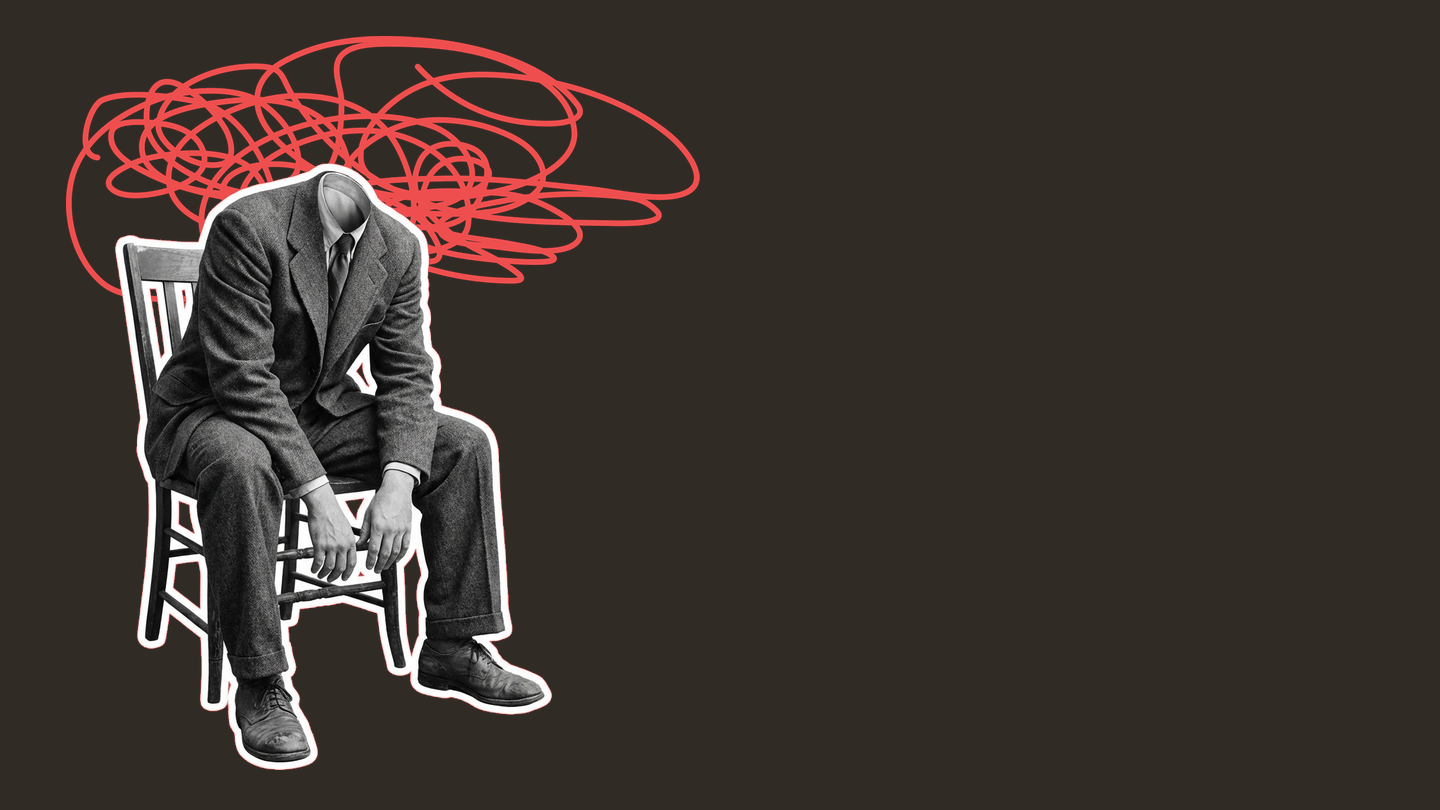
A few weeks ago, I caught something. The experts in burnout have a name for what happens just before you break. Feeling crispy.
That was me.
Agentic fever: if I’m not coding agents, if I’m not creating agents, and if the agents are not working for me at a certain moment, I’m wasting my time. It does not matter that this is irrational. The feeling is there. Constant. Like a pressure behind your eyes that will not let you sleep.
Matteo Cassese, 2026
I was suffering from agentic fever. The definition is simple and the feeling is very specific: if I’m not coding agents, if I’m not creating agents, and if the agents are not working for me at a certain moment, I’m wasting my time. It does not matter that this is irrational. The feeling is there. Constant. Like a pressure behind your eyes that will not let you sleep.
A lot of Silicon Valley is suffering from this right now. A lot of founders I know are too. This is what I have learned about what it is, how we got here, and how to get through it.
From chatbot to CEO: the two-and-a-half-year arc
To understand the fever, you have to understand the speed of what just happened. Because the anxiety makes sense once you see the arc.
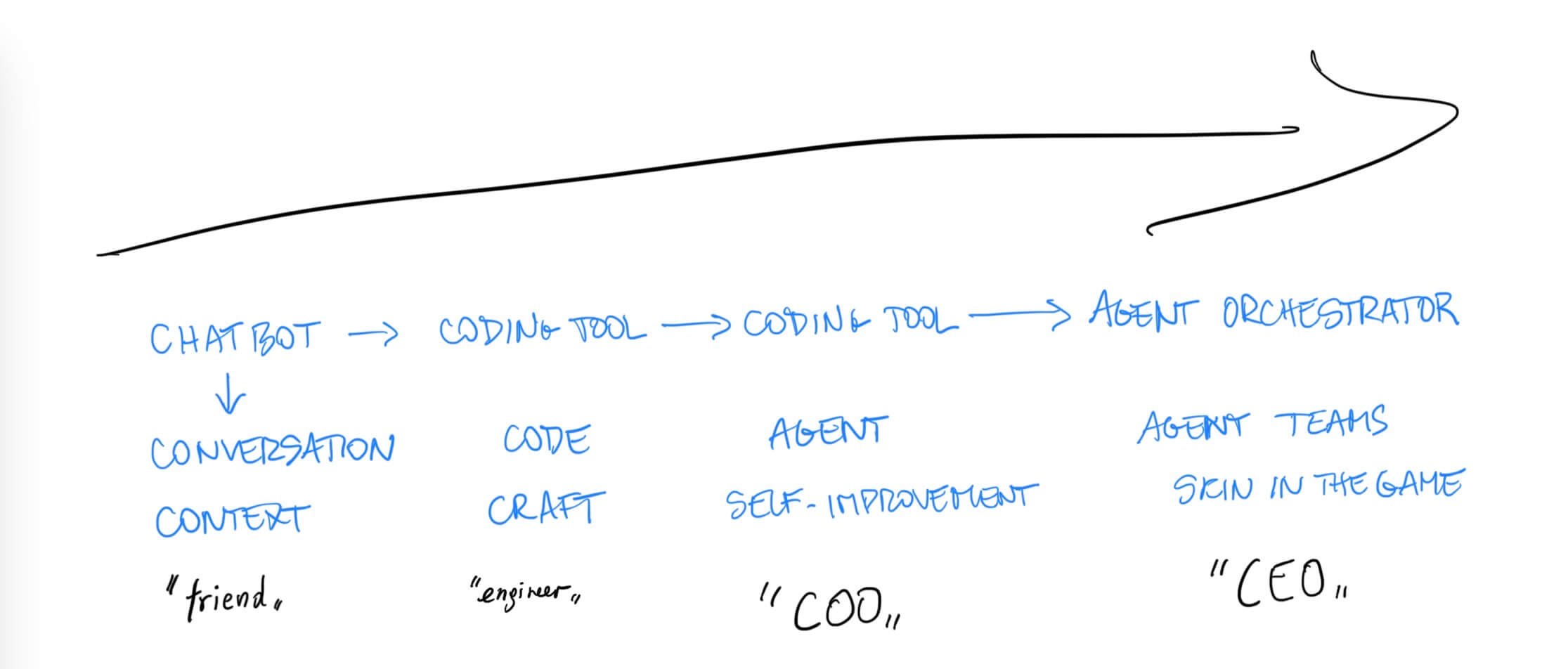
At the beginning, what we thought we had was a chatbot. The artifact was a conversation. The innovation was context. When you ask Siri a follow-up question, even today, Siri does not know what you are talking about. These new systems had context. And so for a moment we had something that felt, genuinely, like a friend.
Then the coding tool arrived. The artifact it produced was code. The innovation was that we finally went from conversation to craft. I had a junior engineer at my service.
Then something else happened. I was using these coding tools, telling the system: create code for me, create a system for me, create a CRM for me, create a Kanban board for me. And then I realized that the same tool could be used as an agent. Not to create something, but to be that something. And once you start getting into these agentic loops, the innovation shifts. It is not just craft anymore. It is craft plus self-improvement. Once the agent is running the whole process, you can inject this self-improvement. We finally have a Chief Operating Officer in the AI.
Now we are moving into agent orchestration. The product of an agent orchestrator is a team of agents. We are seeing the shift of AI from a friend to a CEO in two and a half years.
That is the territory. That is what your nervous system is trying to process right now.
Why founders catch agentic fever worst
Employees worry about being replaced. Founders feel something different. The pressure does not come from above. It comes from inside.
Some people in Silicon Valley are already thinking it is kind of over. This is the last few years to make money. Maybe the last few months to make money. So run. People are constantly feeling that they are missing out. I was constantly feeling that I was missing out because I was not actively, obsessively getting on top of every tool.
This is the founder trap.
You built something from nothing by staying ahead of what is coming. That instinct served you. Now the same instinct is eating you alive. The part of your brain that made you an entrepreneur is the part that cannot stop watching the next demo video at midnight.
I have been here before, without the agents. Two years spent building a funnel instead of on my craft ended in founder burnout, and getting out of it took me nine phases.
I have never been as excited with a technology. The last time I felt this way was 1993. The web. Creating HTML pages by hand. The bleeding edge was CGI bin, and most of you do not even know what that is.
Two and a half years. Chatbot to CEO. Founders who lived through the web, mobile, social, now find themselves in something different: the speed is faster and the stakes feel existential. Not just miss the trend. Miss the window.
The things are moving too fast for us not to have a human reaction. I believe this is just a step. A learning curve. But it is still a curve you feel in your body. And the body keeps score.
Brain rot, brain fry, AI burnout: why the name matters
People are naming this thing fast. Harvard Business Review calls it “brain fry.” The internet calls it “brain rot.” Others say AI burnout, AI fatigue, cognitive overload.
I would never call it brain rot. Brain rot is what happens to something you leave in the sun. It is rotten. You throw it away. The name implies you are already gone. That there is nothing to recover.
Fever is different. A fever means something is fighting. Your body noticed something foreign and responded. You feel terrible. But you can be cured. The distinction matters because it changes your posture. If it is rot, you are a victim. If it is a fever, you are in a process. And processes end.
The same technology that causes the fever is also the cure. That is the paradox worth sitting with.

The human philosophy: calm is the strategy
Here is the deeper paradox. AI is giving you the most powerful execution layer in history. And your response is to burn out.
Our role is not to panic or try to do everything ourselves. Our role is to think in systems and give good instructions.
AI needs us sharp. It is very tricky to have it work the way we want it to work. If you are feverishly burning out in front of the machine, trying to make it do more and more and more because the world is going to end tomorrow, you are going to create a frantic, anxiety-driven agent that is going to fail. If you calm down and then instruct the agent, what you achieve is something much better.
I installed Open Claw a few weeks ago. I wasted a lot of time on it. But it was teaching me the agentic philosophy as I was using it. It does not do anything that Claude Code cannot do. But as a learning experience for the human, it is genuinely useful.
I am sleeping much better than two weeks ago. I have gone back to my healthy routines. I am slowly coming down from the high and the risk of getting crispy. And what I understand now, looking back: your sleep score is an AI performance metric. This is not a metaphor. The quality of your instructions depends on the quality of your thinking. The quality of your thinking depends on the quality of your rest.
The model does not burn out. You do. And when you do, the model produces garbage.
Humans need to continue being sharp. We are the trainers of the models. We are good at being human. What we need to do is go back to systems thinking. Good inputs bring good outputs. That is the whole philosophy.
The machine philosophy: language is the new code
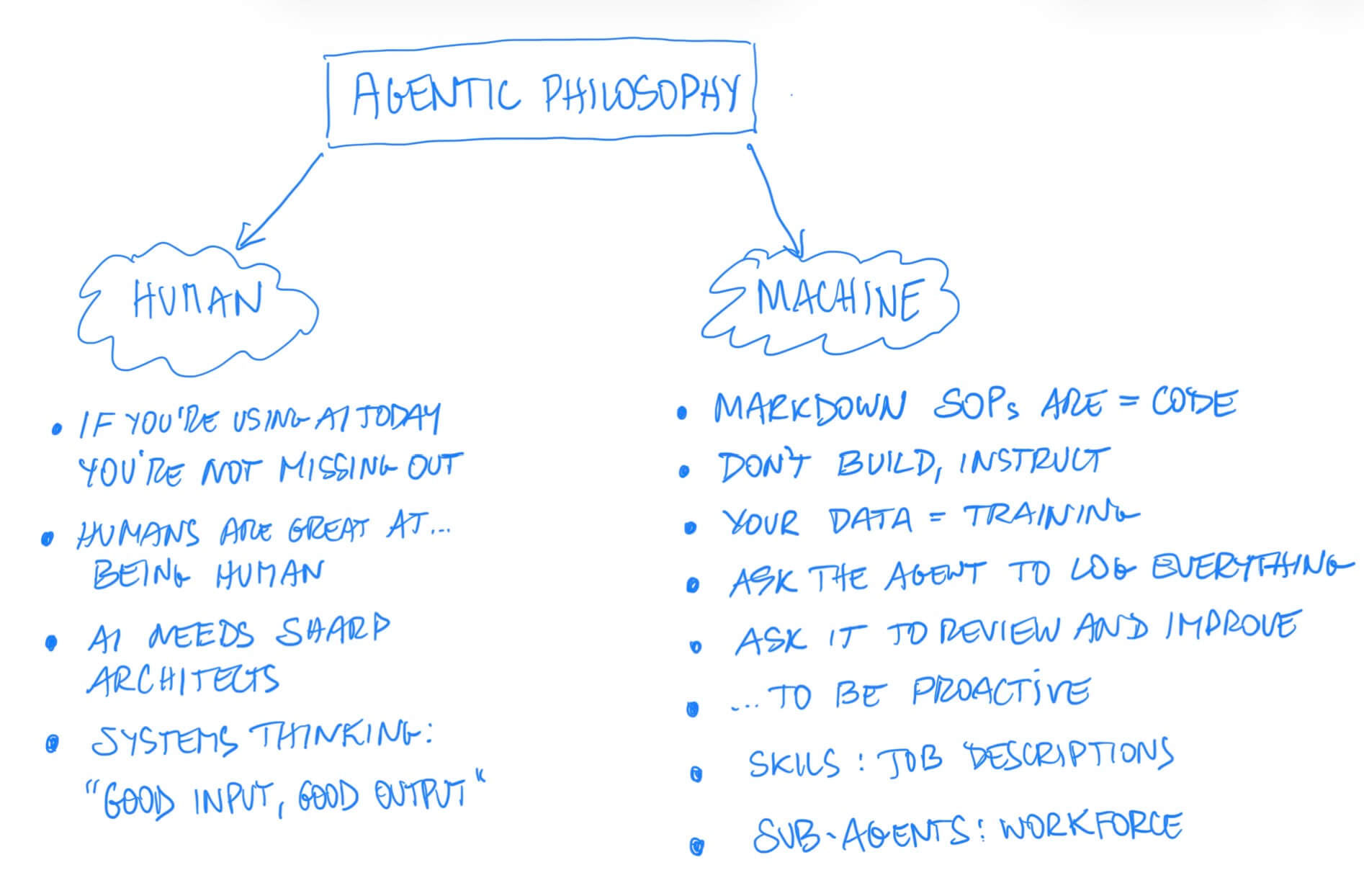
| Human | Machine |
|---|---|
| If you using AI today, you are not missing out | Markdown SOPs are code |
| Humans are great at being human | Don’t build, instruct |
| AI needs sharp architects | Your data = training |
| Systems thinking: good input, good output | Ask it to review and improve, to be proactive |
| Skills: job descriptions | |
| Sub-agents: workforce |
The practical side of agentic philosophy is simpler than it looks. And more demanding than you expect.
Language is now code. Clear instructions, good data, and thoughtful processes train the agents that work for us.
Simple markdown. Standard operating procedures. These are equal to code. The human is not just in the loop anymore. The human is the instructor. And the instruction needs to be very clear. We are not here to build. We are here to instruct. Your data is the training.
When I started building my outreach machine, I was thinking in terms of systems and silos and mechanisms. I need a CRM. I need a web interface. I need to click on things. What I did instead, in the agentic world: the agent is the center. There are API calls. There is a spreadsheet where data is stored. But the agent is the surface. The agent is the software.
Once you connect your data to these agents and you start instructing the agent to log everything, review and improve, and be proactive, you enter a compounding phase. Every day the agent gets a prompt from you: go into the improvement routine. Look at the logs. What can you do better? What can we do more efficiently? And then the agent compounds.
This is the shift worth making. Not from human to machine. From human-as-executor to human-as-instructor. The executor burns out. The instructor sleeps well and shows up sharp.
In my talks I speak about the idea of going from malaise to renaissance. We are possibly in the malaise phase right now. It will get tricky before it gets better. But it will get better.
What the research says about agentic fever
It is not only me. And it is not only founders in tech.
Harvard Business Review published two pieces on this in early 2026. The first, “AI Doesn’t Reduce Work—It Intensifies It,” documents what happens in companies that adopt AI: employees voluntarily take on more, work faster, extend hours, and then hit a wall. The second, “When Using AI Leads to Brain Fry,” puts numbers on it: 14% of workers experience it. Among marketing professionals, 26%. Error rates climb 39%. Intent to quit climbs with them.
Developer Siddhant Khare put it differently: “AI reduces the cost of production but increases the cost of coordination, review, and decision-making. And those costs fall entirely on the human.”
Mark Cuban’s framing is blunter. He described AI agents as “hungover college interns” who make mistakes and do not take responsibility for them. The oversight burden is yours. That is the hidden tax no one tells you about when they demo the product.
Matt Wolfe made a video called “AI Is Frying Your Brain” the same week I published mine. Different title. Same fever.
The research and the internet are converging on the same truth: the humans who are most excited about AI are also the most at risk of burning out from it. This is not a coincidence. It is the shape of every technological transition. The early adopters absorb the chaos so the rest of the world does not have to.
What people are saying in the comments
When I posted this video, the comments told me more than the research did.
One person wrote: “My brain has been fried in a way during these past two months that I haven’t experienced in a long time. I feel like they take my attention required to wrangle agentic mistakes and feed that attention back to the agent to keep it going.”
Another: “I thought I was going crazy feeling like this. Definitely needing to prioritize my sleep schedule instead of making new agent skills at 3am.”
Someone else: “I had to stop and get some food. I was leaving and I saw a yellow flower. It was bright yellow in front of the green background of the trees. I just stopped and looked at it for a couple of full minutes. It was the first time I felt calm in three days.”
And then someone wrote something I did not expect: “Knowing the condition and understanding the importance of a good sleep is a very long way from actually containing it.”
That last comment is the honest one. This article is not a cure. It is a diagnosis. The cure requires something that cannot be automated: the decision to stop, for a moment, and be a human.

What comes next
If you are a founder and this has landed somewhere uncomfortable, that is the right starting point.
The transition from executor to instructor does not happen automatically. It is a psychological shift as much as a technical one. The founders I work with through one-to-one entrepreneur coaching often arrive here first. Not with strategy questions. With questions about what kind of operator they want to become as machines take over execution.
If your organization is navigating this transition and you want your conference audience to leave with something they will feel in their bones, this is the territory I cover from the stage in Berlin, Lisbon, and beyond. The human side of the AI revolution. Find out more about my keynotes.
Quick answers
What is agentic fever?
Agentic fever is the compulsive pressure to be coding, building, or running AI agents at all times. The definition is simple and the feeling is very specific: if I’m not coding agents, if I’m not creating agents, and if the agents are not working for me at a certain moment, I’m wasting my time. It does not matter that this is irrational. The feeling is there. Constant.
Why do founders catch agentic fever more than employees?
Employees worry about being replaced. Founders feel something different. The pressure does not come from above. It comes from inside. You built something from nothing by staying ahead of what is coming. That instinct served you. Now the same instinct is eating you alive. The part of your brain that made you an entrepreneur is the part that cannot stop watching the next demo video at midnight.
How do you recover from agentic fever?
Our role is not to panic or try to do everything ourselves. Our role is to think in systems and give good instructions. If we’re sharp, we can create great outcomes, with or without AI. If we’re mindful, well rested, connected, happy all else will flow.
Is agentic fever the same as AI burnout or brain rot?
Not quite. Brain rot implies you are already gone — rotten, throw it away. Agentic fever is different. A fever means something is fighting. Your body noticed something foreign and responded. You feel terrible. But you can be cured. The distinction matters because it changes your posture. If it is rot, you are a victim. If it is a fever, you are in a process. And processes end.