
European stages, calibrated for the country in the room
Berlin, Lisbon, Hamburg, Oslo, Copenhagen, Helsinki, Stockholm, Frankfurt, Zurich, Munich, Rome, Milan, Athens, Amsterdam, Prague. Fifteen years of speaking on the continent, in countries where Europe is not one register but seven. From the nordics to the mediterranean, every audience reads differently and every keynote carries the calibration that room demands.
Conference organizers, corporate communications leads, and event producers book Matteo Cassese because the talk is built to travel. The arc is stable. The opening, the references, the question prompts shift with the country. Berlin gets the dry version. Rome gets the story up front. Stockholm gets the understated take that respects the room. London gets the British humor before the data.
A keynote in Europe is not one talk delivered in different cities. It is one argument calibrated for the audience, the language, and the cultural register the country actually rewards. That calibration is the work.
“Matteo was one of the best speakers at the conference. He was exceptionally prepared and responsive before the event, and helped promote it. Plus delivered an exciting and valuable presentation, that kept the audience fully involved. We’re actually in the process of booking him for two more events 🤩”
Yurii Lazaruk
Event & Community Architect, 9am.
Keynote topics that travel across Europe
Every talk is customized. No two European audiences get the same keynote. These five themes are the ones that survive a Berlin Q&A, a Lisbon Q&A, an Amsterdam Q&A, and a Helsinki silence. Each one is calibrated for the country in the room.

From Mal-AI-se to Ren-AI-ssance
The AI keynote for European operator audiences. From the Berlin engineering rooms shipping foundation models to the Amsterdam fintech teams pushing AI into production to the Helsinki labs that have done this longer than most. This talk names what is actually happening to leadership when engineers work with AI all day.
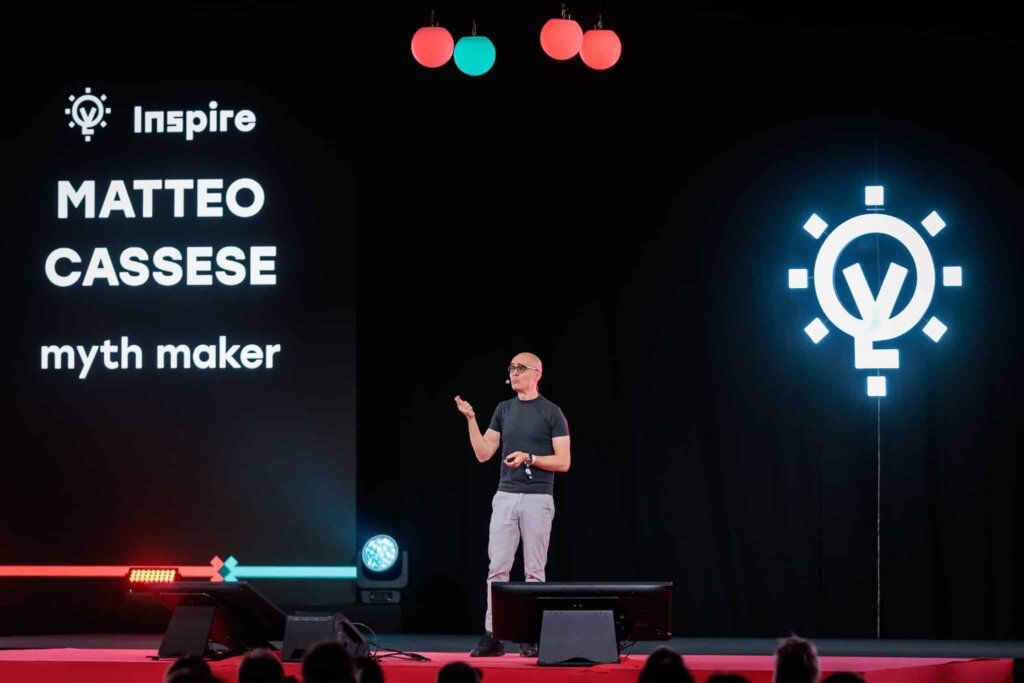
The Power of Discomfort
A leadership keynote that travels well across European registers. Berlin rewards directness, Paris rewards intellectual confrontation, the Nordics reward understatement, the Mediterranean rewards story. This talk holds ground in every one of them by leaning into the discomfort the room is already trying to avoid.
The Confidence Paradox
European boardrooms are full of accomplished people who feel the least ready. This motivational keynote names the paradox most senior leaders already suspect but rarely hear out loud. Lands the same on stages in Frankfurt and Milan, calibrated for each.
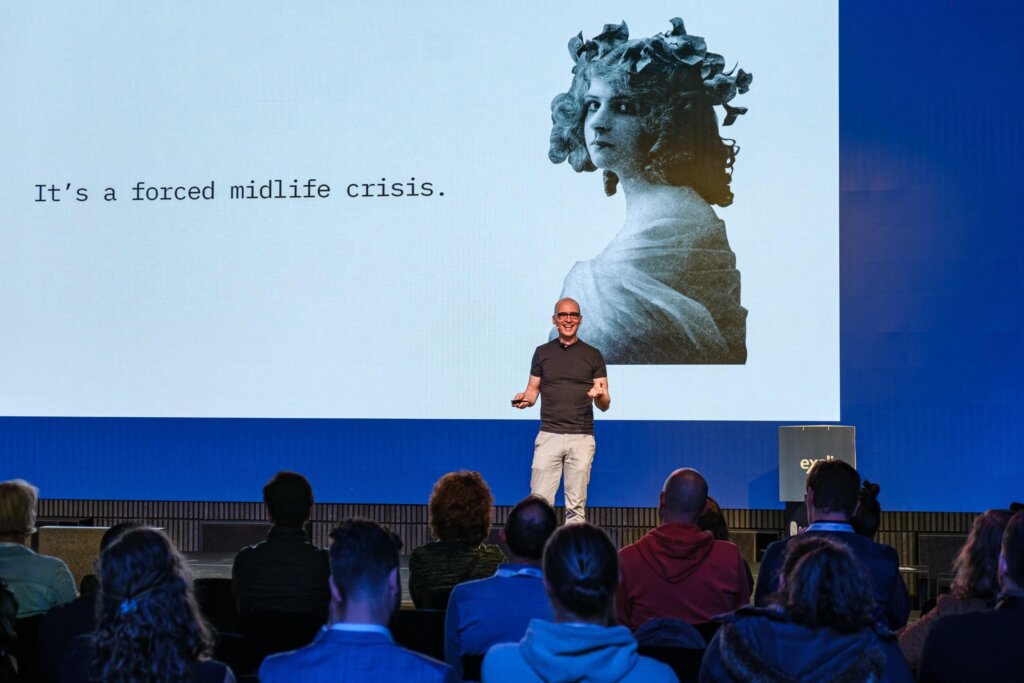
Every Curse Hides a Blessing
Europe has lived through waves of restructuring, energy shocks, and platform shifts. This is the keynote for corporate events in those moments. When the next chapter is not yet written and the leaders in the room have to name what stays and what goes.
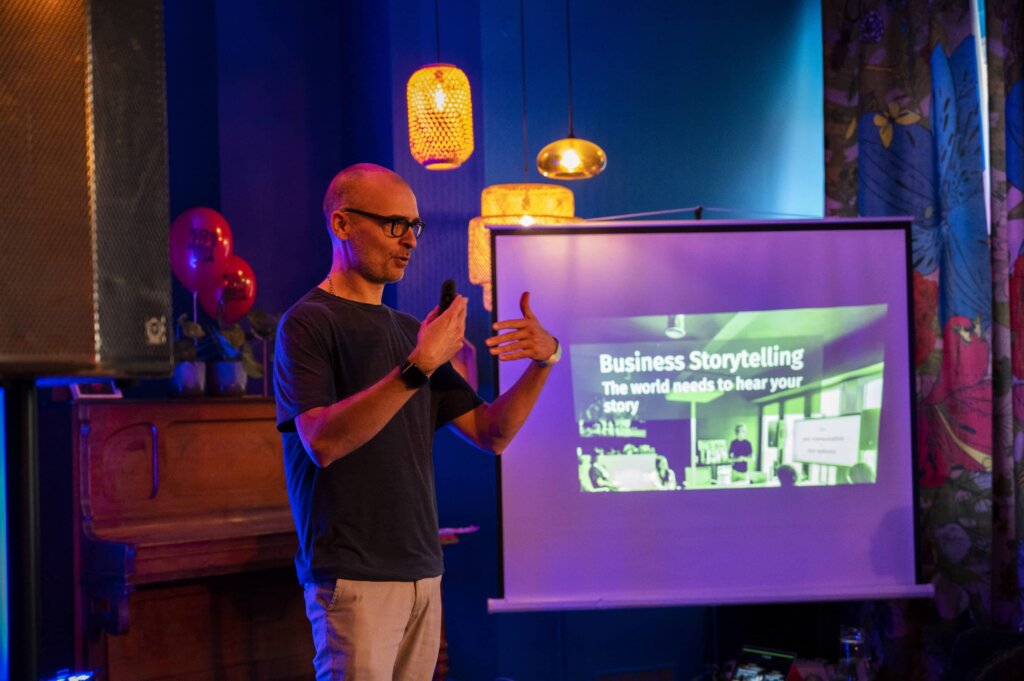
Storytelling Is Not What You Think It Is
European communications and brand teams live on narrative across languages, regulators, and registers. This talk gives leaders the frameworks to tell the story that survives a translation, a press release, an investor deck, and a Q&A in any of seven cultural clusters.
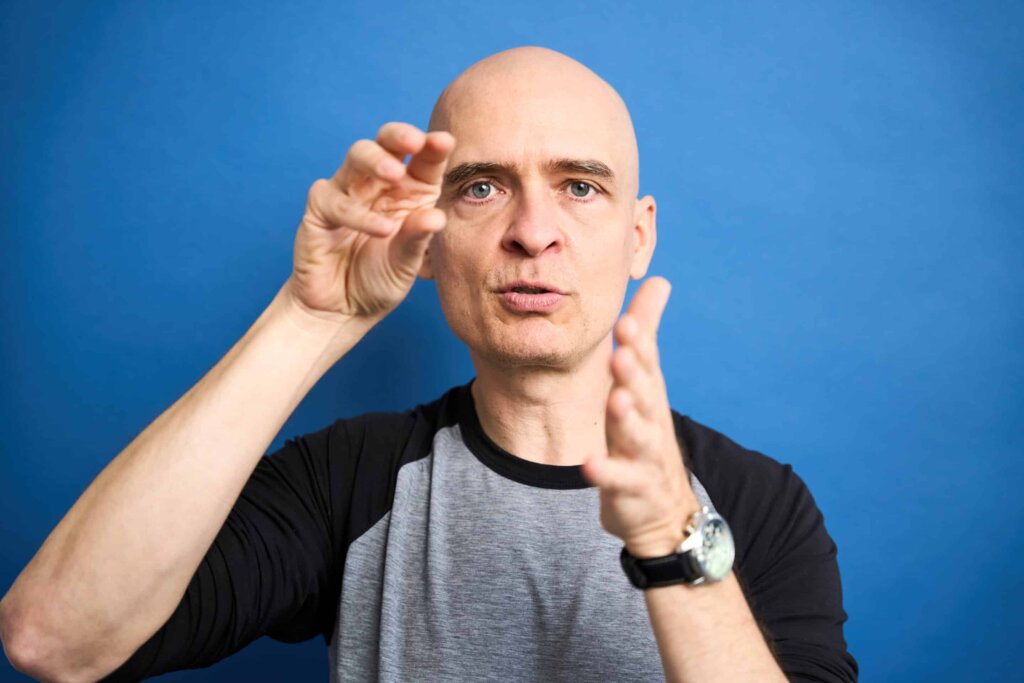
Keynotes that get leaders unstuck
Matteo Cassese, international leadership keynote speaker, helps organizations see leadership differently. Not through motivation posters or five-step methods, but by going to the place most of us avoid to confront the real reasons leaders get stuck. Matteo Cassese brings twenty years of experience to conferences, corporate events, and leadership retreats worldwide. His keynotes cover self-awareness, AI readiness, confidence, and storytelling. They don’t just inspire. They change how people think and act long after the event ends.
Change how your audience thinks
Leaders need new maps. The old ones don’t work anymore.
Matteo Cassese shows them how to navigate technological & social disruption using principles that never fail: building real confidence, telling better stories, understanding what drives them.
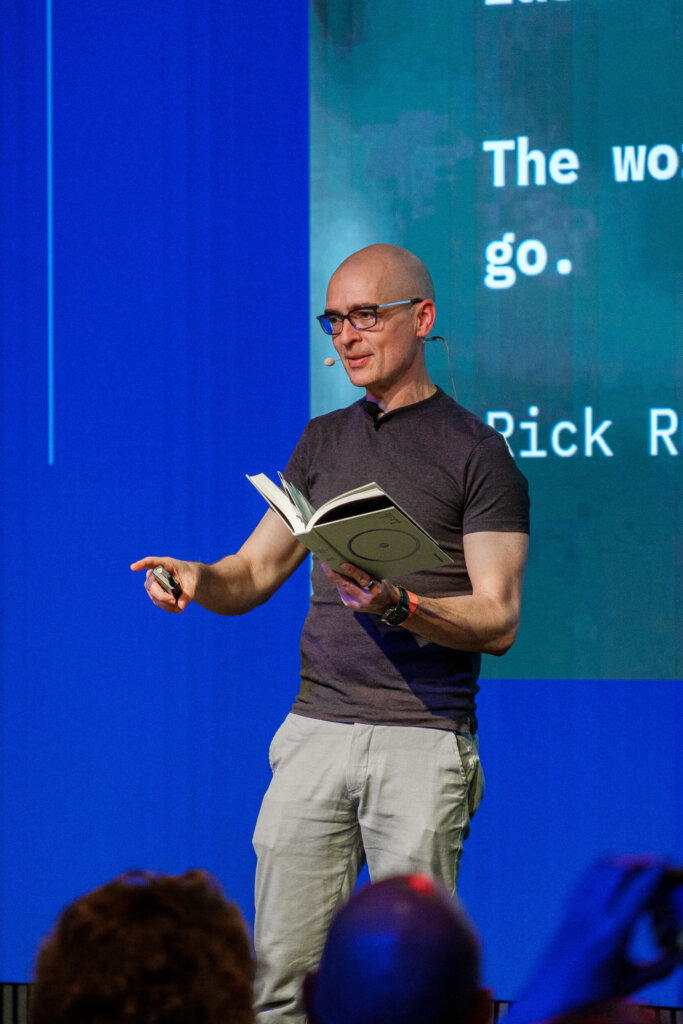
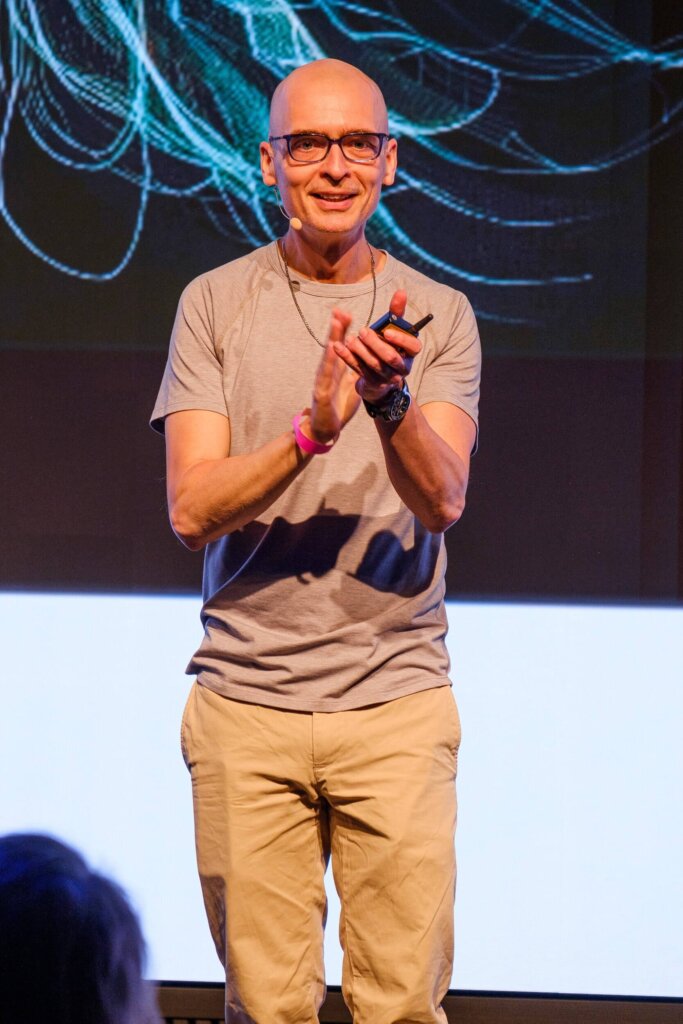
Pick your challenge
- AI making everyone anxious
- Teams burning out from change
- Confidence at an all time low
- Leaders don’t inspire
- Success feels hollow
Your audience leaves with tools they’ll actually use. Not another framework to forget.
What happens before, during, and after your European event
You’re not booking a speaker. You’re getting a partner for the entire arc of your event.
I don’t deliver the same talk twice. I build it around you.

Before the conference
- Personally attend and interact with you in up to 3 briefing calls
- Post to my socials and my email list about your event
- Shoot a promotional reel for you
- Promote your event on podcasts
- Write a blog post
- Host a live coaching session for your audience
At the conference
- Be there early
- Attend all talks on the day I speak
- Integrate insights from previous speakers into my talk
After the conference
- Ask-Me-Anything session for your audience (after the talk)
- Share full video of the talk on my socials
Trusted by leaders at companies that look for depth
Stages that matter

Book someone they’ll still be quoting next year
“There were at least 500 people in the room. I’m pretty sure your speech made an impact and triggered a mindset shift for each and every one of them. Amazing.”

Zeineb Mrabet
“Arguably the deepest talk of the entire conference. You could feel the energy in the room shift.”
Julian Farizi
“A deeply human experience. He presented the very opposite of a quick life hack and gave a feeling of confidence to everyone in the room. The takeaway was empowerment. What a feat.”
Gregor Müllegger
Senior Software Engineer
“The talk was easy to listen to, with a perfectly clear flow of discussion. What stands out most is the lasting impact: the audience leaves with a seed planted in their minds.”
Angela Violino
Brand Communication Designer, Doodle
“And then Matteo Cassese closed the show with his powerful stage presence, challenging us to rethink the future of work.”
Grazia Ravelli
“It was a pleasure to see you speak! In a world of template frameworks and growth playbooks, it was refreshing to hear someone call the chaos! I’m sure it inspired and energized many!”

Norman Schütt
“The first talk I’ll rewatch when the recordings are out is Matteo Cassese’s. Truly inspiring.”
Balach Hussein
The booker handbook for European keynotes
How complex is it to book a keynote speaker in Europe. Here we break it down by lead time, travel handled in the quote, value-added tax under reverse charge, withholding, contract basics, languages, and how multi-city tours actually price.
How booking a keynote actually works in Europe
Six things every European booker learns the hard way. Here is the cheat sheet.
Lead time
Six to twelve weeks is comfortable for a customized keynote. Three weeks works when the date is firm and the brief is tight. Inside ten days is rare and depends on Matteo already being in your city. The earlier you reach out, the more we can do together before the event.
Travel inside the quote
Business class on flights longer than three hours, economy class on shorter hops, hotel within fifteen minutes of the venue. Travel is bundled into the quote at standard European business rates. Your travel desk does nothing afterward unless you would rather it did. No expense forms, no separate invoice, no surprise.
Cross-border value-added tax
For business clients inside the European Union, the keynote fee is invoiced from Berlin under reverse charge. Zero German tax on the invoice. Your company self-accounts in your country. Your finance team does this every day. They need both companies’ value-added tax numbers on the invoice and the line “Reverse charge, Article 196 Directive 2006/112/EC.”
Withholding tax at source
Italy, Spain, Portugal, and Austria withhold tax at source on non-resident speaker fees. Treaty relief is available but requires a Certificate of Tax Residence from Matteo’s German tax office. Cleanest pattern: agree on a fee net of withholding, let your finance team handle the exemption paperwork. Otherwise the speaker chases a refund for six to eighteen months.
Contract basics
Standard cancellation ladder: deposit forfeited beyond ninety days, fifty percent inside ninety, seventy-five percent inside sixty, full fee inside thirty. Force majeure named explicitly post-pandemic, deposit transferable to a rescheduled date within twelve months. Recording, streaming, and post-event distribution are licensed separately. Live attendance is the default.
Languages on stage
English everywhere, including Helsinki and Stockholm where the audience reads English faster than their own keynote speakers. Matteo is an Italian native. Matteo’s German is conversational, fine for hosting a panel or fireside chat in Berlin or Munich, not the language of choice for a forty-five minute keynote.
Multi-city tour pricing
The continent is small. London to Amsterdam to Berlin in one week is a normal calendar. Pricing on a tour is bundled. The second and third dates carry a smaller fee than a standalone booking because the preparation and the travel friction compound less. Four or more dates inside three weeks unlock a tour rate. Ask when you reach out.
Direct booking, no middleman
Most European keynote bookings come through a bureau because that is the channel the market built. Direct bookings are also welcome and tend to move faster. Either way the contract terms are the same. You talk to Matteo’s team. The proposal arrives within one business day.
“Europe is not one room. Every country has a register the keynote needs to respect. A booker who knows the register before the speaker arrives saves the room from the wrong opening.”
How European audiences read, country by country
Fifteen years of speaking on the continent collapses into seven clusters. None of them are absolute. All of them shift the opening, the examples, and the way the keynote handles the questions afterward.
The Mediterranean South: Portugal, Spain, Italy, Greece
Relationship-first audiences. Warm openings work. Personal stories work. Data slides without a story behind them feel cold. Interruption is engagement, not rudeness. The forty-five minute slot is a suggestion. Matteo opens with a story in Lisbon, Rome, Milan, and Athens, then earns the right to bring numbers ten minutes in. Greece runs more cautious on contracts and logistics than the other three.
Germany, Austria, Switzerland
Task-first audiences. Send the agenda in advance. The room is structurally prepared, the questions are precise, humor that depends on exaggeration reads as inaccuracy rather than comedy. Berlin tilts more direct than Munich. Vienna runs slightly warmer. Zurich is the most formal of the three on timekeeping. Across all of them, evidence beats anecdote, and the keynote that admits a real limit lands harder than the one that does not.
France
Intellectually confrontational. Debate equals respect. Agreement on the first pass means the room has checked out. Matteo welcomes pushback in Paris and Lyon publicly, on stage, and the audience reads that as confidence rather than weakness. The American applause-line technique reads as manipulative here. Build the conceptual argument first, then arrive at the practical conclusion.
Britain and Ireland
Indirect, ironic, understated. British audiences laugh quietly. They disagree through humor. They distrust earnestness. “Quite interesting” often means “I disagree.” Self-promotion in the bio reads as American. Matteo opens light in London and Manchester, lets the audience decide if the keynote earns its weight, and watches the laughter to navigate the room. Dublin pairs more with Britain than with the European Union neighbors next door.
The Nordics: Denmark, Sweden, Norway, Finland, Iceland
Consensus-first, low on hype, suspicious of motivational framing. Audiences are quiet during the talk and detailed in the questions afterward. Silence is not disengagement, it is processing. Drop the hero narrative. Use evidence, understatement, and an explicit invitation to push back. Stockholm and Copenhagen run a little warmer than Helsinki and Oslo. Finland runs slightly more direct on disagreement than the other four.
Benelux: Netherlands, Belgium, Luxembourg
Amsterdam is the most direct audience in Europe. Dutch feedback is immediate and unfiltered. If the keynote lands, you know. If it does not, you know faster. Belgium splits internally. The Flemish north reads closer to the Dutch register, the Walloon south closer to French. Luxembourg sits between Germany, France, and Belgium and behaves like the closest neighbor in the room. Confirm which language and which region before you calibrate the opening.
Central and Eastern Europe and the Balkans
Formal openings, formal titles, longer warm-up. Audiences in Warsaw, Prague, Budapest, Bucharest, and Sofia engage fully once the room has decided the speaker is serious. Build buffer time into the questions afterward. The room warms up slowly and then does not stop. Belgrade, Zagreb, and the rest of the Balkans behave similarly with added Mediterranean warmth at the edges.
Every major European city Matteo will travel to
If your city has a stage, an audience, and a flight connection through Frankfurt, Amsterdam, Paris, or Munich, Matteo will be there.
Germany, Austria, Switzerland
Berlin, Hamburg, Frankfurt, Munich, Zurich, Cologne, Düsseldorf, Stuttgart, Hanover, Leipzig, Nuremberg, Vienna, Salzburg, Graz, Basel, Geneva.
The Nordics
Stockholm, Copenhagen, Oslo, Helsinki, Gothenburg, Reykjavik, Tallinn, Riga, Vilnius.
The Mediterranean South
Lisbon, Rome, Milan, Athens, Porto, Madrid, Barcelona, Valencia, Seville, Florence, Turin, Bologna, Naples, Venice, Thessaloniki, Valletta, Nice, Marseille.
France, Britain, Ireland
Paris, Lyon, Toulouse, Bordeaux, London, Manchester, Birmingham, Edinburgh, Glasgow, Cardiff, Dublin, Cork.
Benelux
Amsterdam, Rotterdam, The Hague, Utrecht, Eindhoven, Brussels, Antwerp, Ghent, Luxembourg.
Central and Eastern Europe
Prague, Warsaw, Kraków, Wrocław, Budapest, Bratislava, Ljubljana, Zagreb, Belgrade, Bucharest, Sofia, Istanbul.
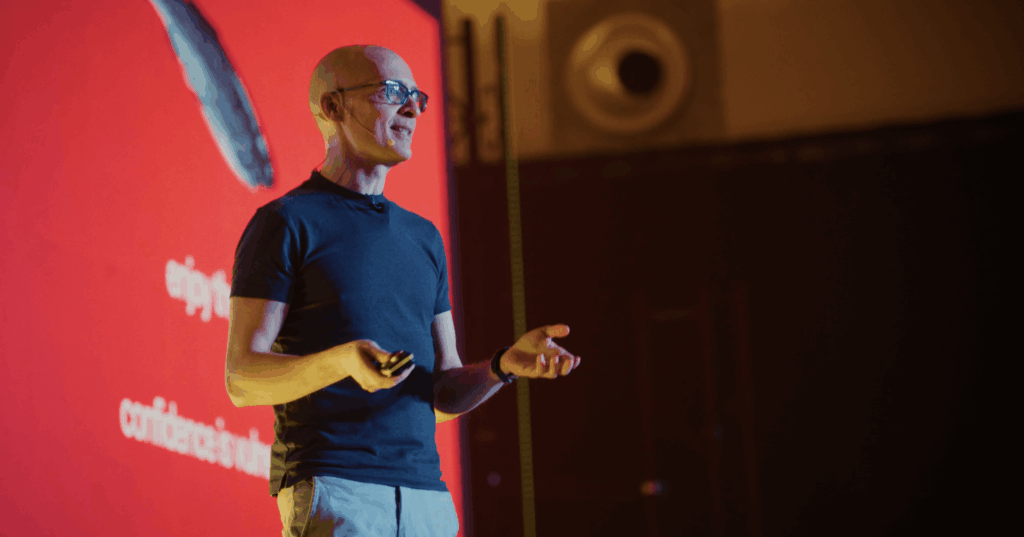
What European venues do that the rest of the world does not
Audio-visual is bundled. European venues often run audio-visual through venue staff, included in the rental.
The green room is a real room. Espresso, water, and usually a hot meal.
Tech rehearsal is sixty to ninety minutes morning of. Europeans take their time to check the tech.
Lunch is seated or buffet, two courses. Wine often included in France, Italy, Spain, and Portugal even at daytime corporate. In Northern Europe often a soup is all that’s offered, and that makes the Southern Europeans squirm.
Coffee breaks last thirty minutes and the speaker stays. The European format gives the speaker time on the floor with the attendees who actually want to talk.
Recording rights default to the speaker in Germany and France. Moral-rights law. Negotiate licensing in writing before the event.
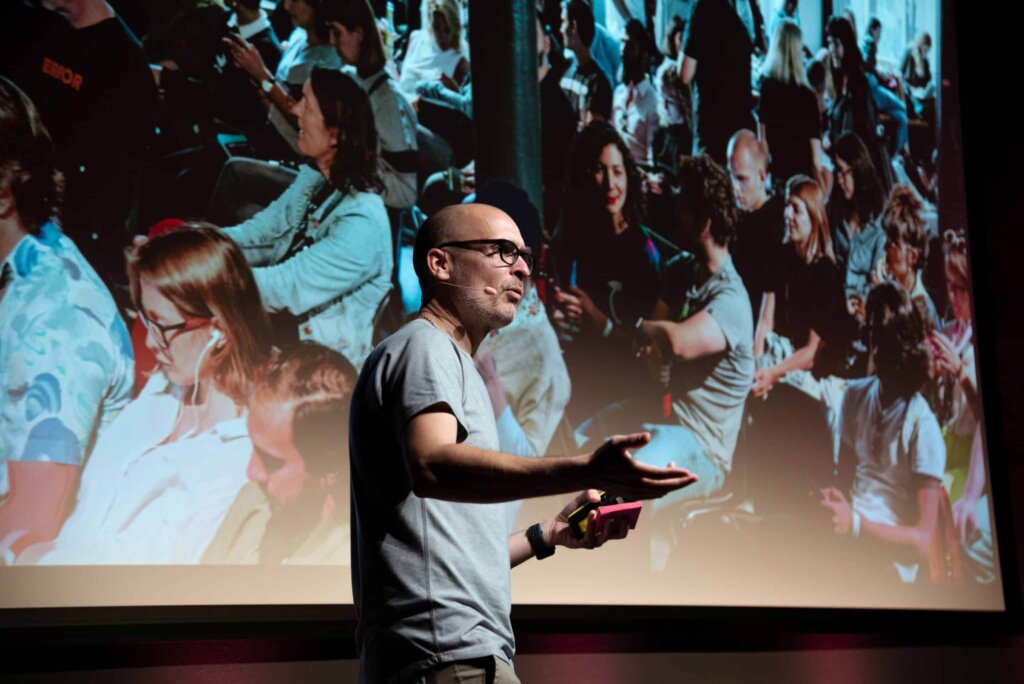
The mythmaker who decoded leadership
Matteo Cassese is an international keynote speaker, business coach, and mythmaker based in Berlin and working across Europe, with twenty years of experience across tech, film, and consulting.
From launching more than 140 films at Warner Bros. to advising Netflix, Sony, LinkedIn, and Heineken. Matteo has observed what truly makes leaders and what breaks them.
His keynotes don’t just inspire. They transform. He blends psychology and myth to help leaders understand the hidden stories that drive their behavior, and how to change them.
A queer nerd passionate about mythology, technology, tarot, fitness, nature, and cars. On stage, something switches on. In his own words: “I am a deep introvert and a stage animal. I can switch it on and make magic happen.”
Whether speaking to a room of five hundred at Alte Münze in Berlin, RAI Amsterdam, or Web Summit in Lisbon, the mission is the same: to help people make meaning out of chaos, so they become someone new on the other side.
Frequently asked questions about booking a keynote speaker in Europe
What makes Matteo different from other keynote speakers in Europe?
Most international speakers deliver the same talk in every European city. Matteo Cassese calibrates per country. Berlin gets the dry version, Lisbon gets the story up front, Stockholm gets understatement, London gets the quiet laugh before the data. Fifteen years on the continent, fluent in three European languages, and a track record across Netflix, PwC, the European Commission, and conferences from Web Summit in Lisbon to InfoShare in Gdansk. Mythology, psychology, twenty years across tech and corporate, delivered in the register the country actually rewards.

What keynote topics travel well across European audiences?
The framing depends on the country and the room. AI anxiety inside an engineering team? “From Mal-AI-se to Ren-AI-ssance.” Leadership performing confidence instead of having it? “The Confidence Paradox.” A restructuring or market shift? “Every Curse Hides a Blessing.” Marketing and communication teams cutting through noise across languages? “Storytelling Is Not What You Think It Is.” Founders avoiding the hard call? “The Power of Discomfort.” Each one is rewritten for your industry, audience, and country. None is delivered the same way twice.

How do you customize the keynote for a European audience?
Up to three briefing calls before the day. Not logistics. Real conversations about your people, your sector, the outcome you need, and the country in the room. Berlin gets data and dryness. Rome gets a story. Stockholm gets understatement. Paris gets a real argument. London gets a quiet laugh. The arc of the talk is stable. The opening, the examples, the references, and the way the questions afterward are handled all shift with the country. Specificity is the work.
Who books Matteo for European events?
Conference organizers across Europe at venues from Alte Münze in Berlin to RAI Amsterdam to Web Summit in Lisbon. People and learning leaders at Netflix, PwC, LinkedIn, Heineken, SoundCloud, and Personio. Tech and fintech leadership teams from Berlin to Stockholm to Amsterdam. Communications and brand teams at multinational corporates. The European Commission. Audiences from fifty to five thousand. What they share is a preference for a keynote speaker who calibrates per country and can hold a point of view in any of them.
What size audiences do you speak to across Europe?
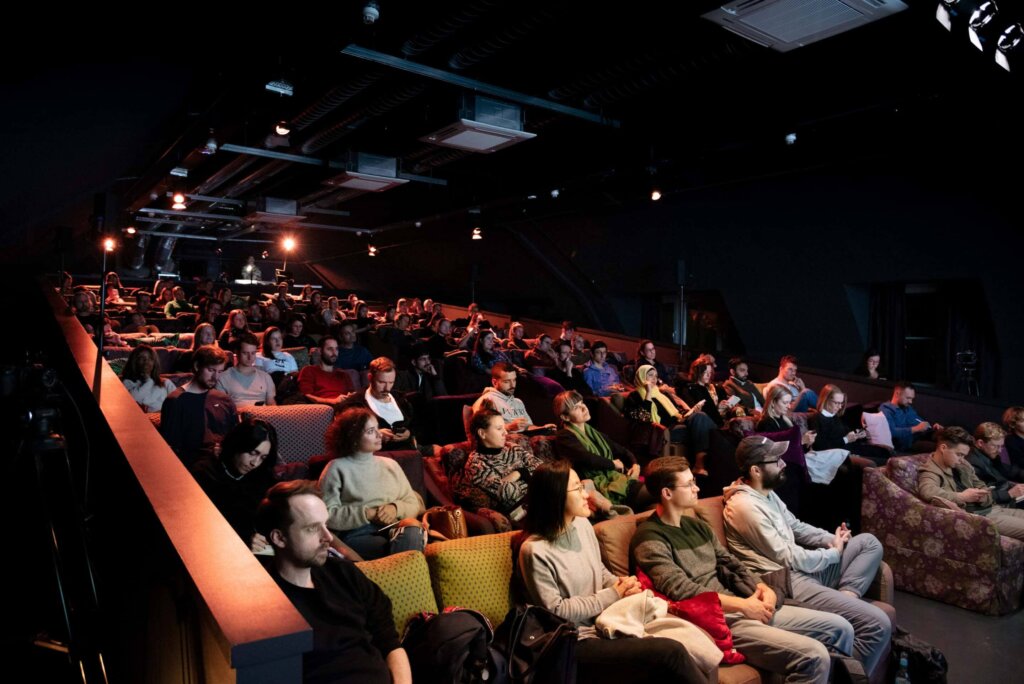
Fifty to five thousand. A private executive retreat in Vienna is a different challenge than a main-stage morning at Web Summit in Lisbon. Both require the speaker to read the room in real time. Both require presence, not spectacle. The talk changes shape for the size of the audience and the country it sits in. The structure and the honesty stay the same.
What languages does Matteo speak on stage in Europe?
English everywhere. Italian native, used routinely in Milan, Rome, Florence, and Turin. German conversational, fine for hosting a panel or a fireside chat in Berlin or Munich, not the language of choice for a forty-five minute keynote. Beyond those three, English with respect for the local register works in every European city Matteo has spoken in. Most major European corporate conferences run in English regardless of the host country.
Which European cities does Matteo cover?
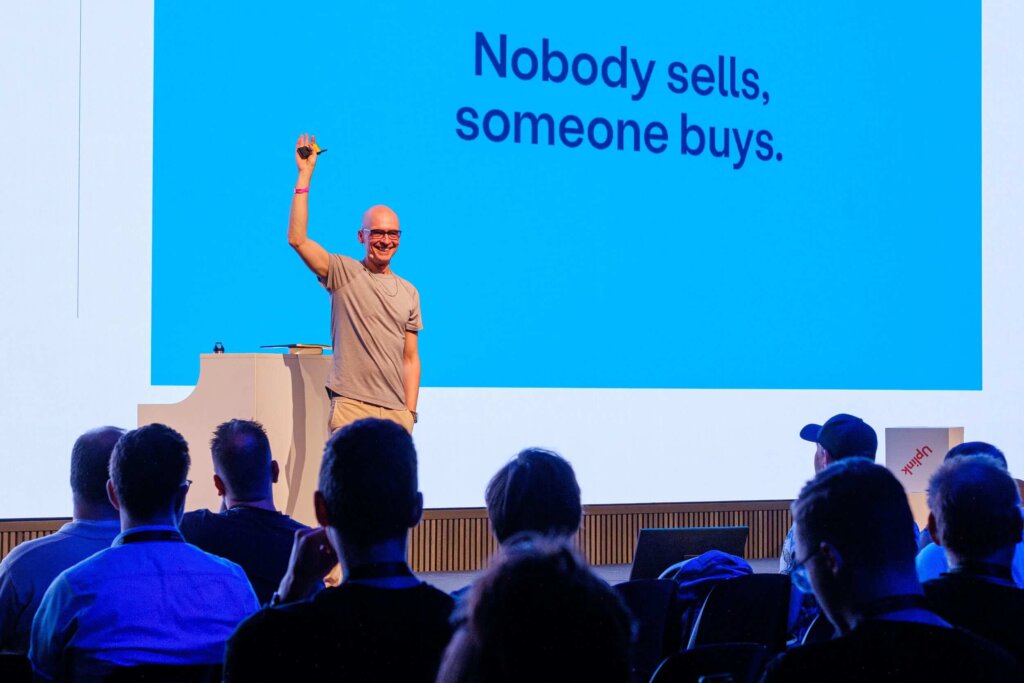
Anywhere with a stage and a flight connection. For instance Berlin, Hamburg, Frankfurt, Munich, Zurich, Stockholm, Copenhagen, Oslo, Helsinki, Lisbon, Rome, Milan, Athens, Amsterdam, and Prague, London, Paris, Madrid, Barcelona, Vienna, Dublin, Warsaw, Budapest, and every other European capital that handles international keynote traffic.

How far in advance should we book for a European keynote?
Six to twelve weeks is comfortable for a calibrated keynote. Three weeks works when the brief is clear and the date is firm. Six to nine months for anything during European peak conference weeks. That includes Web Summit week in Lisbon, Money20/20 Europe in Amsterdam, IBC in Amsterdam, IFA in Berlin, GITEX in Berlin, and the Davos shoulder. Earlier is always better. The briefing work before a calibrated European keynote is meaningful, not cosmetic.
What support does Matteo provide before and after the keynote?
Every engagement starts with a discovery call. Review of the program, alignment on the brief. Before the event, promotion on Matteo Cassese’s channels, a promotional reel, and a blog post for the audience. At the conference itself, the speaker is in the room before the slot, listening to other sessions so the keynote integrates what has already landed. After the keynote, the audience gets an Ask-Me-Anything session and follow-up resources. One-on-one coaching is available when leadership teams want to keep working after the stage clears.
Does Matteo speak at events outside Europe?
Yes. Berlin Brandenburg connects directly to most major intercontinental hubs, and the schedule runs across North America, Asia, and the Middle East alongside European dates. Travel is agreed at booking time. Non-European engagements want earlier lead time, ideally six months or more, because customization across time zones and cultural registers takes more preparation, not less.
Can the keynote pair with a coaching engagement?
The stage and one-to-one leadership coaching are the two deliverables. No workshops are offered in-house. When an organizer wants a workshop wrapped around the keynote, Matteo refers trusted European facilitators who can run the practical session after the talk plants the idea. That keeps each deliverable at its best quality rather than spreading thin across formats.
How do I start the booking process?
Hit “Put your date on hold.” That is not a commitment. It is a conversation starter. Tell Matteo the date, the city, the venue you are evaluating, and what your audience is actually dealing with. You will get a direct answer on availability and whether the brief is a fit, usually within one business day. If it isn’t, the referral goes to a colleague who would serve your room better. No intermediaries, no bureau layers between booker and speaker.
Give your European audience a keynote that survives the Q&A
Every Matteo Cassese keynote is built to hold its argument across countries, languages, and cultural registers. Calibrated for Berlin and Lisbon, for Stockholm and Athens, for Paris and Amsterdam. Your audience will not just be inspired. They will be thinking differently before they leave the hall.
About
Keynote Speaker Europe is a professional speaking service by Matteo Cassese, offering customized keynotes on AI transformation, leadership confidence, business storytelling, and personal growth for conferences, corporate events, and leadership summits across Europe and worldwide. Calibrated per country and cultural register, delivered by a Berlin-based speaker with fifteen years on the continent.
Related
- Provider: Matteo Cassese (Person)
- Related: Professional Speaker (Service)