How to use this guide
This is my free course Founder Journey, written out in full: what founder burnout actually felt like from the inside, and the nine phases I went through after it. There is a text version, which is this page, and a video version, which is five videos. Read, or watch, or both.
My name is Matteo Cassese. I help entrepreneurs turn problems into growth, and I do that in two ways: with coaching, and with speaking professionally.
Why it is free: these are the episodes that I am shooting for my highest paying tier of clients, my one-on-one clients. This is the information that I want them to have.
The five Founder Journey videos
- You can see the business you want and you cannot get there fast enough. The gap between what you want and where you are is your teacher
- A project fails and you feel like a failure. Keep your confidence in yourself, not in your projects, and a failed project stays just a failed project
- Everyone tells you to scale. You know scaling would wreck the part you are actually good at. You are allowed to refuse, and there is a way to grow that starts from who you already are
- Something has to change and you do not know what to do first. The way through starts with stopping everything and ends with becoming who you are
- All five in a playlist
Episode one is the story of the burnout itself. The full written account is on the founder burnout page. In 2022 I decided the solution to my problem was external to me, and that running a business would be solved by applying a framework from the outside in. That is where this course begins.
1. What goes wrong when you copy a plan that already works for someone else?
The usual warning about copying is that the plan you copied was bad, or the person selling it was a fraud. Neither applies here. The plan was excellent. The man who sold it to me told me the truth about it. It still cost me two years.
The program I joined was genuinely good, and that is the trap
I joined a mastermind coaching program from Jonathan Courtney at AJ&Smart, all about facilitation. I had been running workshops for two decades already and I wanted to get better at them, and facilitation is going to matter more, not less.
The program was well made. Regular calls, a course, static material, a community I could engage with. Everything about it worked. That is exactly the problem, because a program that works is the most persuasive argument in the world for doing the same thing yourself, and the argument never gets examined.
“I want to sell people exactly how Jonathan sold me”
Sitting inside the program, the thought went: I want to have that too. I want to offer that to my clients. And there is apparently nothing wrong with that.
Then it went one step further, and this is the step that did the damage. Not just a course, a community, mastermind calls. I want to sell people exactly how Jonathan sold me. The first is about what to offer. The second is about becoming the mechanism that had worked on me.
I asked permission and got a warning: “don’t do it, it’s going to be super hard”
I did the correct thing. I asked Jonathan for permission before copying his funnel. He said yes, I’m going to help you, but don’t do it, it’s going to be super hard. I’m going to support you in this, but it’s going to be super hard.
“Okay, this is all the encouragement I need”
That is what I said to myself when I heard don’t do it, it’s going to be super hard. I heard the yes, filed the rest under encouragement, and started creating a funnel.
That was the moment the decision was made, and it did not feel like a decision at all. It felt like enthusiasm. If somebody who has already done the thing tells you it will be hard and you find yourself converting that into a green light, you are not weighing anything. You have already decided and you are collecting permission.
Paint by numbers: follow 1, 2, 3, 4, 5, 6 and you always get the same shape
The marketing I copied was a paint by numbers framework. Join the numbers in order and you always get the same shape. Follow 1, 2, 3, 4, 5, 6 and out comes the same picture every time.
Which is the selling point. It is also what it does to a market. Everybody who buys the same numbered sequence produces the same shape, and the result is absolute sameness in the market, with every one of those businesses convinced it has just built something of its own.
My personal offer, run through the numbered steps: “they all lost power completely”
What went into the machine was a very personal offer. Things I had discovered and explored over two decades. What came out was the same material with the power taken out of it, oversimplified, because a six step Russell Brunson style funnel had been imposed on top of me.
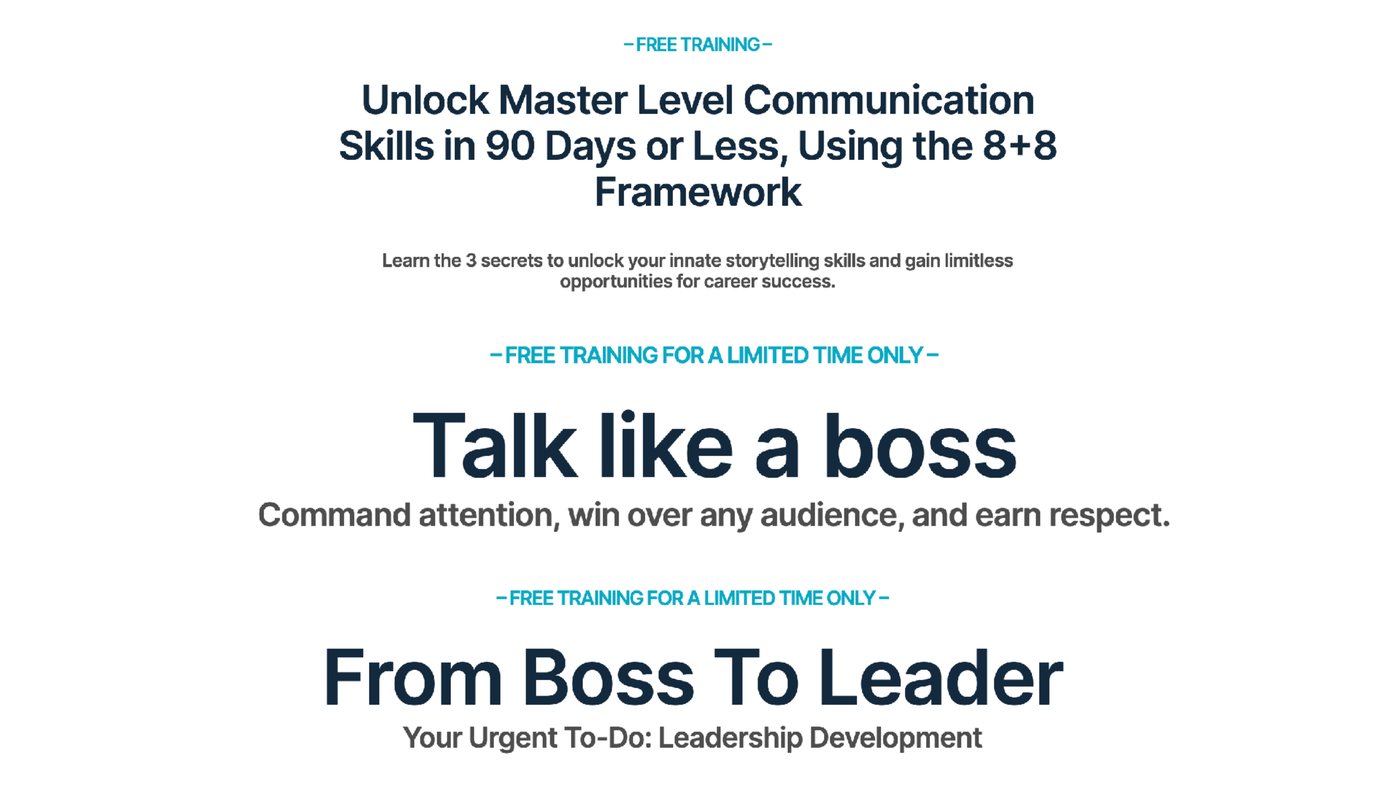
I ended up with the phrase talk like a boss. Then I softened it to from boss to leader. I am really not proud of showing that slide, and I show it anyway, .
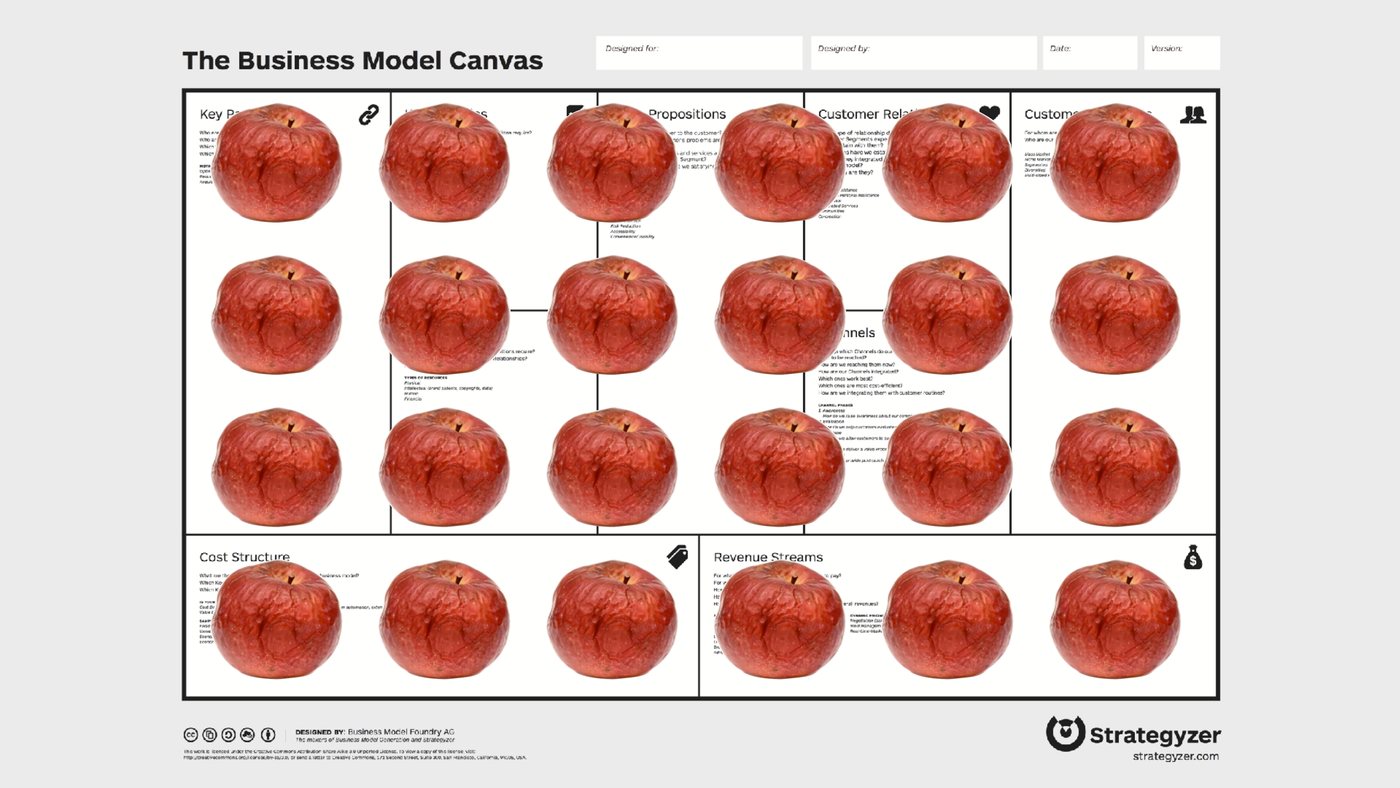
The first rotten apple, and all the rotten apples that followed
The first rotten apple was the flattening of the offer. Everything after it followed from that one, and none of it looked like a consequence at the time. It looked like work.
Once the funnel existed it had to be fed, and feeding it meant the ads, the video server, the editing, the scripts, the landing pages, the conversions, the pixels. A single decision to adopt somebody else’s shape generated two years of operational work whose only purpose was to keep that shape alive.
2. Philosopher or opportunist: which half of your thinking is running your business?
“I know the steps. I know how I should be doing to start a podcast. I know what I should be doing to start a YouTube channel or whatever it is. But then I list these items. This is a list of 30 items, or whatever it is. And then I become completely overwhelmed and I become stuck, paralyzed, paralysis by analysis.”
Every founder I work with is split down the middle between two ways of thinking. I would say 100% of my clients. The split is not a flaw and it does not get resolved. What matters is which of the two has been running things unsupervised, because each one fails in its own recognisable way.
Two definitions of the entrepreneur, both older than either of us
I did not invent either half. The entrepreneur as an opportunistic doer comes from economists far more famous than me, Schumpeter among them. The entrepreneur as a philosopher of action comes from a French economist in the 1800s.
Two centuries of economics could not agree on which one the entrepreneur is, . They were both right and they were each describing one half.
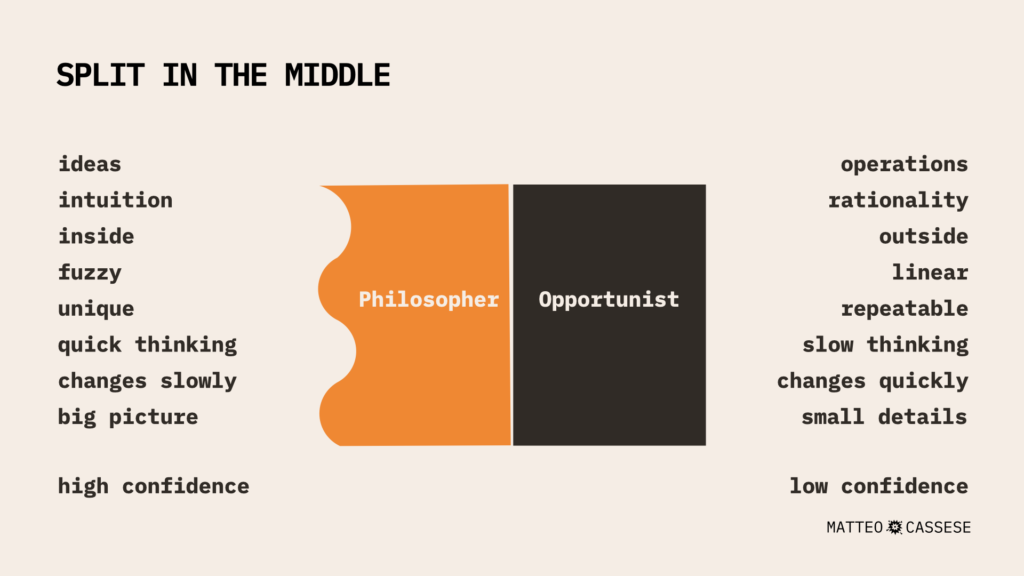
The split I see in 100% of my clients: ideas against operations, intuition against rationality
The philosopher has the ideas. The opportunist has the processes. On one side sits intuition, on the other rationality. Draw it as two figures facing each other and you have the picture I use with clients.
Both are needed to operate. A business needs someone who can see what nobody has built yet and someone who can run the thing twice on a Tuesday, and in a company of one those two people are the same person, taking turns.
How each half thinks: one deep customer against hundreds, fuzzy bursts against linear process
The philosopher is talking to one customer, really deeply. The opportunist is talking to hundreds. For the philosopher what matters is what happens on the inside, the hunches and the gut feelings. For the opportunist all that matters is what the clients are saying, what the competition is saying, what is happening in the market.
The philosopher thinks in bursts of intuition and it is fuzzy. The opportunist is linear. The philosopher has unique ideas. The opportunist has repeatable processes. The philosopher deals with the big picture, the opportunist with the small details. And they change their minds at completely different speeds: if currency trading is the thing right now and then it goes stagnant, the opportunist switches immediately. The philosopher does not turn that fast. Everybody changes, but the philosopher changes slowly.
Characters you already know: Sherlock and Columbo, Yoda and Spock, 007 and Q, Jobs and Gates
Sherlock Holmes walks into the scene of the crime and immediately senses what happened. Columbo asks the same question a hundred times. At what time did you get here? At what time? Remind me. At what time did you get here?
Yoda is intuition and the Force. Spock is rationality, this does not compute, no sensations, all facts. 007 always has the solution and always figures it out, while Q methodically builds the gadgets for him to use. Steve Jobs and Bill Gates. Before them, Nikola Tesla and Thomas Edison. Indiana Jones and Jason Bourne belong on the intuitive side too.
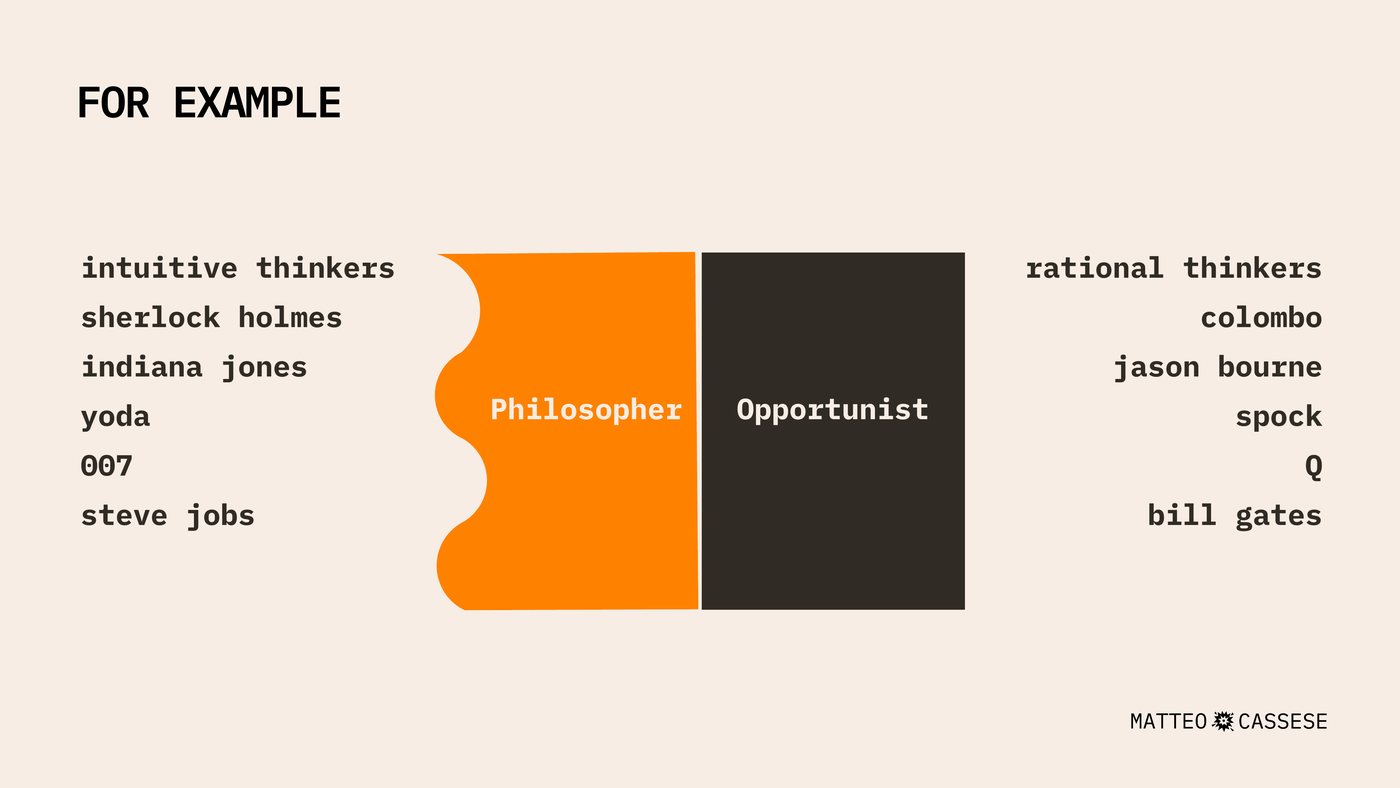
None of those pairs has a winner. You already know instinctively that a story with only Q in it is not a story, and neither is a business.
Why the philosopher needs high confidence and the opportunist can run on data
This one comes back later in the guide, . The philosopher works very close to who they are, which means they have to work at a high confidence level. There is nothing else holding the work up.
The opportunist is running A/B tests, and you do not run an A/B test with confidence. You run it because you want the data to tell you what is going on. So the opportunist can operate at a low confidence level indefinitely, and the philosopher cannot.
Which explains something that otherwise looks like a personality problem. When a founder’s confidence drops, the philosophical half goes quiet first, because it is the half that needs confidence to function at all. What is left is the half that can run on numbers alone. And then you are always busy and out of ideas.
What happens when only one of them is in charge
Opportunist alone: always busy, out of ideas, questions everything, obsesses over numbers and the competition.
Philosopher alone: no operations, no money being made, a lot of projects started that never finish, the strategy changing all the time, the competition ignored.
The philosopher alone is not making any money. And I do not think the opportunist alone makes a lot of money long term either. They make a lot of money short term. The two have to get together to have vision and operations at the same time.
Imagine the same split as two co-founders in conflict, or as two camps inside your team
The split does not only live inside one head. Put it between two co-founders and you have the argument that has been running in your company for a year. Put it across a team and you have the two camps that never quite agree on what the next quarter is for.
What is the power of having two different ways of thinking, two different ways of seeing the world, and letting them clash? There is conflict. Conflict comes up a lot in this course, and never as a problem to be removed.
3. What do you do when your gut and your numbers point in opposite directions?
Most advice on this makes you pick. Trust your gut, or trust the data. Both instructions assume the answer is one of the two things already on the table.
There is a third option that is neither your gut winning nor your numbers winning. I first saw it in a dream
In the dream I was a public speaker, which I also am in life. There was one speaker representing the left, and a second speaker representing the right, some kind of political debate. Then I was invited up, and what I presented was a third opinion. Not the left. Not the right. Not against either of them. The auditorium liked it.
I have got into the habit of feeding my dreams to Claude, the AI from Anthropic. I voice note in the morning and upload it. What came back about this one was that the experience has a name, Jung’s transcendent function. When you see words that size you usually get scared, and I did.
Jung’s transcendent function, in street language: get over it
So I dug into it. To transcend just means to get over. In Latin, transcend means to get over. You would say it on the street. Trans, get over it. Go on, and get over it.
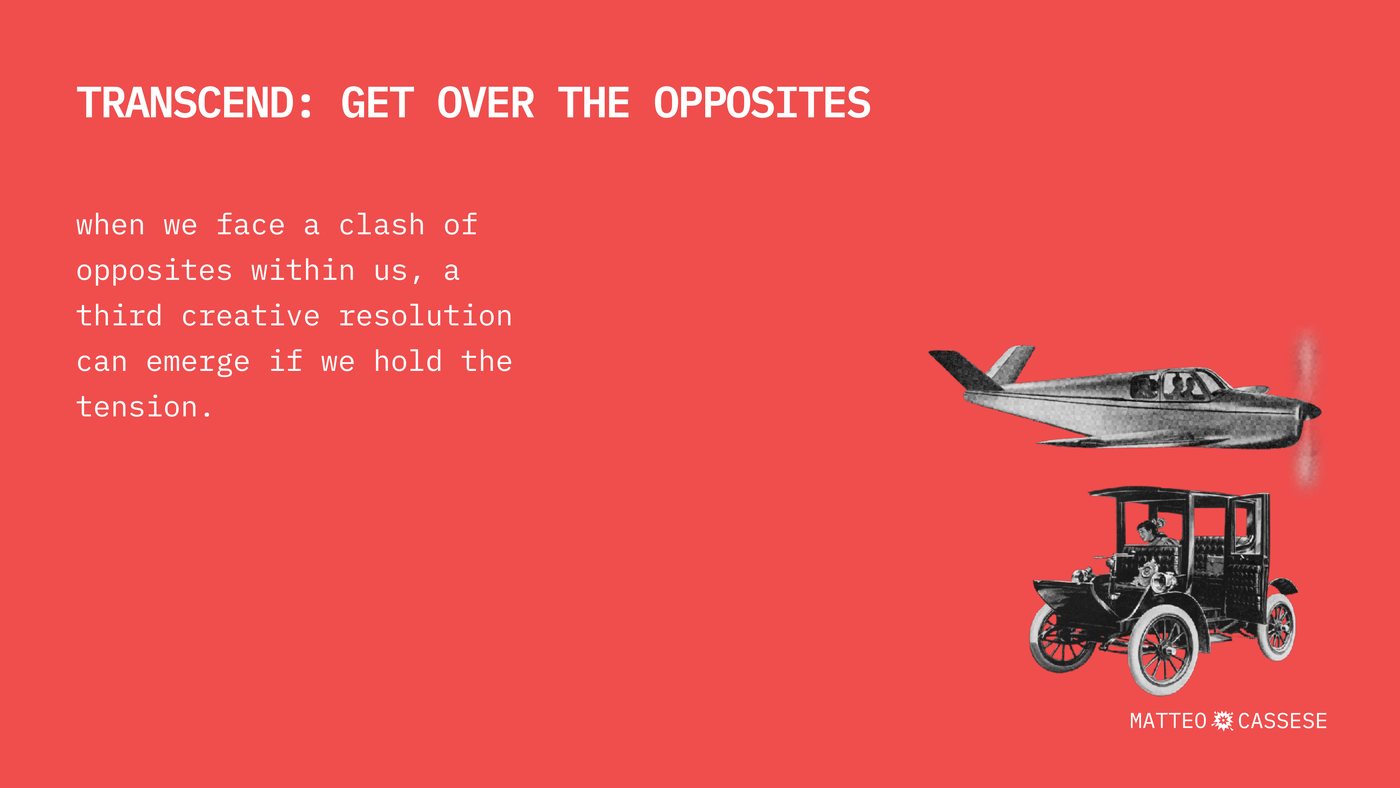
Something is in the way and there is a way over the top of it that is not either of the two directions you were fighting about.
Hold the tension and the brain starts working on a third creative resolution
The mechanism, according to Jung, is that the brain cannot stay with a conflict. There has to be a resolution.
Which gives you one instruction, and I want to underline it. If we hold the tension, if we do not jump away, if we do not run away, the brain will start working on a third creative resolution. The resolution is not something you go and find. It is something that arrives, on condition that you do not leave the room first.
Hold the two options long enough and a third appears: not the car, not the plane, going on foot
You are stuck between the car and the plane. Hold it long enough and the answer turns out to be neither. It could be a third idea. It could be going on foot. It could be swimming. It could be something that gets over the opposites entirely.
Nobody arrives at going on foot by making a better comparison table between cars and planes.
Jim Collins and the genius of the AND: purpose and profit, continuity and change
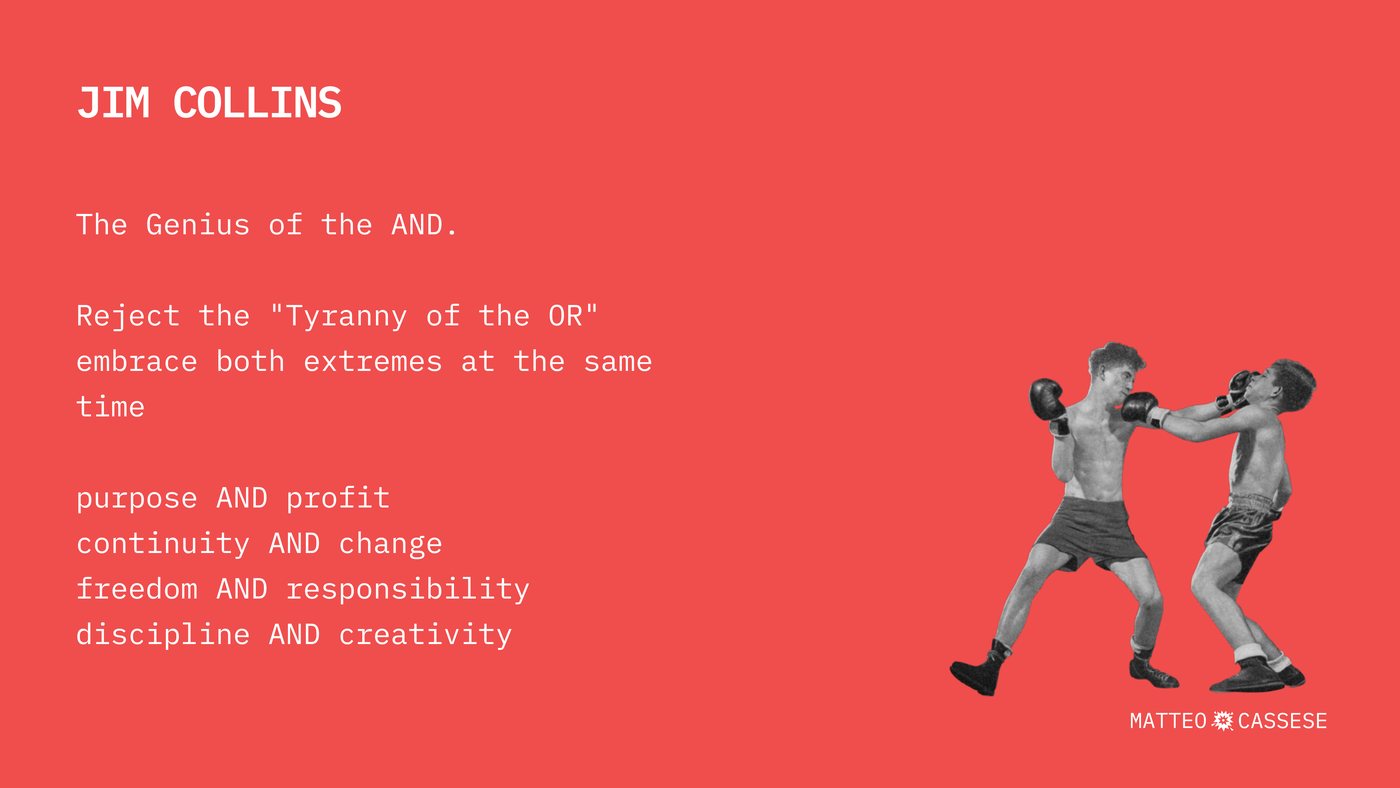
Business thinkers have their own version of this. Jim Collins, in Built to Last, calls it the genius of the AND. Great leaders reject the or. They refuse the choice between purpose or profit and put them together. Purpose and profit. Continuity and change.
Same move as the dream, in a different vocabulary. The two things you were told to choose between are not a conflict. They can be brought together.
I bought the cookie cutter instead, and paid two years for it
I am describing a discipline I did not have. In 2022 the tension was there, exactly as described on the founder burnout page, and I did not hold it for a minute. Instead of tackling those problems and holding the tension, I immediately ran away from them.
And instead of adopting a unique solution I adopted a cookie cutter, paint by numbers solution, where the same shape always comes out if you connect the dots. That is what running from the tension buys you. Not nothing. Something worse than nothing, which is somebody else’s shape, at full price.
My own third option is this course: only I could make it, and I record it once while it gets watched again and again
The tension between the two halves is real for me too. The philosopher wants unique positioning. The opportunist wants scale. My way of holding them together is to make these videos.
They reinforce my unique positioning and my philosopher nature. They also give me scale, because I create a video once and it gets watched multiple times. It is not paint by numbers, because I make the content in ways that are unique to me. I will still do the things that are required of me and that I do not love, short form vertical video among them. But I make sure that 80, 90, almost 99% of what comes out is my essence, unique, not repeatable. I do everything with AI, and AI on its own cannot do these things.
A compromise between the two halves would have produced something smaller than either of them. This came out of holding both at once, and it did not exist as an option when the argument started.
4. The Gap: why can’t you get from where you are to where you want to be? Because you keep trying to jump over it
If you were an American convertible you would want to jump the gap. Foot down, ramp, applause on the far side.
The one concept clients keep telling me was the most useful thing
Whenever I give a workshop, or whenever I work with a client, this is the one they come back to me about. Not the exercises, not the models. The gap.
I did not build it as a teaching tool. I learned about it involuntarily, as a kid, which is the subject of chapter eight. It became the most useful thing I have because it names something people are already living in and have no word for.
Here, there, and the drop in between that everything in you wants to jump
You are here. Over there is something you want. Life is supposed to be a line between the two, and it is not. Between you and what you desire there is no line at all. There is a drop, and you have to spend some time down in it.
Two points and the space underneath them. What makes it useful is not the drawing, it is the instruction attached to it, which runs against every instinct you have: go down there on purpose.
Stories, marketing and this very thumbnail all run on opening gaps in you
Have I told you the story of the hobbit who got the ring of power and left the Shire? That is how stories begin. They open a gap between where you are and where you want to be, and then you sit there until it closes.
Marketing communication and marketing messaging work the same way. All of it is about creating gaps, about making you want a new product. Look at the last thing you bought online. And the thumbnail on the video above this paragraph does exactly the same job to you. You look at it and you think, I would love to know what happens inside there. Everything in the attention economy is built out of this one move.
So the gap is not exotic. You are surrounded by manufactured versions of it all day. The one you refuse to sit in is the one that belongs to you.
Six names for the same place: vulnerability, antifragility, pain, the shadow, suffering, the cave
A lot of people are pointing at this space and none of them call it the same thing. Brené Brown calls it vulnerability. Nassim Taleb calls it antifragility. Ray Dalio calls it pain. Jung calls it the shadow. David Goggins calls it suffering. Joseph Campbell calls it the cave, and the cave comes back later in this guide.
Six vocabularies, six audiences who would not read each other’s books, one location. When that many people arrive at the same place by different roads, the place is probably there.

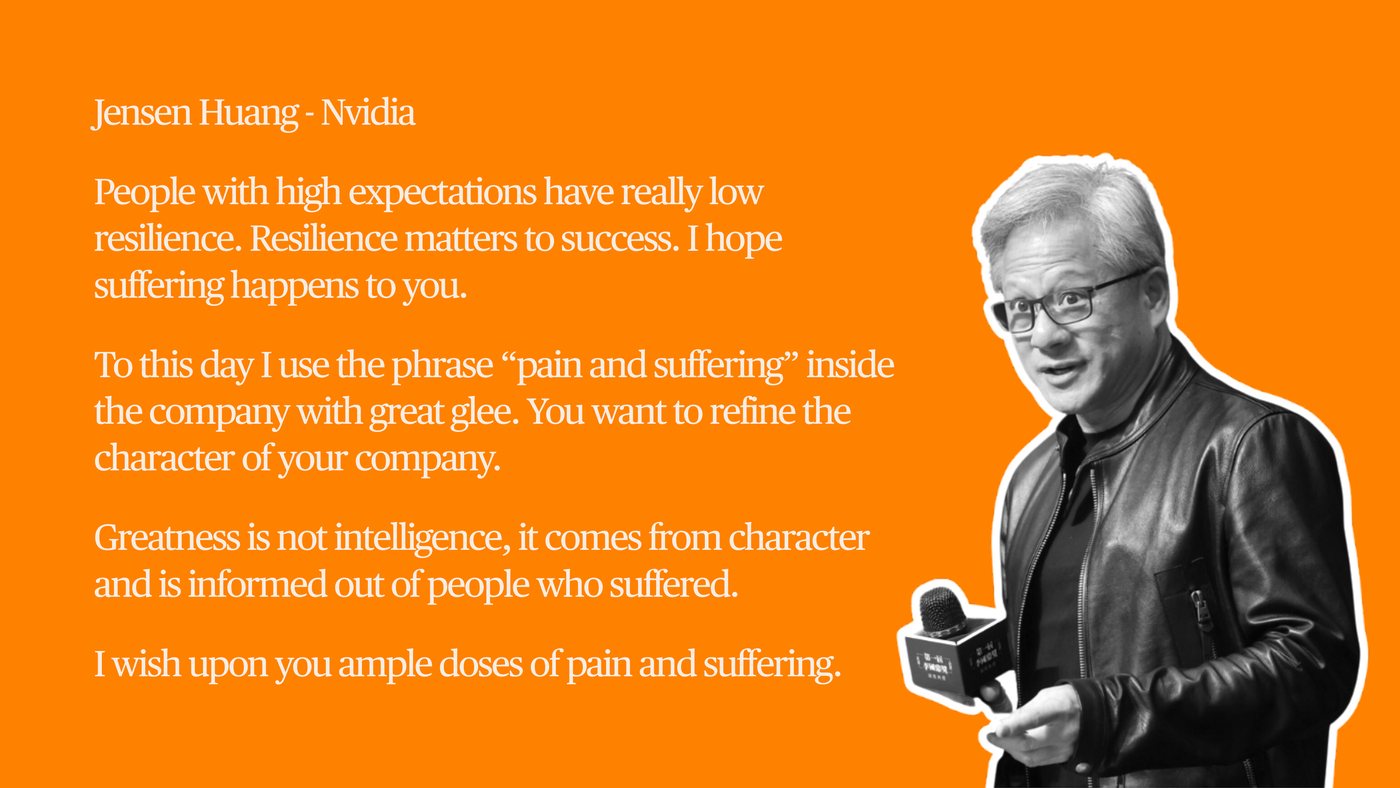
“I wish upon you ample doses of pain and suffering”: Jensen Huang at Stanford
Jensen Huang was addressing a class of Stanford students. Top of the class, at one of the best universities in the world and probably the best in the world for computer science. And what he told them was that he had nothing to give them, because they were the best and they had no resilience, because they had high expectations.
Then he said he hoped suffering would happen to them. In his words: to this day I use the phrase pain and suffering inside our company with great glee. You want to refine the character of your company. Greatness is not intelligence. Greatness comes from character, and character isn’t formed out of smart people, it’s formed out of people who suffered. I wish upon you ample doses of pain and suffering.
He is standing in front of people whose entire education has been a successful avoidance of the thing he is wishing on them, and he is telling them it is the missing input.
Why the Stoics came back: Ferriss, Holiday, Ravikant, and embracing pain to embrace joy
Tim Ferriss, Ryan Holiday, Naval Ravikant and many others brought about a revival of Stoic philosophy, and they are obsessed with the writings of Marcus Aurelius and Seneca.
The Stoic position is about encountering pain and embracing it together with embracing joy, and learning how to embrace the pain so that you can embrace the joy even better. The two are not on separate circuits. The capacity is one capacity. Turn down the first and you have turned down the second without being asked.
Crashing into the gap on purpose: stay, feel, listen, take notes, reach for no framework
Go back to the starting point and intentionally crash into the gap. Then stay with the pain. Stay with the discomfort. Feel. Listen. Take notes. You are exploring, and you are making space for the tension.
Do not try to frameworks your way out of it. Reach for a framework and you have recruited a solution from the outside in, which is the same move that cost me two years. You want a solution from the inside out.
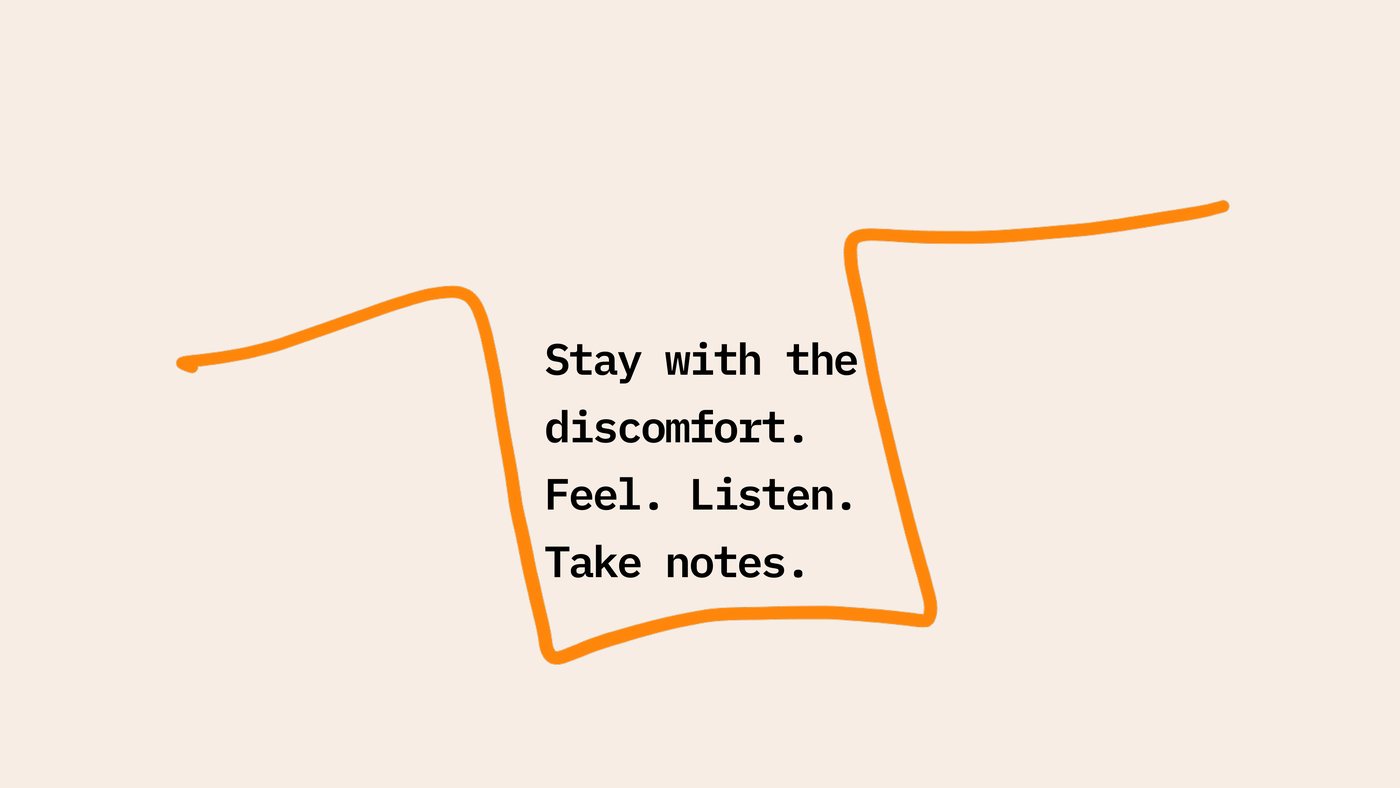
Where it takes you is not guaranteed. Maybe the solution brings you back to the beginning. Maybe it gets you deeper into the gap. Or maybe it gets you out.
“Your gap is unique. Your problem is unique, and so is your solution”
What you learn in the gap is yourself. Not a method. The first thing that happens down there is that you get to know yourself, and since nobody else is you, nobody else’s exit route is going to fit. A framework is a solution shaped for the average of a thousand people. Your problem is not average and neither are you.
What Jen calls it: the rabbit hole with the gold in it. What Sophie calls it: opportunity, curiosity
I asked my clients what the gap is to them. Jen said it is like going down the rabbit hole with Alice, and there is gold there. Then she said she was reminded of the Joseph Campbell line: the cave you fear to enter holds the treasure you seek.
I asked Sophie the same question. She said: the gap, opportunity, space, challenge, exciting, curiosity. Totally in the positive. How is that possible?
It is possible because after a while it flips. You get to the point of saying, finally, I have a problem. And I have a way to solve the problem. I should stay with myself, go into the gap, explore, be curious, get excited about the new problem. Neither of them arrived there by being told to be positive about hardship. They arrived after going down.
The catch: being in the gap costs you confidence exactly when you need it most
You want to be right. And you are only confident when you are doing the right thing. Being in the gap is basically doing the wrong thing. So while you are down there you are not right, you are very wrong, and if you lose your confidence on top of that, you are going to be doubly suffering.
Which is why the next part of this guide is about confidence, and why it has to be reframed completely before the gap is survivable. There is a way of being confident without being confident.
5. Why do you reach for your phone the second the work gets uncomfortable?
Not because you are addicted, or weak, or badly disciplined. Because the phone is the fastest exit from a specific feeling, and the feeling shows up at a specific moment: right when the work stops being executable and starts requiring you to not know something for a while.
Whenever I have a problem, I want a solution. Whenever I am in discomfort, get me my phone. Whenever something feels queasy, push it away
Those are my three reflexes, . Whenever I have a problem, immediately I want a solution. Whenever I am in discomfort, immediately, get me my phone. Whenever I feel queasy about something, I immediately need to push it away, to get it out of my sight.
Three different situations, one identical response, and the response is always immediate. What all three have in common is that they close a space. We do not want the conflict to happen to us, so we go away from the conflict, and what we do is deny space.
Every grab of the phone closes the space where the creative solution was about to appear
Go back to the mechanism from chapter three. Hold the tension and the brain starts working on a third creative resolution. Create the space and the creative solution can appear.
The space is the raw material. The reflex removes it, reliably, the moment it opens. Which means the cost of the reflex is not lost minutes. It is every third option you never got to. You cannot tell what they were, because they never had the room to form.
Convenience has removed the last gaps from your day, and doomscrolling took the rest
We live in a society that gives us all the convenience possible. If we want to move, if we want to receive something, if there might be a gap where we would be alone with our thoughts, there is entertainment, there are podcasts, there is a platform like YouTube.
And whatever is left over, the commute, the queue, the four minutes before a meeting, we can doom scroll. So we do not see the gap anymore. It is a line now, thanks to doomscrolling. We can finally celebrate our lives on our phones.
The work of avoiding discomfort used to require effort. It has been fully automated. Nobody had to become weaker for this to happen.

The last thing you bought online: “out of anxiety, out of FOMO, out of fear”
Think of the last thing you bought through e-commerce. Chances are you bought it out of anxiety, out of FOMO, out of fear. Not out of desire.
I am guessing, obviously, and my guess is that some kind of negative emotion led you to it. Which makes that purchase the same reflex as the phone, with a payment attached. A gap opened, it was uncomfortable, and something closed it in one click. An entire industry is built on the reliability of that reflex.
Two years of pain and suffering, caused by avoiding pain and suffering
What happened in 2024 was two years later, and a lot of pain and suffering later, caused by avoiding pain and suffering. Because I was avoiding pain and suffering by getting an external solution.
The avoidance did not remove the pain. It postponed it, added interest, and delivered it in a lump two years later. I should have spent the time in the gap.
What I will not prescribe about your phone, and why control of it comes later
I am not saying you should uninstall Instagram or stop being on YouTube. Maybe I am saying it. I do not want to give you a prescription of what you should or should not do. What I want to invite you to do is spend time in the gap.
There is a point in this guide where the phone does get handled properly, and it is a whole phase with its own chapter, called Regulate. It comes late on purpose. The order matters, because you regulate in order to protect something you have developed by then, and doing it first turns into one more system imposed on you from the outside.
6. Why does going your own way leave you on your own?
“I feel a bit stuck, a bit lonely, and I feel pressure to embark on this by myself.”
The loneliness founders describe is rarely a shortage of people. It is usually a room full of them, none of whom are standing where you are standing.
The loneliness comes from standing where other people are not
Most people are on a line. School, then university, then the job, then the next job. When you step off the line, whether by choice or because you never fitted on it, the space you move into is largely empty. Not hostile. Empty. There is nobody there to compare notes with, and the loneliness is a straightforward consequence of the geography.
Where mine started: computers over people, sci-fi over the ball outside, boys not girls, dropping out
Four things, and I did not choose most of them.
As a kid I loved computers, which made me a nerd, and I loved computers more than people. I loved spending time with books, especially sci-fi, and nobody else. Other people loved to play with a ball or be outside, while I wanted to be inside with computers and books. My romantic interests were for boys, not for girls, and that also set me apart from my peers. And I chose my own path in life. I started university and I dropped out.
“A space where seemingly other people weren’t, because they were on this linear path”
All four of those did the same thing to me. They made me spend a lot of time in a space where seemingly other people were not, because they were on this linear path.
The space is not actually empty. It looks empty from inside it, at the age when you most need it not to be.
What the solitary space turned out to be: the raw material of everything I now teach
I learned about the gap involuntarily. Not from a book, not from a coach. From being a kid in that space with no way out of it and no name for it.
That is what has led me to where we are today. The concept my clients say is the most useful thing I give them is a description of the place I spent my childhood, written up decades later. The years that felt like a deficit are the entire supply.
What I will not pretend: it is lonely while you are in it. Later you will choose allies, friends and supporters who do the work with you
It was lonely. Saying it turned out to be valuable is a thing I can only say from here, and it would have been no use to me then.
The company comes later, and it comes chosen rather than inherited. In the Review phase, near the end of this guide, one of the practical instructions is to get a board of allies, of friends, of supporters who can do the work with you. That is a different thing from the crowd you were lonely inside. You pick it, and you pick it after you know who you are.
7. Should you shut the business down, or would you be quitting too early?
What I did in 2024: shut the business, fired all my clients, no revenue, savings, doing nothing
In 2022 I decided the solution to my problem was external to me, and that running a business would be solved by applying a framework from the outside in. In 2024 I said, okay, I got it, I got the lesson, now I am going to spend some time in the gap.
What that looked like: shutting down a business, firing all my clients, not having any revenue, tapping into my savings, doing nothing. And being tempted to do a thousand things and doing nothing.
The hard bit was not the shutting down. It was the thousand available things, every day, and not doing them.
“It’s so scary. It’s so scary, the idea of doing nothing”
If you have spent your working life measuring yourself by output, doing nothing is not rest. It is the removal of the only instrument you have for telling whether you are all right. That is the fear, and it does not go away by being reasoned with.
What the days looked like: closing the laptop, walking, hobbies, reading, meditating
Closing the laptop. Going on a walk. Working on other stuff, working on hobbies. Reading. Meditating. Again, doing nothing.
There was no retreat in the desert and no programme. The whole content of it is the absence of the business from the day, repeated for long enough that something else could get a word in.
It lasted four or five months. In the fourth month I started organizing what would become MythMaker
Four to five months, and at the fourth month I started organizing the stuff that would become MythMaker, which is what you are experiencing right now.
Three months of that period produced nothing you could show anybody. The thing that arrived in month four could not have arrived in month one, and there was no way to tell from inside month two that it was coming.
“Some people consider, oh, that was so extreme”: how others rate the decision
I did this in what I think was quite a normal way. Some people consider, oh, that was so extreme.
Both readings are available to anyone looking at the same set of facts, which tells you the rating is not a property of the decision. If you are waiting for the people around you to agree it is a reasonable move before you make it, you are waiting for something that is not going to arrive.
The guard, and the honest limit: I had savings, I chose this, and I have no test for whether you should. My account, not criteria
I had savings, and I spent them on this. That is a condition, not a detail, and without it the whole account is a different account. I chose it. Nobody shut me down, and choosing is a different experience from being closed. And I have no test, no threshold, no list of signs that tells you whether you should do the same. There is no such test in this course because I do not have one.
It is not criteria, and anyone offering you criteria for this decision is selling something.
8. Where did your confidence go, and can you get it back?
Jen, a coaching client: “Why don’t I have confidence? I never had confidence.”
Confidence gets treated as a trait. You have it or you do not, and if you do not, you build it by achieving things until it turns up.
My answer to Jen: “you had confidence. It was educated out of you”
Jen is a client of mine. She asked me: but why don’t I have confidence, I never had confidence.
I told her, no, you had confidence. It was educated out of you.
If you never had it, you are trying to acquire something foreign. If it was taken out, you are recovering something that was already yours, and that is a completely different job with a completely different success rate.
There is no lack of confidence in a baby
Look at a child. Look at a baby. She has all the confidence in the world. She knows exactly when she is hungry, when she is tired, when she wants to play and with which toy. She knows exactly who to smile at and who to frown at.
There is no lack of confidence in a baby. Not a single one, anywhere, has to be talked into asking for what it wants. So whatever confidence is, it is not something added later by achievement.
Sit down, shut up, follow the plan, get with the program: how it gets crushed out of us
Then we tell you to sit down. To shut up. To follow the plan. To get with the program. To stop complaining. And this confidence is being crushed out of us.
Every one of those instructions is reasonable on its own and they are all delivered by people who mean well. Nobody sets out to remove it. It comes out anyway, and then one day switching on a camera for the first time is the hardest thing you have done all year.
What you call confidence is what I call experience: a million reps buys “I’m used to it”
First of three reframes, .
What you call confidence is what I call experience. If you have done something a million times you have a lot of feedback, and that is helpful, but it does not bring confidence. It brings this: I am used to it. Right now, when I step on a stage or shoot a video, I am used to it. That is not real confidence.
Real confidence is the thing that helps you switch on the camera for the first time. It is the one thing that allows you to step on the stage for the first time. Which means waiting until you feel ready is waiting for the wrong substance to arrive.
The overconfident are compensating. Stop using them as your benchmark
Second reframe, and it matters more now than it used to. We look up to overconfident people and we think they have all the confidence. They are actually compensating, because they do not feel they have enough.
I wish we would stop using those people as a benchmark. If you cannot picture who I mean, look at your government, and look at who people elect into office. We are typically electing the overconfident.
Measuring yourself against them is measuring yourself against a performance of the thing you are trying to find.
Real confidence: I see you, and I bring myself. “Doesn’t that sound just like the definition of vulnerability?”
Third reframe, and maybe the most important of them all. Being confident is: I see you and I see myself. I see your issues and I am bringing my own issues to the table.
The overconfident say there is only me, there are only my needs. The insecure say there are only your needs, I am not so important. Actual confidence is when you see the other person for who they are and you also bring yourself forward for who you are.
And does that not sound just like the definition of vulnerability? Is that not the same thing? I will leave you with the doubt on this one.
Reclaim it however works for you: vipassana, weight training, therapy, dream analysis, medicinal plants, LSD
What I want to invite you to do is reclaim it, how you can, how you prefer. Silent meditation retreat. Vipassana. Yoga. Pilates. Weight training. Psychology, psychotherapy, psychoanalysis. Dream analysis, Jung, Freud. Walking meditation, Zen, zazen. Whatever works for you. You can go and explore chemicals. You can explore medicinal plants. You could explore LSD.
Whatever gets you in touch with who you are. This is the work that will give you confidence, and there is no framework for it, no one recipe I can hand you.
Some people will find their confidence just by being in front of a computer, because that is where they belong. Some people will find it paragliding, because that is where they belong. Then you bring those experiences, your whole self, into entrepreneurship. That is how you find it and how you use it.
Then invest it in yourself, not in the projects
Once you have that natural confidence back, invest it. Invest it in yourself. Do not invest it in the projects, because then you can allow your projects to fail.
Recovering confidence and placing it are two separate operations, and doing the first without the second leaves you exactly as exposed as you were.
9. The zero-confidence strategy: how do you stop a failed project from feeling like personal failure?
A launch goes badly and you do not think the launch went badly. You think you are the problem. It is an allocation error, not a character flaw.
A budget of ten confidence coins, and four places they can go: the project, the strategy, the mission and yourself
I am going to give you a confidence budget. Say there are ten confidence coins. In the video they are seashells.
You have four places to put them. You have a project. You have a strategy. You have a mission. And you have yourself.
A project is a specific thing. This video is a project. A presentation is a project. A campaign is a project. A website is a project.
Where instinct puts them: 40% on the project, because you want the project to succeed
I ask this question a lot, and when I ask it of a large group there are always many people who want to put coins into the project. They want the project to succeed.
So 40% of the coins land there, and whatever is left gets divided between the strategy, the mission and yourself. Nobody does this on purpose. It is instinct, and the instinct is that backing the thing you are making is the same as backing it well.
The arithmetic of feeling like a failure: project fails, 40% gone. Strategy wrong too, 60% gone
Now run the scenario. The project fails. If a project fails I wipe out 40% of my confidence coins. I lose a lot of my investment in one event.
And if the strategy was not the correct strategy, and the strategy changes all the time, I wipe out 60%. So whenever things fail, I feel like a failure.
The feeling of being a failure is what it feels like to have most of your holdings in an asset that just went to zero.
My split: 70% in myself, as much as possible on the mission, zero at the project level
Let us reset all of it. Given those same ten coins, I start from the other end. I invest 70% in myself. Then I place as many coins as I can on the mission, because the mission can change but it does not change fast. Obviously I want some confidence in the strategy.
And right at the end, at the project level, I want to have zero confidence. Zero, on purpose, because then I can allow the project to fail.
That is what I call the zero-confidence strategy. It is what lets you keep working when the thing in front of you does not land.
“I can allow this video to fail miserably without becoming a failure”
I am here and I am showing up with 70, 80, 90% of my own confidence, and I have no confidence in this specific video. If it goes online and gets four views, and three and a half of them are me refreshing the page, then under the old allocation I lose my confidence. Under this one, if I am confident in who I am and how I show up and what my values are and what I stand for, I can allow this video to fail miserably without becoming a failure.
Sophie, about to get funded for the wrong startup, running her first retreat three months later
Sophie came to me doing all the right things. She was raising money for a SaaS-based, AI-powered, product-based startup. Following the exact playbook. She had a technical co-founder. She was so good at the playbook that she was about to get the money.
She also had questions that did not fit a founder in that position. Who is the market? How do I market it? How do I advertise it? How do I reach out? How do I use the marketing budget, and we need a lot of marketing budget to launch this.
Once we peeled everything off and started building the confidence in her rather than the confidence in the project, it turned out she wanted a non-scalable business. She wanted to organise leadership retreats for a select, specific group. And she knew exactly how to market that, exactly how to bring it to life. In three months she was not only up and running, she was running the first retreat.
Three months, against a funding round she was about to close. She did not get faster. She stopped pushing a thing she was never going to be able to sell.
“When you hear a founder that doesn’t know how to market their thing, they’re usually doing the wrong thing”
That is what Sophie’s questions were telling me, That is what Sophie’s questions were telling me..
Not knowing how to talk about your own thing is rarely a skills gap. It is usually accurate information, arriving in the only form it can take. This is what happens when you go from borrowing a playbook because you are insecure, saying, oh gosh, how do I do this, let me get the safe version, let me get the safe playbook where everything is step by step.
Being wrong becomes information: “I am fine being wrong as long as I’m being authentic”
You do not want to be wrong, and being in the gap is doing the wrong thing.
By being confident in myself and not being confident in what I do, I am fine being wrong as long as I am being authentic. The coin has completely changed. Confidence is just being the best version of me.
That is the answer to the catch at the end of chapter six. Once nothing personal is staked on the project being right, being wrong stops costing you anything except information.
10. Confidence is a decision: what do you do when it is your turn and you have never done it?
Five hundred students, a microphone, and nobody stepping up
I was 16. We had agreed with the school leaders that we would start a protest, and by the time it came to it there were 500 students in front of us and none of us would step up to the stage, take the microphone and say the thing.
We were looking at each other nervously. Who is going to step up. At some point I got the message that it was my turn.
“I didn’t have the experience. I just decided and I stepped up to the microphone”
So I stepped up to the microphone and I talked to 500 teenagers, 500 adolescents. We started the protest, everybody agreed, and there was a happy ending.
Where did I get the confidence at that time to step to the microphone? By the way, I probably said something that does not make any sense. Did I have it in my bones? I did not have the experience. I just decided and I stepped up to the microphone.
“I didn’t have the confidence. I had courage, and I made a decision”
Those are two different substances and we use one word for both.
Confidence, in the way people usually mean it, is a state you check for before acting. Courage does not require the check. It is available at zero, in the exact condition where you have nothing to draw on and something is happening anyway.
Thirty years later I’m a public speaker. The decision came first
Thirty years later I am a public speaker.
The decision did not come out of the career. The career came out of the decision. Nothing in that room qualified me and nobody there thought I was the right choice, including me. The credential is what the decision built over thirty years, not what preceded it.
Where confidence will not come from: not experience, not other people, not something you have
It will not come from experience. Experience is feedback. It is putting in the reps. Useful, and not a confidence driver. It will not come from other people, so do not ask them to give it to you, and do not admire the overconfident, because they are compensating for a lack of their own. And it will not be something that you have.
It is going to be a decision that you make.
“Confidence is something you do, not something you have. It’s an action, it’s a verb”
Confidence is something you do, it is not something you have. It is not something you ask other people for. It is an action, it is a verb.
Imagine confidence as something you can do into the world. I am confident, you can confident.
Confidence is recovered, because it was educated out of you. Confidence is allocated, because where you put it decides what a failure costs. And confidence is decided, in the second before your turn, with nothing in the bank.
11. Do you actually need leverage, or is it fine to get very good at what you do?
The most important point, first: “not everybody should have leverage… some people are looking for their craft and that’s perfectly fine and there’s absolutely no blame”
I said this at the very end of the leverage video and then admitted I had got the order wrong: maybe I should have started with this, this is maybe the most important point.
Not everybody should have leverage, and not everybody is looking for leverage. Some people are looking for their craft, and that is perfectly fine, and there is absolutely no blame.
Nobody in this territory says that. Everything written about leverage assumes you want more of it and that the only open question is which kind. If what you actually want is to get very good at the thing you do, for a small number of people, for the rest of your working life, you can stop reading here without having failed anything.
What leverage is: “generating more value than you could generate just with pure effort”
Leverage is about generating more value than you could generate just with pure effort. I got most of the way through the video before I noticed I had not defined it, .
Pure effort is the baseline: your hours, your hands, one at a time. Anything that produces value beyond that line is leverage. Which also means that if you are burning out doing everything yourself, the reading is not that you are lazy or badly organised. You are running on pure effort, and pure effort has a ceiling that arrives on a specific Tuesday.
The four places business finds it: ideas, people, systems, money
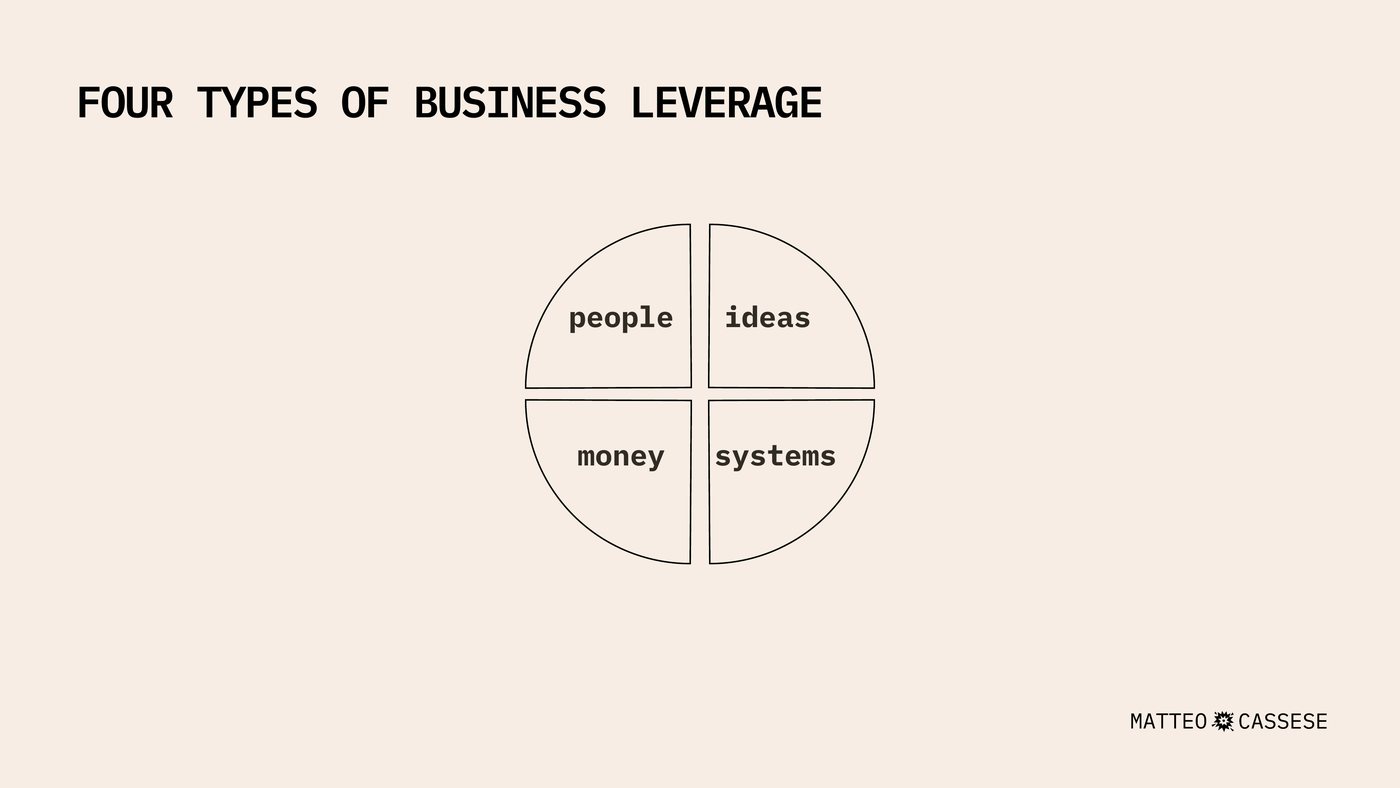
There are four ways leverage is usually split in the business world. Leverage of ideas. Leverage through people. Leverage through systems. Leverage through money.
Most of the time we think about money, because of compound interest. We believe very much in systems: the industrial revolution showed that a factory was a system that created value, and software has been revolutionary in the same way. And we know that moving ideas and moving people are very, very strong.
I do not hand you the menu. I ask which one is already true about you: “I want everything to be inside out”
Four options presented as a menu is the standard treatment, and the standard treatment invites you to pick the one with the best returns and then go and acquire it.
That is the wrong question, and it is the same mistake as the funnel in chapter one, at a higher altitude. I do not want anything to be externally imposed in your life. I want everything to be inside out and not outside in.
So the useful question is which one is already true about you. So the useful question is which one is already true about you, in two layers rather than one, because how your business creates value and what actually drives you are two different things. in two layers rather than one, because how your business creates value and what actually drives you are two different things.
Nobody says you must scale. “Scale is really not human. It’s not a very human destination”
There is a path that runs from problem to solution, from solution to a system around that solution, and from that system to scaling it. People who work that way can stop at any point on it.
They might stop either place, because scale is really not human. It is not a very human destination. It is a very businessy thing to do.
Sophie, in chapter eleven, stopped deliberately at a non-scalable business, walking away from a funding round she was about to close, and was running her first retreat three months later. She stopped, deliberately, at a non-scalable business, walking away from a funding round she was about to close, and was running her first retreat three months later.
If the endgame is not money, what is it: sustained growth, a planet you can still do business on, well-being, a legacy
Modern capitalism is working something out. If we do not have a planet in twenty or thirty years, if the planet is not inhabitable, that decreases the business opportunities for the economy in general. So sustainability and well-being are becoming something the money end of business is genuinely in tune with.
Maybe the most important thing is not success. Not this automatic money machine that through the power of compound interest grows and grows and grows while we, as human beings, stay flat or go down. Well-being is probably the thing we need in order to thrive in the future, especially if the current promise of AI is fulfilled and everything becomes much easier.
So the list at the far end is growth, leveraged capital, a planet that is still standing, sustained growth, and a legacy in the longest possible term. Money is on the list. It is not the last item.
12. Myth Maker, Group Guru, Logic Legend or Wealth Wizard: which one is your business built on?
Four kinds of leverage make four kinds of founder
Ideas, people, systems and money are abstractions until you attach a person to each one. Based on those four types of business leverage you get four characters as an entrepreneur, and characters are easier to recognise yourself in than categories.
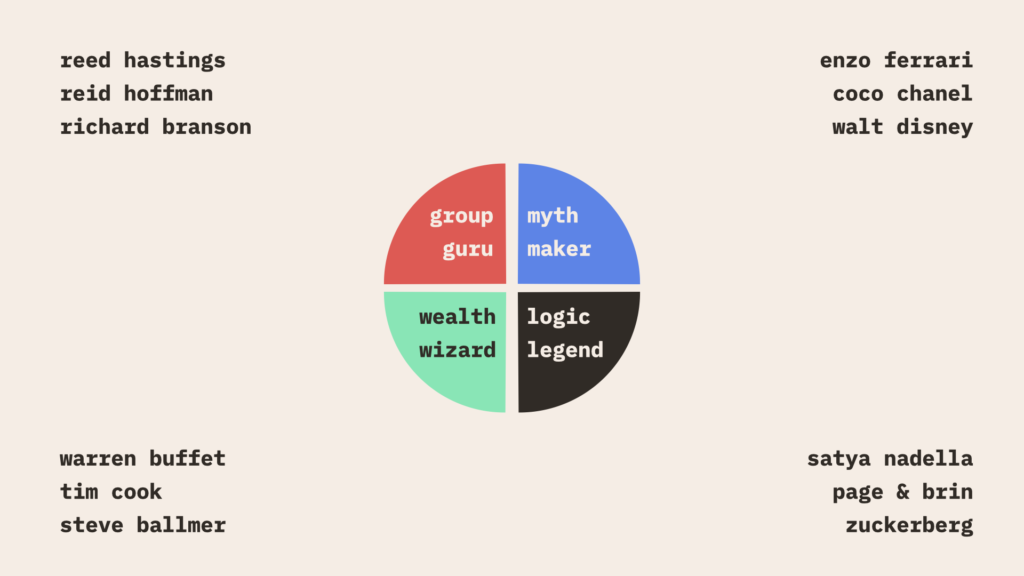
The Myth Maker builds worlds and belonging: Ferrari, Coco Chanel, Walt Disney, Oprah Winfrey
I am the myth maker, and I am the founder of MythMaker, so of course this is the one I start with.
A myth maker is a world builder and a brand builder. They create influence, and they create a sense of community and belonging, because we are wearing a certain brand or identifying with a certain ideology or religion. Myth makers are the creators of systems of belief and the creators of brands.
Ferrari, arguably one of the most precious and most important brands in the world. Coco Chanel. Walt Disney. Oprah Winfrey. Martha Stewart. All of them able to create a world for other people to live in. Think of the most powerful brands, the most powerful movements, the most powerful religions. They are usually started by myth makers.
How myth compounds: story into symbol, symbol into ritual, ritual into identity
The mechanism has four steps and it runs in one direction.
You create stories. Stories transform into symbols, which is what a brand is. Symbols become ways of being, which are rituals. And those ways of being become ways of belonging, of identifying oneself.
Starting from a story, starting from an idea, we are changing how human beings perceive themselves. The power of the myth maker is huge, and it is slow, and it does not show up in a quarterly report.
The Group Guru builds trust that travels: Reed Hastings, Reid Hoffman, Richard Branson
The group guru deals with influence and partnerships. With sales, with trust, with collaboration. If I get people to trust me, or if I can create a network effect and influence people, I can get ideas out into the world.
Reed Hastings, the founder of Netflix. Reid Hoffman, the founder of LinkedIn. The founders of social networks. Sheryl Sandberg. Richard Branson, getting different businesses together, different people together, different causes together.
The group guru deals with people, and people want to collaborate, trust, and get new ideas. The final form of it is influence: the moment your ideas start to have an audience and you can build networks of people and trust.
Why those two need each other: a story with nobody ready to listen is not a good story
A story without people who are ready to listen to that story is not a good story at all. And a group of people without collaboration, without trust, does not really work either.
Which is why founders who are strong on one of those two often feel like they are failing at marketing when they are actually missing the other half. The myth is not weak. There is nobody assembled to hear it.
The Logic Legend runs on problems: Satya Nadella, Page and Brin, Sam Altman. “I don’t think that AI will take anything away from the logic legends”
This is the one everybody is talking about: leveraging systems, automation, software, data, efficiency. It has been very hot, it is very hot, it is going to be very hot. I do not think that vibe coding or AI will take anything away from the logic legends.
Satya Nadella. Page and Brin. Zuckerberg. Jensen Huang. Sam Altman. These are the entrepreneurs we currently cherish, and you will notice a few names missing from that list, which I come back to below.
Do not think about this only in terms of software. It is leveraging systems in general and logic in general. And the fuel is not stories and it is not people, it is problems. There is somebody who thrives, and the more problems you throw at them, the better they live. They go from the problem to the solution, from the solution to building a system around that solution, and from that system to scaling it.
The Wealth Wizard plays the long game: Tim Cook working with resources where Jobs worked with innovation
The wealth wizard is not just about money leverage. It is about assets, and it is also about sustainability and well-being, for the reasons in the last chapter.
The clearest example is Apple. The big difference between Steve Jobs and Tim Cook is that Tim Cook works with resources. He does not work with innovation as such, and he is transforming Apple into something different. The same difference exists between Bill Gates and Steve Ballmer. When Steve came on board, everything changed.
“Nobody is a wealth wizard. They’re evil.” My answer: they are not dealing with money, they are gambling with the future
Whenever I present this, that is the pushback I get. Nobody is a wealth wizard. They are evil. We do not want them. They are the source of all problems.
My answer is that they are not dealing with money. They are gambling with the future. What they have is a long-term look, and inside that long-term look they want growth, they want to leverage capital, they want to sustain the planet, sustained growth, and finally to leave a legacy in the longest possible term.
When people realise the wealth wizard is about the future, and that the endgame is not money as such but the fact that money is leverage, they tend to see it differently.
The three kings of Microsoft, and who created the value
Microsoft went from Bill Gates, creator of software, to Steve Ballmer, and now to Satya Nadella. Three kings, three quite different management styles.
And who are the ones that generated more value? The logic legend and the myth maker. Bill Gates was the inventor, the myth maker and the logic legend in a way. How interesting.
The ones who straddle two: Jobs and Musk across myth and logic, Bezos across systems and wealth
Those are the names missing from the logic legend list. I had not talked about Steve Jobs or Elon Musk, because they are actually combining the two, the myth maker and the logic legend. Very strong innovation intuition and very strong communication capability at the same time. Some for good, some for bad, who knows which.
And there are extraordinary entrepreneurs connecting systems and wealth, like the famous inventor of Bitcoin, or Jeff Bezos. Some of these people have superpowers that come together.
My own honest sketch: myth maker, a little wealth wizard, the other two underdeveloped. Now sketch yours
Here is mine, without flattery. I am very much the myth maker, and I have a little bit of wealth wizard in me, but my logic legend and my group guru are very, very underdeveloped.
Half of the standard toolkit is not available to me. It is also why I do not run a scalable systems business and why nobody should take my funnel advice.
I invite you to sketch this for yourself, just to see how you express your leverage. And then hold it loosely, because this is not you. Your why is you, and that is the next chapter.
13. Explorer, Healer, Keeper or Builder: which human drive is underneath the business you built?
“I hate maintaining. I’m a builder, I’m a shaper. Maintaining, for me, is boring.”
Those four names describe how your business works, not who you are: “your why is you”
Something was missing from the last chapter. I can tell you that you are somewhere in that pie, that you are here or there, but that is not you. Your why is you.
So there is a second, more personal layer underneath, and there is correspondence between the two. This one is very debatable, . I think that we as humans are either explorers, healers, keepers or builders.
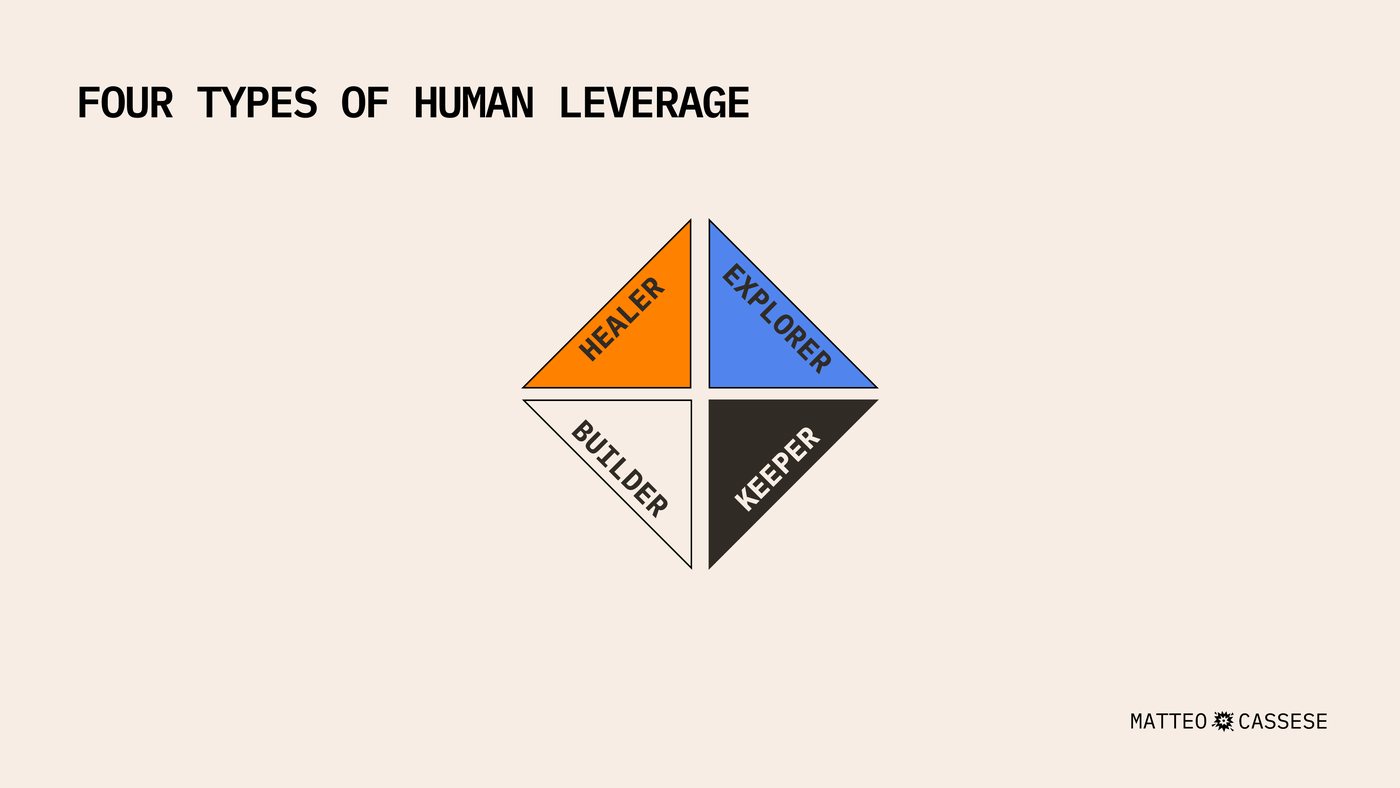
The Explorer is driven by thirst: Marie Curie, Amelia Earhart, Charles Darwin
The explorer wants to discover. Is curious. Wants to research, wants to travel, is tempted by new things.
Marie Curie. Amelia Earhart. Charles Darwin. They really want to know more. They are thirsty, and it is a thirst that drives the explorer, which is a different engine from ambition and a much harder one to switch off.
The Healer is driven by the we: Princess Diana, the Dalai Lama, Martin Luther King, Nelson Mandela
The healer is a slightly different beast. They thrive in relationship, in belonging, in connection, in harmony, in togetherness, and they want to preserve the group.
Princess Diana. The Dalai Lama. Martin Luther King. Nelson Mandela. For the explorer, the future, new ideas and curiosity are what matter. Here it is the we that matters, and that is a very big definition to sit underneath a business.
The Keeper is driven by continuity: Warren Buffett, Winston Churchill, Marie Kondo
The keeper is the conservation expert. Stability, continuity, self-preservation, security, logic, systems thinking.
It is similar to the logic legend, with one difference that matters: the keeper is not an innovator. Warren Buffett. Winston Churchill. The software people of the world. And Marie Kondo, organising everything.
The Builder is driven by making the thing: Steven Spielberg, Frida Kahlo
Builders have a great relationship with explorers. They are creators, designers, storytellers, craft people.
Steven Spielberg. Frida Kahlo. The drive here is to make the thing, and to have made it. Discovering is the explorer’s engine. Holding a group together is the healer’s.
The Explorer and Builder innovate. The Healer and Keeper hold everything together
That is the axis that runs underneath the four. The explorer and the builder are the innovators. The healer and the keeper are the ones keeping everything together.
In all the gaps between them there are slightly different combinations, which is where most real people actually sit.
The warning I attach to my own model: “we really don’t need another framework”
I want you to reflect on this, and I do not want you to accept it at face value. I want you to push back, because we really do not need another framework. We have enough frameworks.
I do not think you should use this right now. Use it at your own risk, because you might be a square peg and you might not fit the round hole we are presenting.
Chapter one is what happens when somebody adopts a good framework wholesale.
“You’re not one of eight.” Eight directions, not eight boxes. Inside out, never imposed
You are not one of eight. You are not limited by these eight possibilities. These are eight directions where stuff can happen for you in your life.
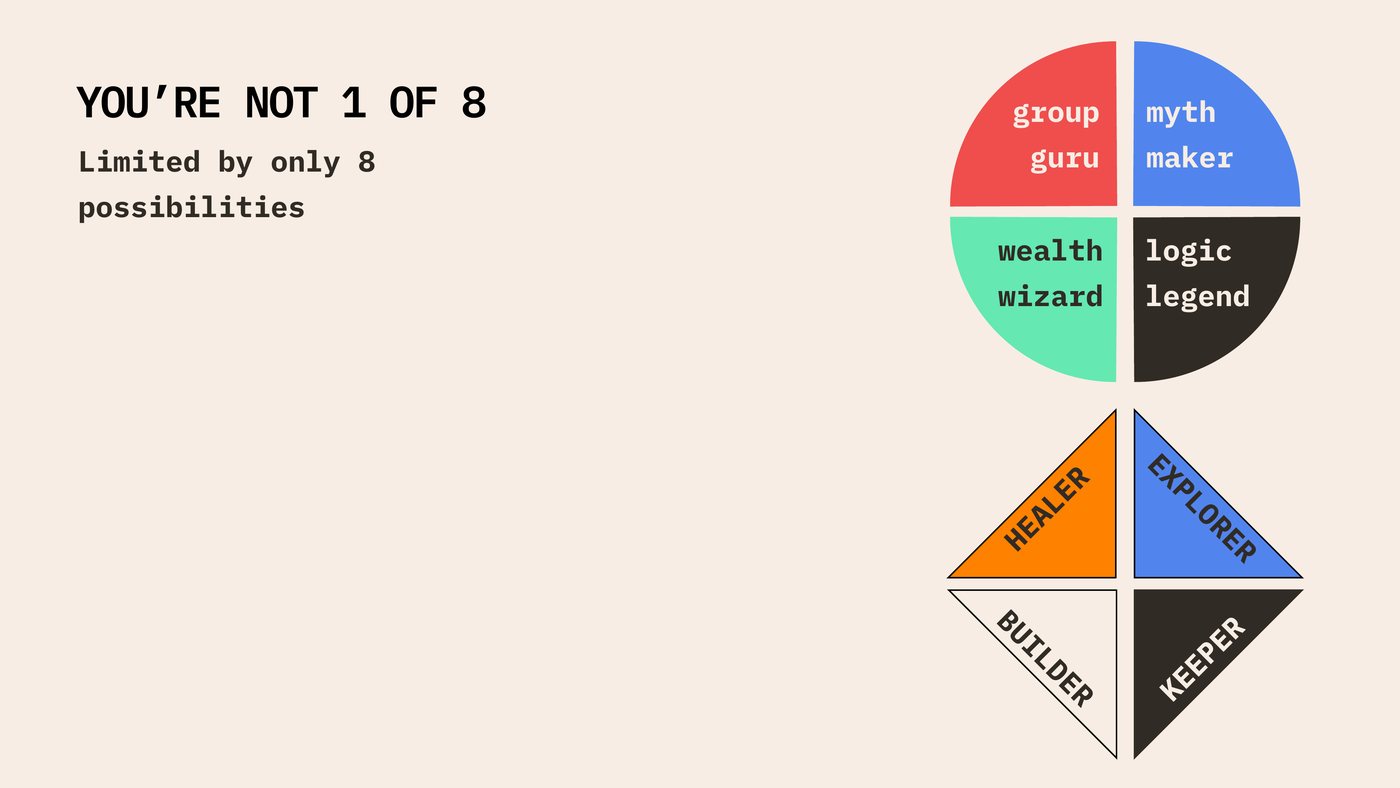
A box tells you what you are and what you therefore cannot be. A direction tells you where a road goes and leaves you holding the map.
I do not want anything to be externally imposed in your life. I want everything to be inside out.
The Leverage Assessment is free at matteoc.com/leverage/. It tells you which kind of entrepreneur you are and the blind spot that goes with it. No call attached.
14. Do your emotions have any place in running a business?
“I’ve been running a startup for four years and I still haven’t had a chance to cry. And I’m wondering, what is it I’m doing wrong? Why haven’t I cried yet?”
Fifteen years of thinking I was a rebel while asking a system for permission
When I was 20 I dropped out of university and I had three jobs at the same time. I moved out of my parents’ house. In my family you were meant to get a degree and go to university, so I believed I was breaking all the rules.
That led me to fifteen years in corporate. And what I realised is that when I was getting jobs and proving I had a worth beyond a degree, because corporates would hire me, and I was thinking, look at me, I am a total rebel, I am doing it, what I was actually doing was standing back inside a system of approval and asking for permission. I did that for fifteen years.
The real rebellion: 2011, giving myself permission to work for myself
I was constantly in this desire for freedom, and I thought going into corporate was my rebellion. The rebellion actually came in 2011, when I gave myself permission to start working for myself.
Successfully and less successfully, I have been an independent solopreneur and freelancer for fifteen years since. There was nobody to ask, which is precisely what made it hard.
The choice that changed the work: bringing my feelings and my emotional nature in
What changed dramatically is that I made a choice to stop being too logical and too pragmatic and too rational at work, and I started progressively bringing my feelings and my emotional nature into the work.
I am not going to tell you this is going to make you more money. I think it is just going to make you happier. The other two are in chapter 25.
The belief I argue against: the Silicon Valley idea that the mind is flat
One part of Silicon Valley is convinced, or at least wants to convince you, that the mind is flat. That great people in history did not have to go through therapy, journal, reflect, introspect, philosophise, or deal with their emotions in any way.
That belief is doing a lot of quiet work in how founders behave. It tells you the inner life is a hobby, at best neutral to performance and probably a drag on it, which makes every hour spent on it feel like theft from the business.
The two brains: slow system 2 that builds technology, fast system 1 that calls the shots
Most of the problems we are having right now can be summarised by saying we are using the wrong parts of our brain.
In Daniel Kahneman’s terminology, my whole corporate career ran on the system 2 brain. System 2 is the newer neocortex. It is great at logic, great at numbers, it can do calculations. It is the thing that gives us all the technology I am using to communicate with you. It is a fantastic brain, and it is the one we spend most of our time in dialogue with, because it is the part where there is language. And by the way, if language models have a brain, that is the only brain they have. It is made of concepts and made of language.
But we have a much more powerful, simpler, faster brain. System 2 is slow. System 1 is fast, intuitive and emotional. It is what gives you the first-impression judgement: I like this, I do not like this.
“It makes the decision for us, and then we rationalize it with System 2”
If you are still reading this far into one page from one person, it means somehow your system 1 said, okay, you can listen to this guy. It is extremely powerful, and it often calls the shots for us. It makes the decision for us, and then we rationalise it with system 2.
The reasoning in the document is real reasoning. It is also frequently written after the decision, by the part of you that is good at writing documents.
What I was doing in corporate: logic only, struggles left at the door
What I was doing in my work career was basically saying: with logic I shall get through. I do not need to bring my therapy history, I do not need to bring my struggles, I do not need to bring my emotions to work. I can only deal with the career, the applications, the craft.
I do not want to disparage one system against the other. In their own right they are both great. What I want to show you is how we can get the two to work together, and the reason we want that is that we are founding a company, running a company, scaling a company.
I would love for you to do it from the inside out. To find confidence inside, then build your own plan your own way, drop any kind of success framework playbook, have a strong system 2 rational base for your decisions, and then take those decisions with the inside-out confidence of system 1, and have the two play out together.
The claim this whole course rests on: “feeling your feelings is gonna be good for you and is gonna be good for business, and it’s also going to be good for your wallet”
It also sits next to the sentence three headings above, where I said it is not going to make you more money, it is just going to make you happier. Both are in the same video and I have left both in. That is what an honest position on this looks like from the inside while you are still living it.
15. How do you get from founder burnout to a business that fits you?
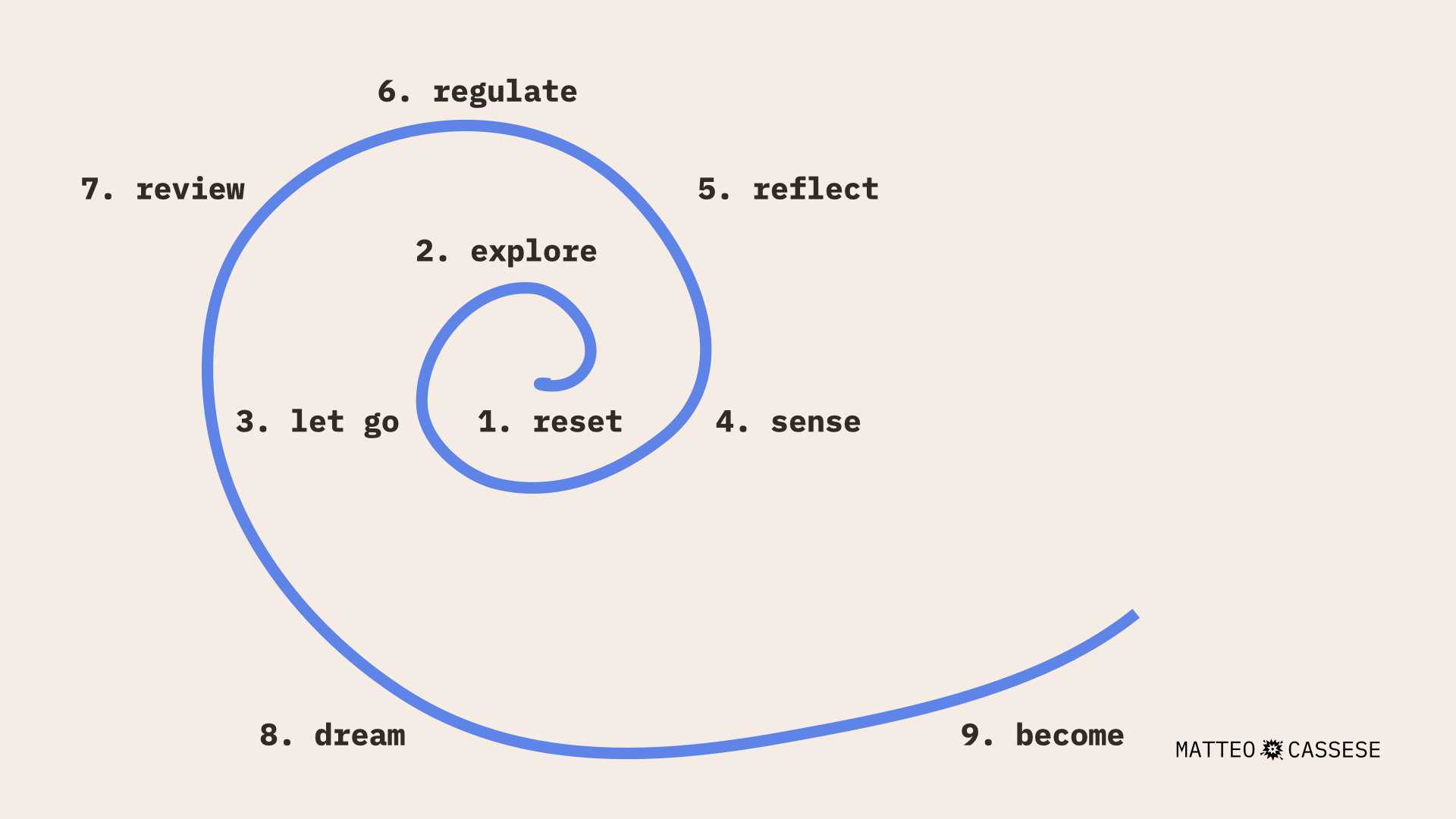
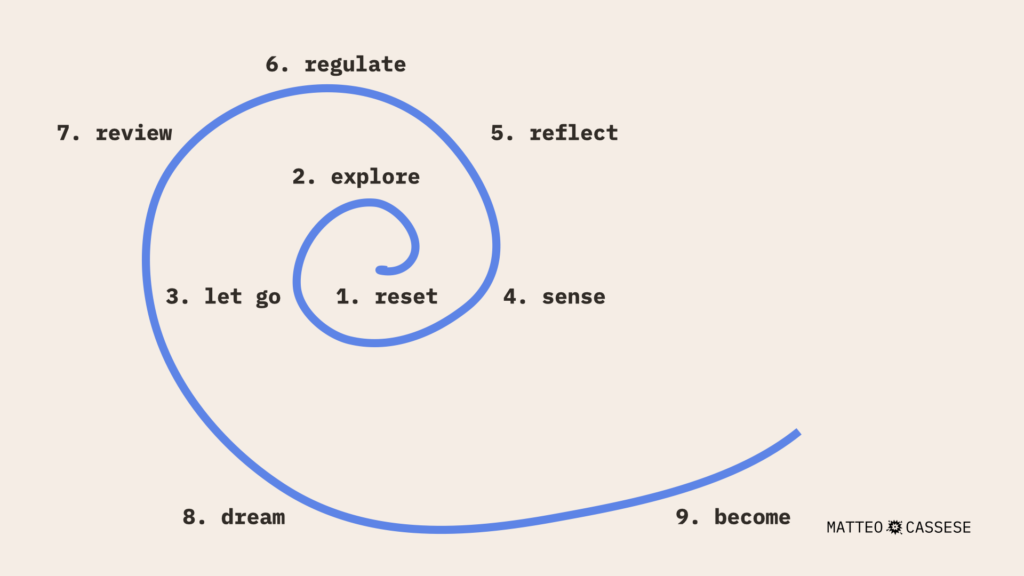
The nine phases: Reset, Explore, Let Go, Sense, Reflect, Regulate, Review, Dream, Become
Nine steps. Reset. Explore. Let Go. Sense. Reflect. Regulate. Review. Dream. Become.
This is my story and it is also nine steps with practical exercises you can go through.
Drawn as a spiral: inward first, away from the market, then back out into the world
The nine are drawn as a spiral, not a ladder. The first steps run inward, away from the market and towards the core. Reset, Explore, Let Go and Sense all happen on the inside part.
Reflect is where you start to come out. By Regulate you are capable of doing stuff in the world again and operating comes back. Review, Dream and Become happen facing outward. So the market disappears for a while by design, and it returns to a different person.
Why every phase carries a tarot card and a movie beat: they are how I actually work
Every phase has a tarot card attached and a step of the hero’s journey attached. It is how I work.
I love the hero’s journey in movies because I used to work in movies. And the tarot is a business tool I use all the time, which for fifteen years I never took out in front of a client. Chapters 17 and 21 are about what it cost to keep that hidden and what changed when I stopped.
“It’s not very linear, this journey”: the card numbers jump around instead of counting up
We start at 10 with the Wheel of Fortune. Then 13. Then 18, then 17, then 4, then 20, then 21.
It is not very linear, this journey, in terms of numbers. And the entrepreneurial version does not start at ground zero either. It never starts at step one.
What you are aiming at: confidence from inside, your own plan your own way, both brains together
Find confidence inside. Build your own plan your own way. Drop any kind of success framework playbook. Keep a strong rational base for your decisions, and take them with inside-out confidence, so the two brains play out together.
These nine phases are also my 1:1 client process. If you want to go through them with me, my offer is business coaching for founders: matteoc.com/entrepreneur-coaching/.
16. Reset: how do you actually stop when there is too much on your plate?
“I’m done. I’m really close to explosion here.”
What the phase asks: stop being busy, close open projects, stop operating, stop reacting
The main thing is to stop being busy. Close any open projects. Close the business. Forget all you know about mindset, about work mindset, about work-life balance. Forget all you know about money. Forget everything about the old business.
Stop operating. Stop running around. Stop reacting.
Every item is a subtraction. That is what makes this the hardest phase for people who are good at their jobs, because none of the competence you have built is any use here.
The sentence that started mine: “we are not gonna renew”
My own reset happened a couple of years ago. I was on a flight after a coaching retreat, and I realised that what I was doing was deeply wrong. I was definitely limiting myself. I was limiting my value. I was not doing as much as I could.
Specifically, I had built a funnel and spent two years on marketing, purely on marketing, rather than two years on craft. And I was proposing products to a customer that I had been a few years earlier, when I was in corporate providing services for corporate. That did not work.
I needed a reset. And that meant telling them we are not gonna renew.
Throwing two years of pixels and campaigns in the bin
It meant taking two years of learning about pixels and Meta campaigns and Google campaigns and throwing them in the bin.
Not archiving them. Not keeping them warm in case. Two years of hard-won operational skill, discarded, because keeping it would have kept the shape it belonged to alive.
The refund I still remember: a bundle of nerves, no money, twelve monthly payments, and the situation diffused
It also meant dealing with refunds. The most painful one I remember was a person I had over-delivered with. They had bought a group program and I ended up giving them one-on-one.
At the final meeting they came in like a bundle of nerves. I could tell. And they did not even ask for the refund. They were just in an awful state. I felt that they needed a refund.
I did not have any money, so I promised to refund them during the following twelve months, and that diffused the situation completely. It also created pain for me, and it ran for a year.
The cost I will not skip: “I had to disappoint all of these people I was working with”
I had to disappoint all of these people I was working with. Not abstractly. Individually, in conversations, each of whom had said yes to me at some point. There is no version of this phase where you do it cleanly and nobody is let down.
But I needed this reset. I needed to close with something and open something else.
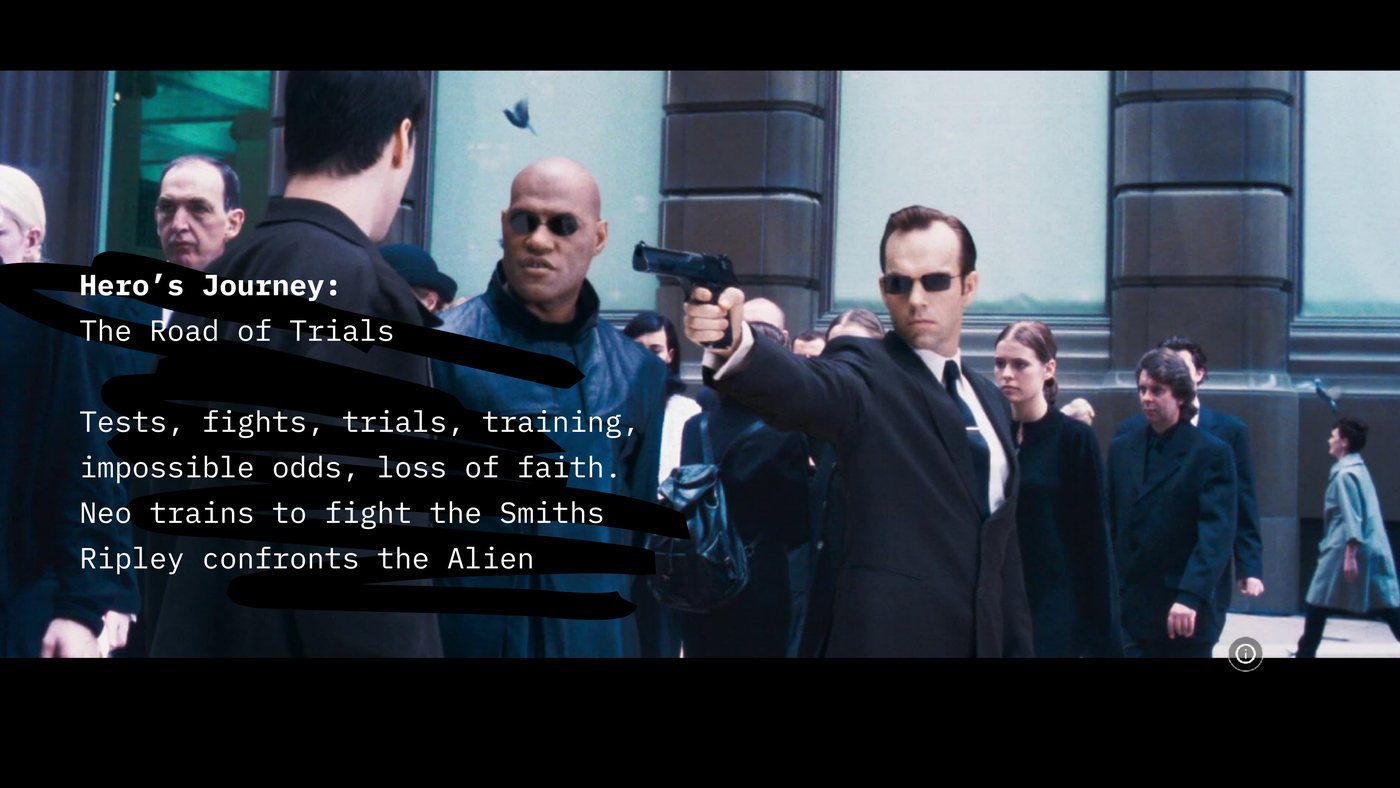
The Wheel of Fortune, card 10: beginning, end, or continuation of the cycle
We start at number 10, the Wheel of Fortune, and this is a card that can mean beginning, end, or continuation of the cycle. It is up to you to work out which one is going on.
There is a lot going on visually in it. Stare at it for a second and you will find it really hard to understand what is happening: who is pushing, who is pulling, who is collaborating, who is not collaborating.
It is a moment of complication. It is a moment of pain, this reset.
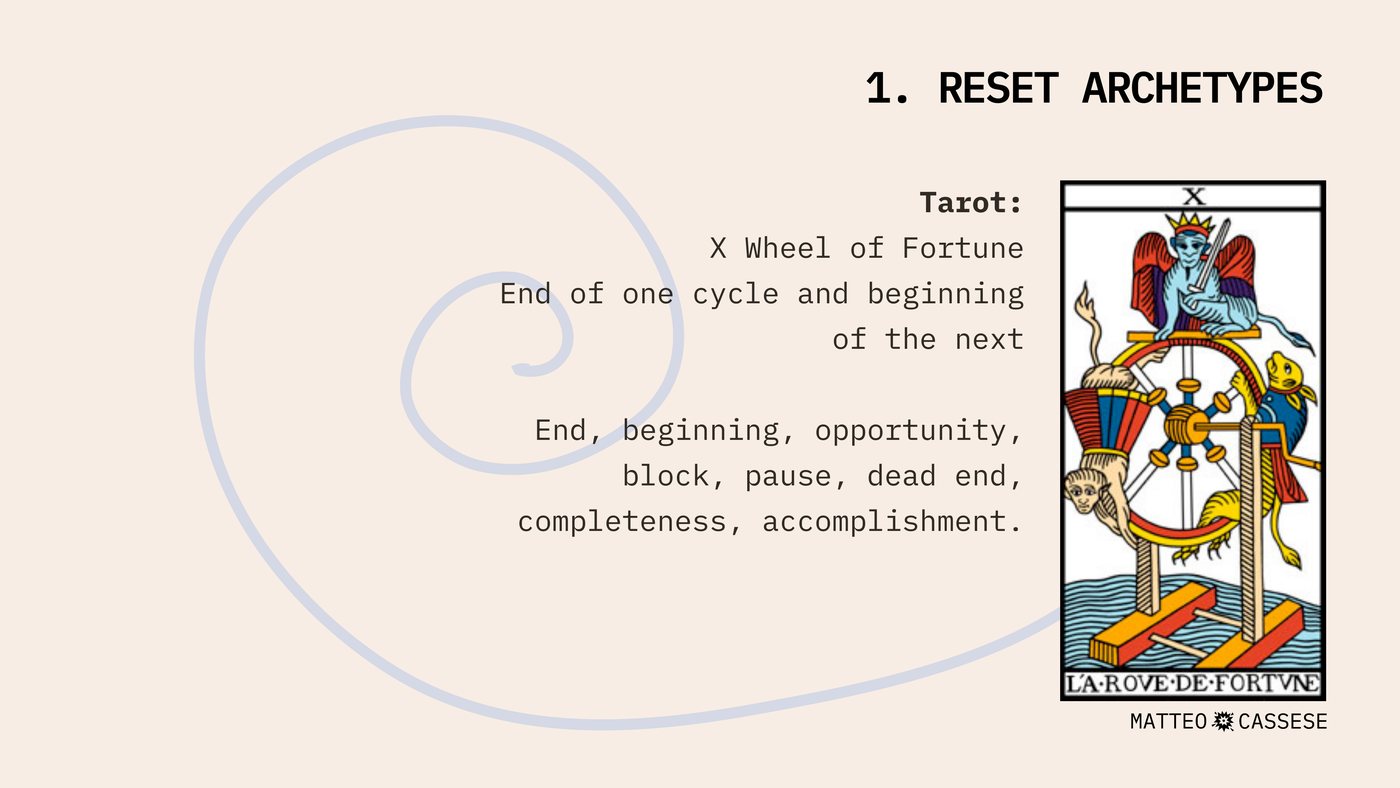
Your story starts at the road of trials, not the call to adventure: Neo training, Bruce Wayne, Luke in the helmet
What I love about the entrepreneurial version is that it does not start with the call to adventure. It starts with the road of trials, the moment where the hero is presented with all sorts of really hard challenges, almost impossible to deal with.
Neo training with Morpheus in the simulation of the Matrix, getting ready to enter the real one. The training in Batman Begins, where we do not realise that Bruce Wayne is training with his own nemesis, which is part of what makes that film worth rewatching. And the scene in the original Star Wars where Luke has to wear a helmet he cannot see out of and chase a ball with a lightsaber using the Force, learning something completely new that requires a complete reset.
None of those characters gets a fanfare and a quest. They get put in a room and made to fail at something for a while. That is where your story starts too.
How long it takes: “a day, a week, a month, or a year. I don’t know. For me, it was quite a few months”
Okay, but we are not in Star Wars. How long does the stopping last?
This could be, for some of you, a day, a week, a month, or a year. I do not know. For me, it was quite a few months.
17. Explore: what do you do with the space once you have stopped?
Buying time with savings: “something that civilians are not supposed to do”
When I started my own exploration I realised I needed time, and that I needed to buy it. So I did something that civilians are not supposed to do. I started using my savings to cover the day-to-day.
That is painful too, and it added to the pain of firing the clients and having to fund my own journey on my own. Savings are a condition, not a technique.
Making space concretely: stop the hamster wheel, stop reacting, start being intentional
Making space is such a vague thing. How do I make space?
It is really connected with stopping the hamster wheel, stopping reacting, and starting to be intentional. Then explore: where do your thoughts go? What attracts your attention? Where do you want to go?
They only produce anything once the reacting has stopped, which is why the order of the phases is not negotiable.
The instruction that sounds backwards: take twice or three or four times as long doing the same thing
Surrender. Slow down. The best way to make space is actually not to make space at all.
It is to take twice, or three times, or four times as long doing the same thing, being extremely intentional about it. You are not clearing the calendar. You are changing the speed at which you move through it, which is available today and does not require anybody’s permission.
Letters arrive, people ask. “Don’t respond”
You get letters. People send you stuff. People ask you stuff. Don’t respond.
It is easy to make space.
The turn that changed the phase: from “how do I stop the chaos?” to “how do I embrace the chaos?”
If I think about my own time in this, I was feeling the chaos all around me. Instinctively I was saying, oh my God, there is this chaos here, I want to get away from the chaos, because the clients are resigning, I am still serving some of them, there are these refunds. How do I stop the chaos?
And then it came to me. How do I embrace the chaos? What can I do to embrace the chaos?
In a regular life you would say, I want less chaos, can I get settled please. In the entrepreneurial version we lean into it.
The warning: chaos increases the moment the bills stop getting paid, so I am not telling you to stop paying them
Obviously there are consequences. Chaos increases the moment I stop paying my bills, because then I go into collection, and collection is interest, and so on and so forth.
So I am not suggesting you are necessarily going to stop paying your bills. Not responding to letters is a practice. Not paying what you owe is a different thing that produces exactly the kind of chaos this phase is not about.
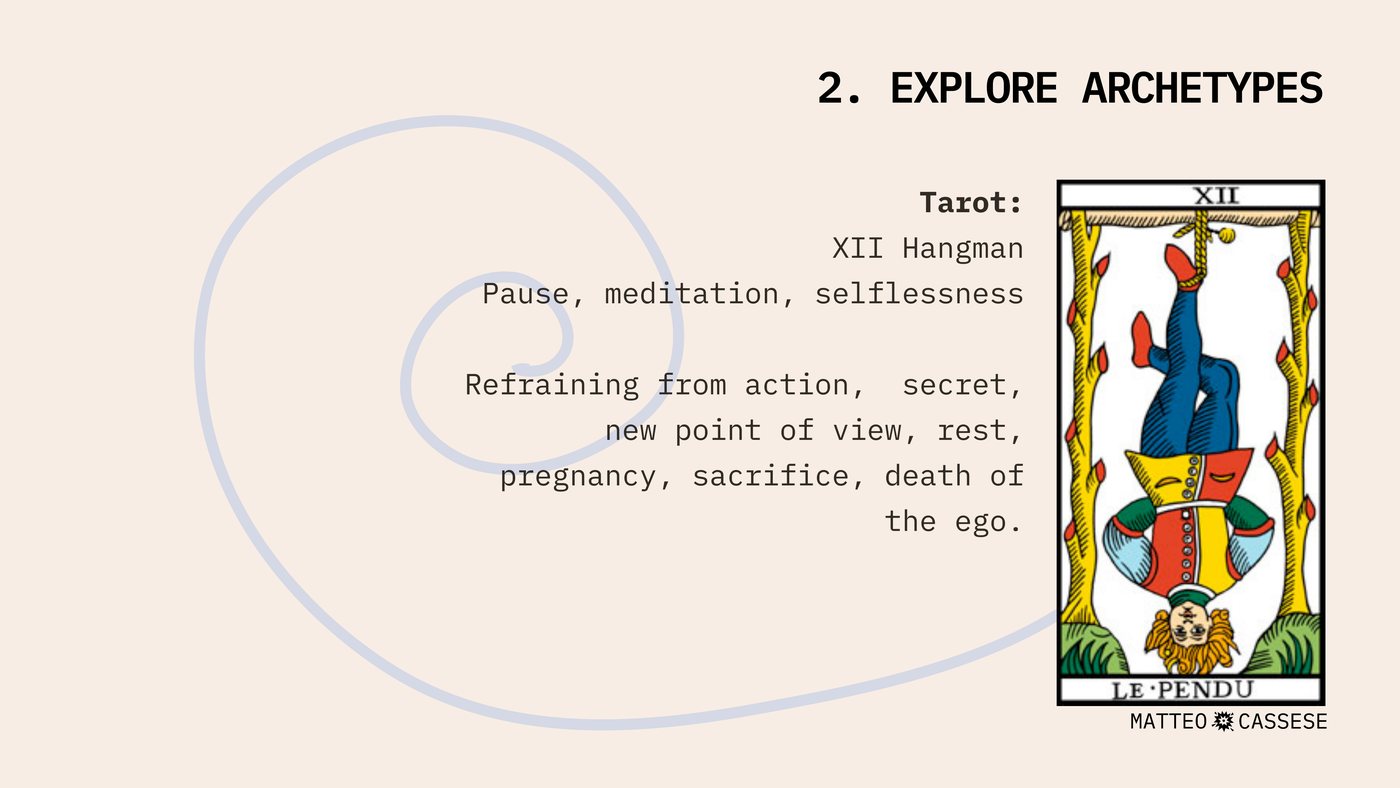
The Hanged Man: stop reacting, retreat inside, start to receive
This card is the Hanged Man, and in it there is a deep reflection and a meditation. We stop reacting, we retreat on the inside, and we start to receive. Two, in tarot numerology, is all about receiving, getting, not striving.
Have a look at the card. Pause here if you want. Stare into the eyes of the hanged man and see what it tells you.
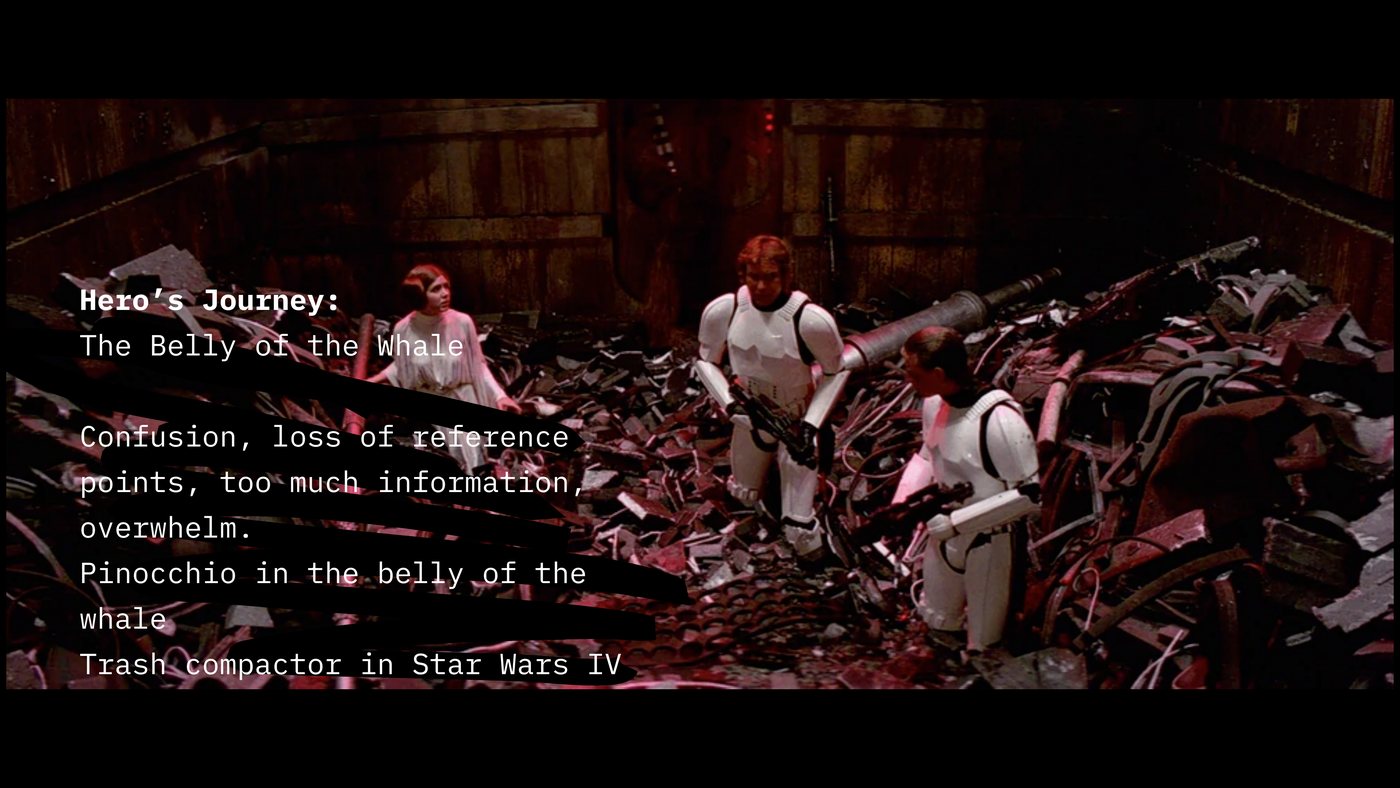
The belly of the whale: Pinocchio, Star Wars, down is up and up is down, by design
In story terms this is one of the classic tropes. You can find it in Pinocchio and you can find it in Star Wars. Joseph Campbell calls it the belly of the whale.
The idea is that there is too much chaos and too much information. Down is up, up is down. In the movies it is a physical journey through space. In reality it is a journey inside the mind, and we do not know which way is up, because inside the belly of the whale there is no right side and we are in utter confusion.
The belly of the whale is also the space where we discover the new things we have to do.
The open questions: what happens if I stop reacting, meditate, invite chaos, drop the notifications?
What happens if I stop reacting? What happens if I meditate? What happens if I invite chaos? What happens if I refrain from the notifications? What if I am less distracted? What if I become more focused? What if I go more into that meditative space?
18. Let Go: what do you have to give up before anything moves?
“I do feel in the process of renewal, so I have to let things die.”
This is one of my favourite steps and it was really intense. I had to let go of a ton of stuff.
The beliefs that went first: I am not enough, I need frameworks and playbooks, I do not know my job
I had the belief that I was not enough. That I did not know enough. That I needed to learn more. That I needed frameworks and playbooks to tell me how to be good at my job.
And I did not quite know what my job was.
Go back to the founder burnout page and you will find the same sentence underneath the funnel: I am not enough, I do not even know what I am doing. It was there in 2022 and I bought a system instead of touching it.
The movement reversed: stop shrinking your value to fit the market. Grow it, then bring it to market whole
I was constantly taking my value, reducing it, and bringing it to market. Rather than taking my value, increasing it, and bringing it to market.
Completely different movement, and the difference is not attitude. It is direction. One of them arrives at talk like a boss. The other arrives at something nobody else could have said.
Letting go of needing help, needing mentors, needing playbooks. I disconnected from most of my mentors
In this moment, for one reason or another, I disconnected from most of my mentors. I really was in an alone state where all I could do was shed things, let them go, let them be.
You let go of your conviction that you need help. You let go of your conviction that you need mentors, that you need playbooks, that you do not know things. You just let go of everything. It is an extremely powerful process if you do it in a deep way.
Support comes back later, chosen rather than needed, which is chapter 22.
“I’m an idea person. I’m not great at money. I’m not good at sales”: simply not true, just fixed mindset
You also let go of who you are. I am an idea person. I am not great at money. I am not a great salesperson, I am not good at sales.
All of these things float inside our minds and they are not true. They are simply not true. It is just a fixed mindset, and it is not understanding that the obstacle is the way.
Every one of those sentences sounds like self-knowledge. They are delivered in the voice of someone being realistic about themselves.
The fix for one of them: throw yourself into a lot of sales conversations. That’s all
I do not feel that I am good at sales. Well, I have got to throw myself into a lot of sales conversations. That is all I need to do.
The remedy is embarrassingly small next to the size of the belief.
The coping mechanisms of the child become the operating system of the founder
Release your coping mechanisms as well. Our coping mechanisms as children develop into our work operating system.
Whatever you worked out as a child to get through what you were in is still running, and it is now called your work style, and people compliment you on it. That deserves a video of its own, which I will make separately.
Creative destruction, on repeat: “destroy and create, destroy and create”
This is one of the most important things an entrepreneur needs to do: creatively destroy.
Destroy and create. Destroy and create. Destroy and create. Understand, unpack, and then destroy and create.
It is a repeating operation rather than a one-off clearing, and something we can do inside ourselves every once in a while.
Card 13, the nameless one: not death, just clearing the way
Letting go is connected with the nameless card number 13, which is also my zodiac sign in tarot terms.
Thirteen is the bad luck number in a lot of the Western world, and the iconography on it is the one we associate with death, so it must be terrible, it must bring bad omens. The way I love to define it is creative destruction.
Spend a little time looking at the card. The creature on it, and we do not know whether it is a he or a she, is not caring about kings and queens and limbs and all of that. It is just making space. It is just clearing the way.
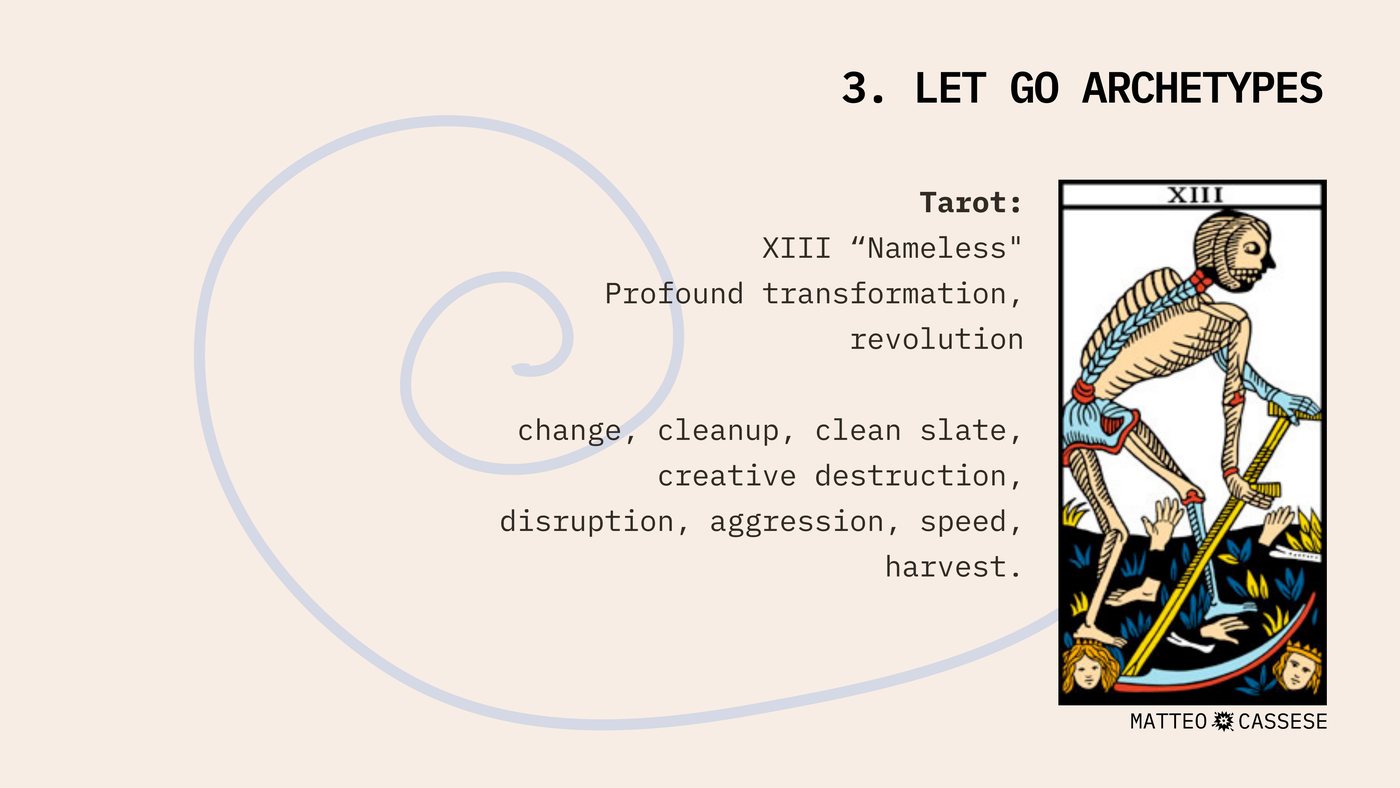
Apotheosis and the fade to black: the chemical burn in Fight Club, a before and an after
The step of the hero’s journey here has a complicated name. Apotheosis means rising to the level of the gods, and it is the moment the hero understands that he or she has become a new person, because they have gone through death and resurrected.
One of my favourite examples of exactly this scene is the chemical burn in Fight Club, with the soap. It embodies the sense that there is a before and there is an after. The hero lets go of their finiteness and becomes infinite.
You can see this moment in every movie, because at some point the screen fades to black, and that is usually the transition from the second act to the third.
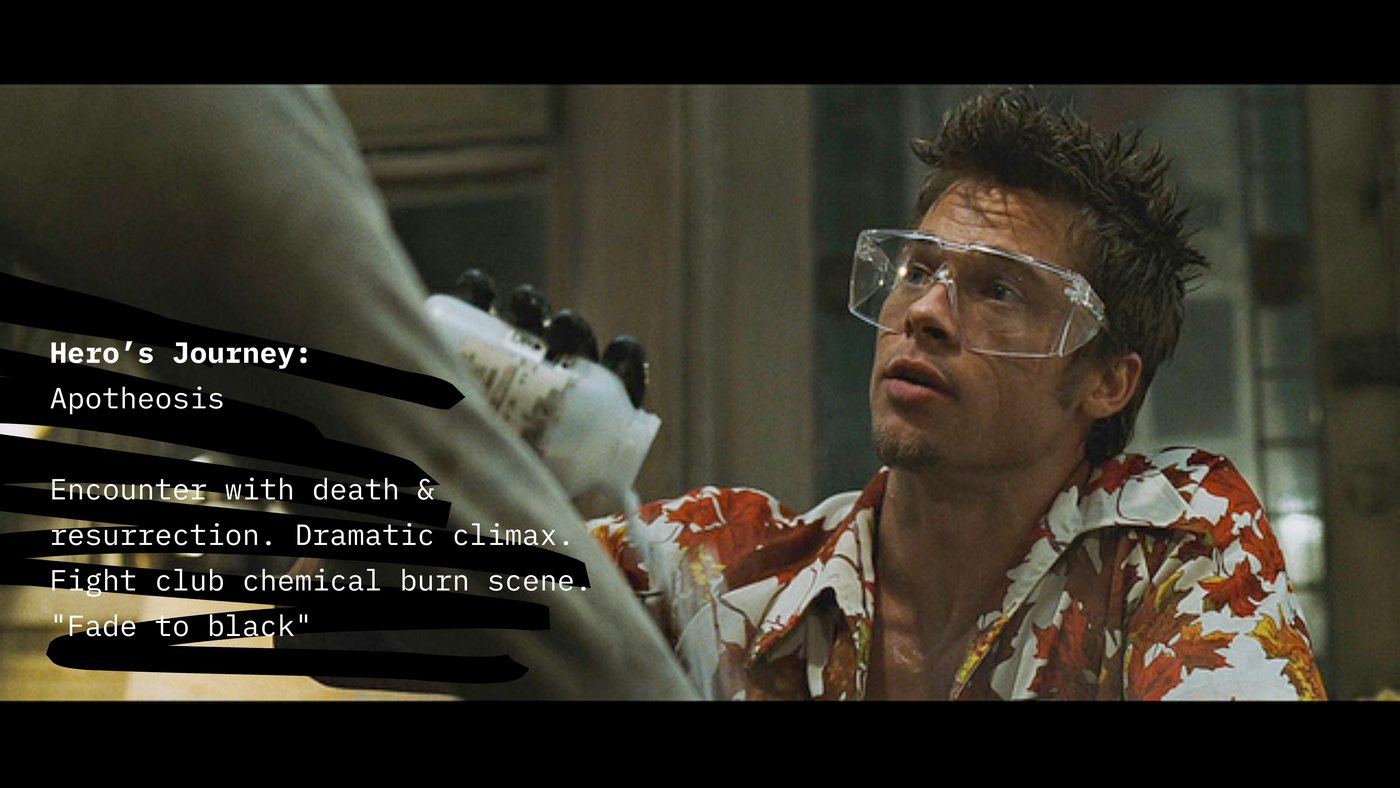
What goes on the list: release judgement, old beliefs, therapy, your art. Ask “who am I?” like it is the first time
Rising to the level of the gods is quite complicated, so let us make it very practical.
Make more space and make it a blank slate. Let go. Release judgement. You invited chaos in Explore, so deal with the chaos. Release your beliefs. Adopt new habits, new practices. Go to therapy. Go and do art. Do your art, whatever it is. Do physical stuff. Do mental stuff. Release old beliefs. Start new things. Release your coping mechanisms. Accept that something new is emerging, and do the creative destruction.
And ask yourself, who am I, like it is the first time.
19. Sense: what does business intuition look like in practice?
The question the phase runs on: is there a bigger, scarier version of what I am doing?
Ask yourself: is there something bigger? Is there a bigger version, a bigger, scarier version of what I am doing right now?
A bigger version that does not frighten you is usually just more of the same thing with better margins. The one that has some fear attached is the one that requires you to be different, not busier.
The flight from San Diego and the domain I registered in the air
I was on a plane from San Diego and I registered a domain, Imagination Action, because I thought there has to be something bigger.
At the time I was focused on storytelling. Business storytelling, storytelling for corporate. And I was constantly thinking there must be something bigger, there must be something more substantial.
Registering a domain mid-flight is not a strategy. It is what acting on a hunch looks like before the hunch has a name.
“It’s not storytelling, it’s myth-making”: feeling it before I could name it
Then I started figuring it out. Okay, it is not storytelling, it is myth-making. It is something that is above.
The sense arrived first, on a plane, attached to nothing. The word arrived later. If I had waited for the word before acting I would still be selling business storytelling to corporate.
The crucial decision: “now I have to bring my whole self to the work”
This is the crucial moment, where I said to myself: okay, now I have to bring my whole self to the work.
That is the switch away from being a good rational robot at work.
Fifteen years of never taking a tarot card out in front of a client
Here is what whole self meant in my case, concretely. I had been running my own company for fifteen years, freelancing, consulting, training, with startup projects along the way. In all that time I never allowed myself to take out a tarot card in front of a client. Let alone make a video with tarot cards, or be public about the fact that they are a business tool and I use them all the time.
Fifteen years of using something daily and hiding it from everybody who paid me. Whatever your version of that is, it is probably not tarot, and it is probably costing you the same thing.
A successful entrepreneur, defined: someone who bridged the gap between intuition and experience
I think the definition of a successful entrepreneur is having bridged that gap between the intuition and the experience.
Between the logic of system 2, which says we have to have a plan, we are working towards objectives, and the other side, where I feel confident about the plan and I can communicate confidently about it thanks to my connection with intuition.
Not the one who has the best plan. The one whose plan and whose gut are pointing the same way, which is why they can talk about it without flinching.
The plan becomes apparent because of who you are, not because everyone suggests it
What you are aiming for at this point is that you start to discover who you are, and the plan becomes apparent because of who you are. Not because it is a good plan. Not because it is the plan everyone suggests. Because it is your own plan.
Which is the opposite direction from chapter one. There, a good plan was imposed on a person. Here, a person produces a plan.
The Moon, card 18: the light that only works in the dark, the crab receiving from the source
This is a beautiful card. Number 18, the Moon. It is wild, it is powerful. The energy of the moon, night, mystery, the cycle that repeats every 28 days, this light that happens in the dark.
And what does it illuminate? It illuminates our subconscious. Within the subconscious, represented as always by water, there is a crab with an open claw, ready to receive new information from the moon, directly from the source of intuition. It is a representation of the cosmic mother archetype, and of Mother Earth.
A light that only works in the dark is the exact opposite of how founders are taught to find things out. It is dreaming, receiving, and it is beautiful.
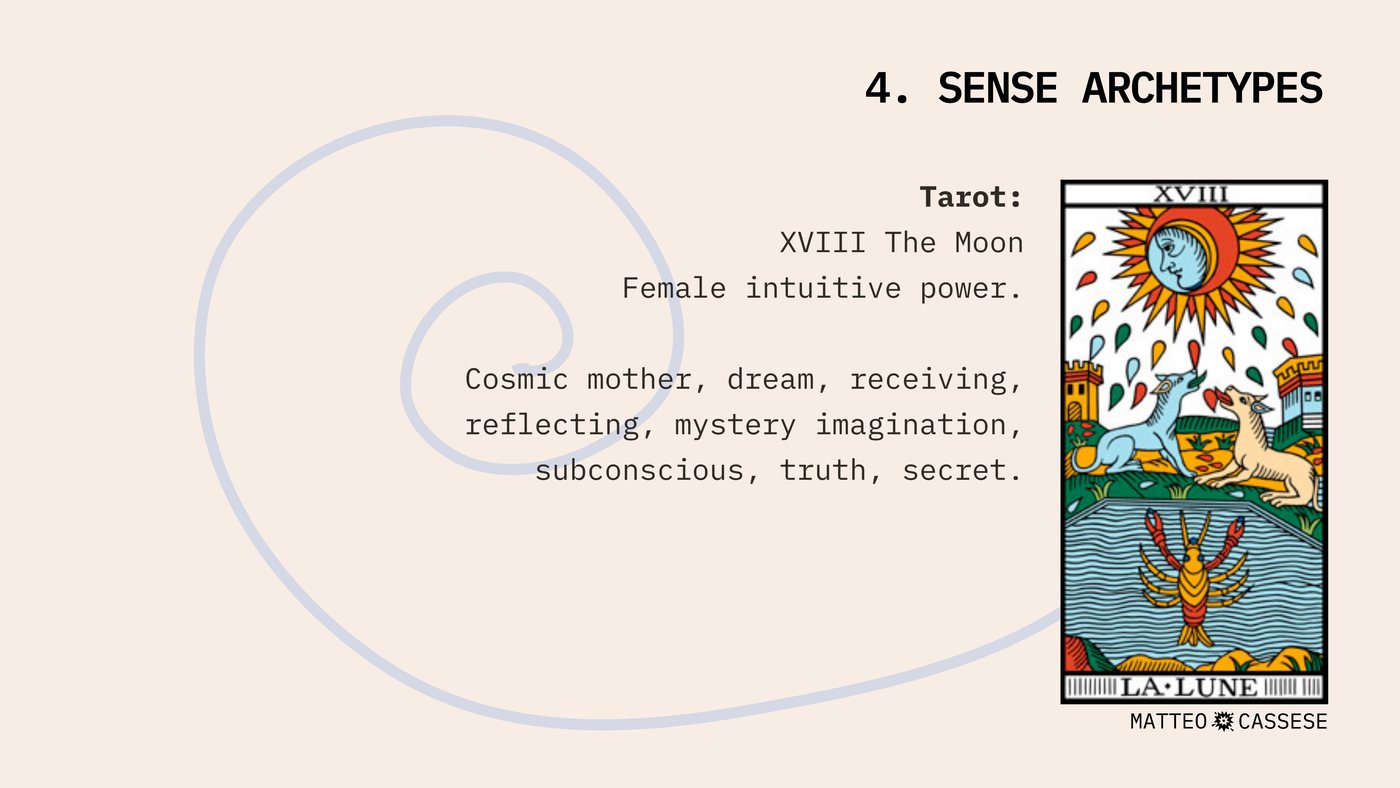
Meeting with the goddess: Wall-E seeing EVE, Neo meeting the Oracle
In the hero’s journey this is represented extremely literally, with the step called the meeting with the goddess. A mother, a feminine energy that illuminates us with pure knowledge, intuition, wisdom.
The scene in Wall-E when Wall-E meets EVE. Neo meeting the Oracle. And many other examples in movies.
Wall-E is in awe of EVE. He has never seen anything that beautiful, powerful, harmonious, wise. That is the posture of this phase: listening to yourself, listening to your intuition, putting yourself first, receiving, like the crab receiving from the moon.
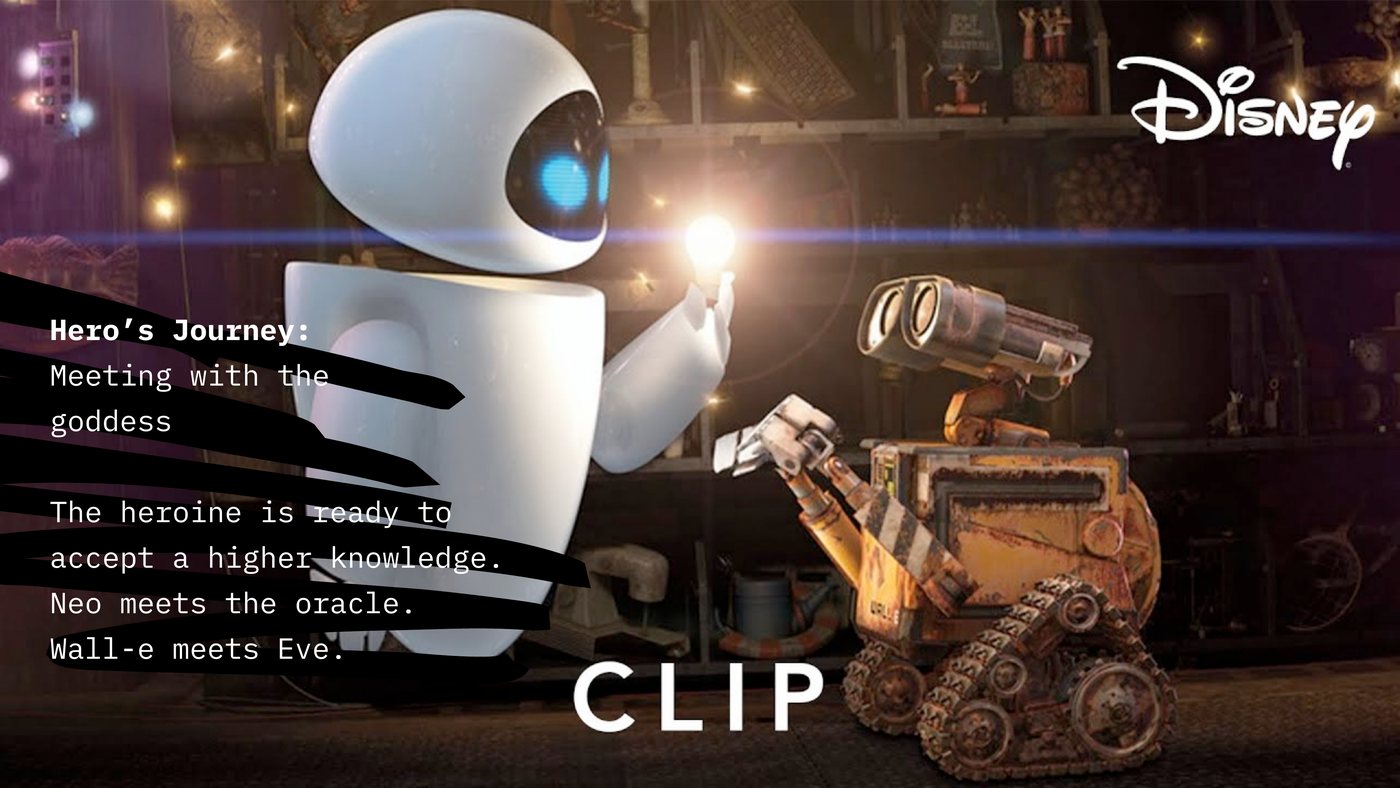
The practical list: journal, record your dreams, go on a retreat, meditate, open the taps of your intuition
This is the culmination of the making space and the letting go, .
It is a good time to journal. To record your dreams. It is a good time to go on a retreat. It is a great time to be intentional about your environment, to meditate, to reflect, to open the taps of your own intuition.
20. Reflect: who are you without the business?
This is where the spiral turns. Everything up to here has been inward. From this phase you start coming out.
What I asked my therapist for: “tell me if I’m bullshitting myself and if I am missing any crucial thing”
Years of therapy altogether, and maybe that is not even enough. I do have the desire to do more.
I went back to my therapist a year and a half ago and asked for a few additional sessions. And I told him: I am not here for your advice or for anything. I would like to tell you my story with today’s knowledge, and I want you to tell me if I am bullshitting myself and if I am missing any crucial thing that I am telling you and not reflecting about.
What came out: a talk. I expected fifteen friends, sixty or seventy people came · youtube.com/watch?v=BQMJAP7Kc28
Out of those sessions came a talk. I sent out an invite in Berlin thinking I would get ten or fifteen people, ten or fifteen friends signing up. I did it at a big innovators community, and shortly after I had sixty or seventy people in a room.
The whole talk is on YouTube at the link in the heading above, .
Hiring a videographer on my own dime while making no money: positioning, not expense
It was also the first time I invested in a videographer to come and shoot one of my talks, on my own dime.
This was a moment when I was not making money at all, because I was still in my reset phase. So it was an investment in my own positioning.
This is the first thing in the whole sequence I actively spent money on, at the point where I had the least of it, and it was spent on evidence of who I now was rather than on getting clients.
The question the talk is built on: “Is it a blessing or a curse?” Watch it before this phase
The whole point of the talk is that question. Is it a blessing or a curse?
I am not going to spoil it here. For me it was a powerful way of liberating a part of my history, and I would rather you watched it than read my summary of it.
Rewriting your own story with the knowledge you have now
What the talk did for me was literally rewriting, reflecting, rewriting my own story with the knowledge that I have right now.
The events do not change. What changes is which ones turn out to be connected, and you can only see the connections from further along.
The habit I gave up: judging life events as positive or negative
I was dealing with all of these life events, and a lot of them I was keen on judging as a positive or a negative.
Slowly I realised that it is not my job to judge them in any specific way.
Give that up and a strange thing happens to your history. Chapter eight is the example. A childhood spent in a space where other people were not reads as a deficit while you are scoring it, and as the raw material of your entire practice once you stop.
The Star, card 17: if this was a marketing deck, this would be positioning
Another wonderful, powerful card. Number 17, the Star.
If this was a marketing deck, this would be about positioning. The stars are one of those diagram maps where you have an X and a Y axis, and you know where your star is. Its action in the world is taking your place. It is finding the connections between the dots of your story.
Spend a little time looking at these cards, to see whether they communicate something at a more subtle level, at a more intuitive level.
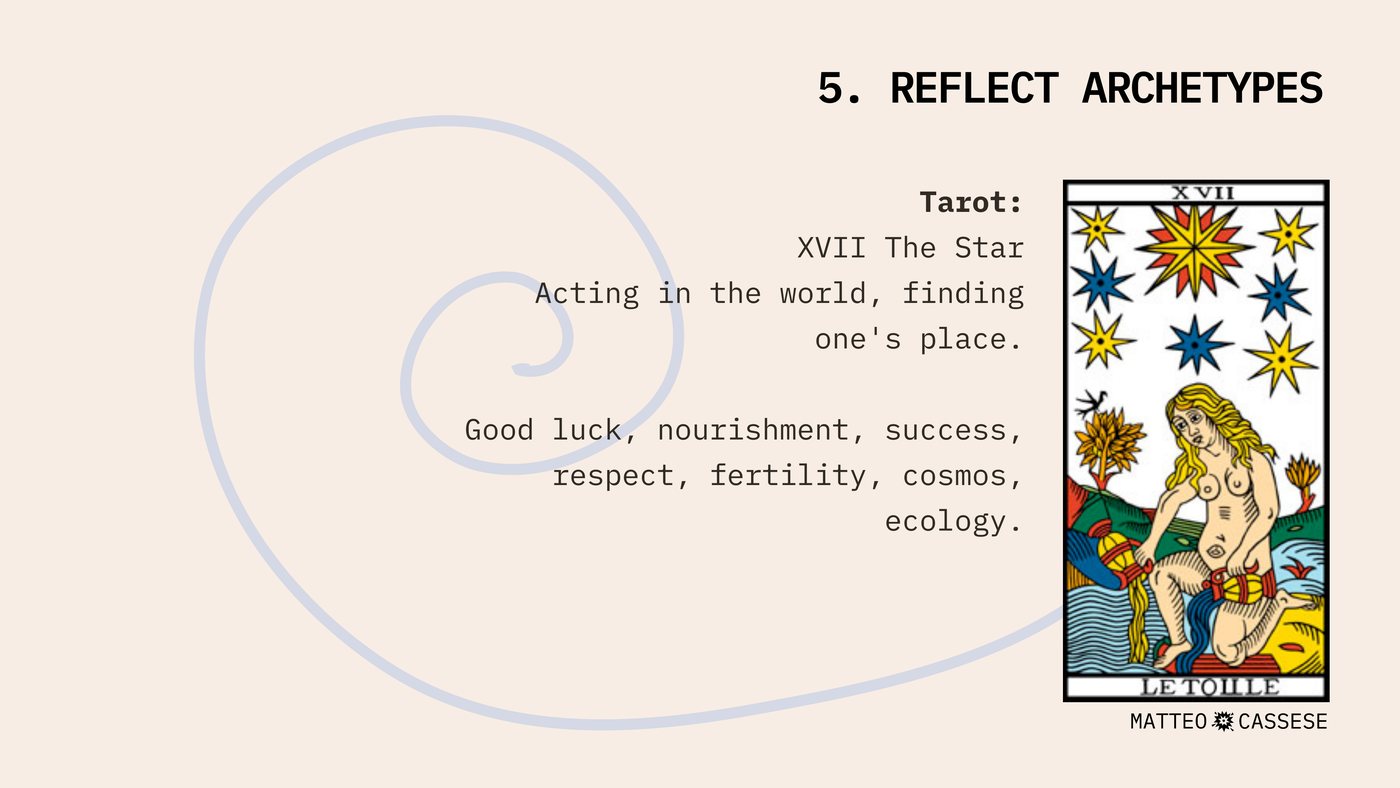
Neo starts dodging the bullets: the transformation has landed
In the story, this is the moment where the hero figures out that they are transformed. The transformation has happened.
It is the moment Neo starts dodging the bullets, just like the agents do, and it is extremely powerful.
He is not stronger than he was an hour earlier in the film. He has stopped operating under the old assumptions about what is possible, and the change shows up as a physical fact.
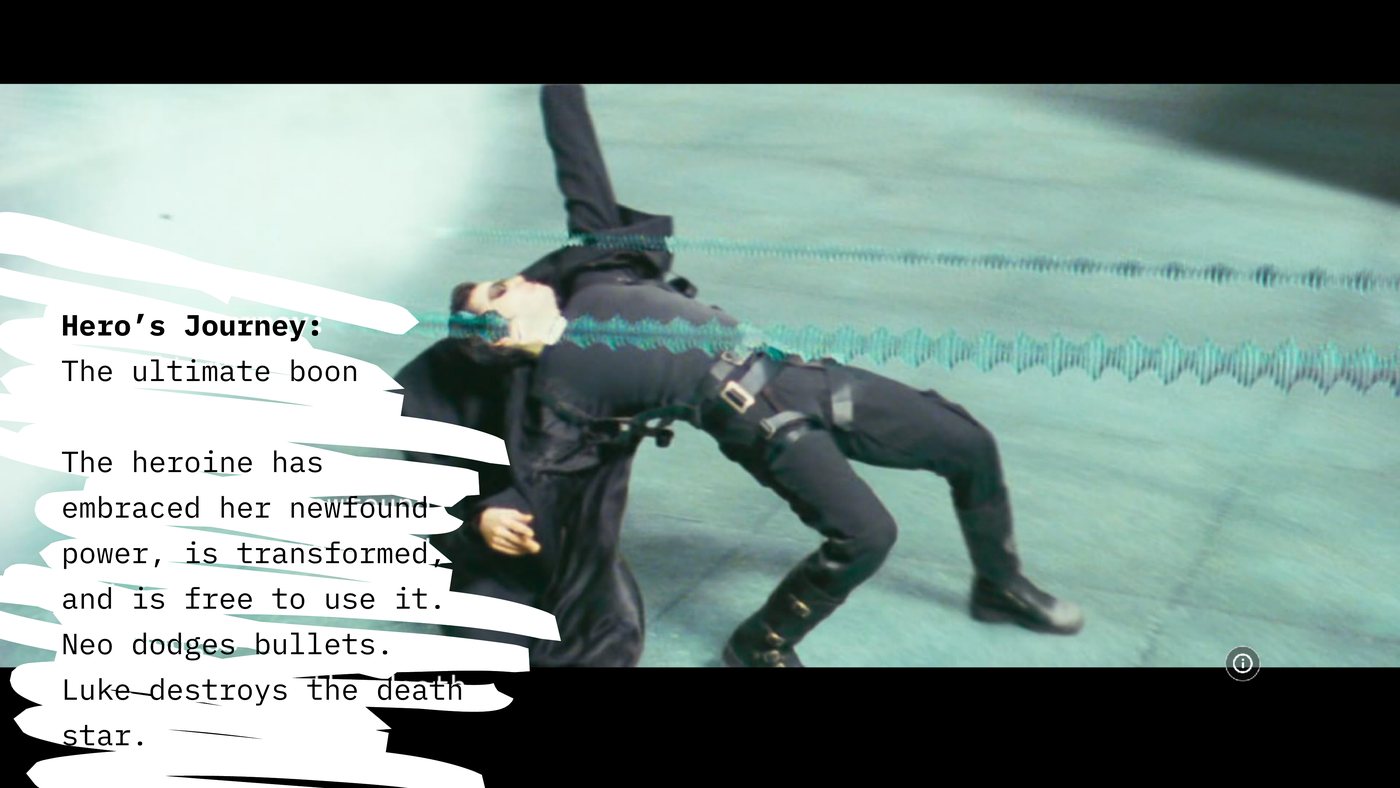
How you dodge them in practice: therapy, your story told out loud, people pardoned, a battle nickname, out in the world
Therapy. Healing. Making peace with the past. Telling your story, performing whatever performing you do. Working on your positioning. Closing open tabs. Pardoning people you might be in conflict with.
Adopt a battle nickname. Baptise yourself with a new name. Perform.
This is a great moment to get out in the world for the first time after the journey inside, where you have been reflecting, exploring, letting go, resetting and sensing new things. Now you can get out.
21. Regulate: how do you get notifications, social media and your own addictions back under control?
It might sound a little bit boring after the last two chapters. We also have to be disciplined, because entrepreneurship is not easy.
The sentence the phase rests on: “I’m as effective as an entrepreneur as I am in control of myself”
As much control of myself as I have, that is how effective I am. The ceiling moves with the self-control, in both directions.
The odd prerequisite: permission to be in control of myself, which nobody hands over
In order to be in control of myself, I need to get permission to be in control of myself.
Fifteen years in corporate were fifteen years of asking a system for permission, as chapter 14 describes. The habit does not stop at the door when you go independent. You keep waiting for something external to authorise you, including for the decision to run your own attention.
Nobody hands that over. This is where the archetype of the phase comes in.
What goes in check: notifications, social media, addictions, anything that excites you
How I personally regulated: keep everything that excites me in check. Notifications, keep them in check. Social media, keep it in check. Addictions, keep them in check.
The category is not vice. It is excitement, which is a much wider net and includes things nobody would put on a bad habits list.
Why now: protect the ability to sense that you just developed
Get rid of anything that can harm the ability you have developed at this point to sense, to intuit.
Do it first and it is one more externally imposed regime, and it will not survive contact with a bad week. Do it here and it is protection for something you have just spent months developing and can feel yourself losing when the notifications come back on.
The blunt version: leave your phone in a cupboard for a few days. Go away
Eliminate distractions. Get everything under control. Eliminate all addictions, all notifications.
Leave your phone in a cupboard for a few days. Go on a retreat. Go away.
The body half: become an athlete, regulate your diet, do that cut or that bulk
Become an athlete. Regulate your diet. Do that cut or that bulk you always wanted to do.
Self-control is not only a matter of what you look at.
The Emperor, card 4: stability, the square, a father figure joining the mothers
Up to now the archetypes guiding us have been mother figures, and they continue to guide us through the rest of the sequence. Here a father figure joins them, represented by the Emperor, another one of my favourite cards.
The Emperor is a representation of stability. The number four is usually drawn as a square, and the square is the most stable of the figures we can make. The card is about power, responsibility, rationality, solidity, father, money, success, peace.
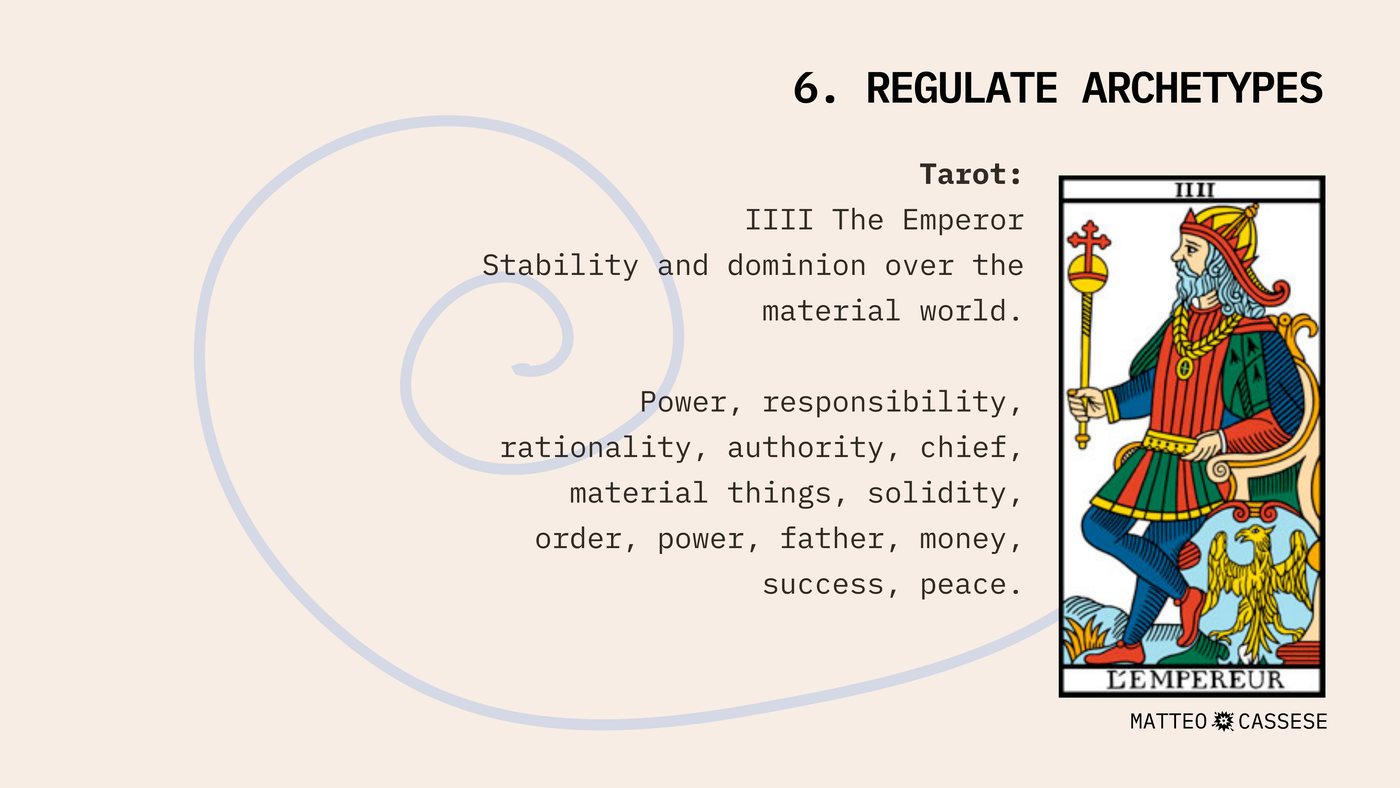
Atonement with the father: Michael Corleone taking the family, Vader and Luke
In the hero’s journey this is the encounter with the father, and also the atonement with the father. The moment where we take the baton from the previous generation and accept our own power.
There is a beautiful scene in The Godfather where Michael, the Pacino character, accepts the responsibility to run the family from a very ill Don Corleone. Reluctantly at the beginning, and then he accepts it.
And the same thing, obviously, with Darth Vader and Luke, which is possibly the most famous father scene in the movies.
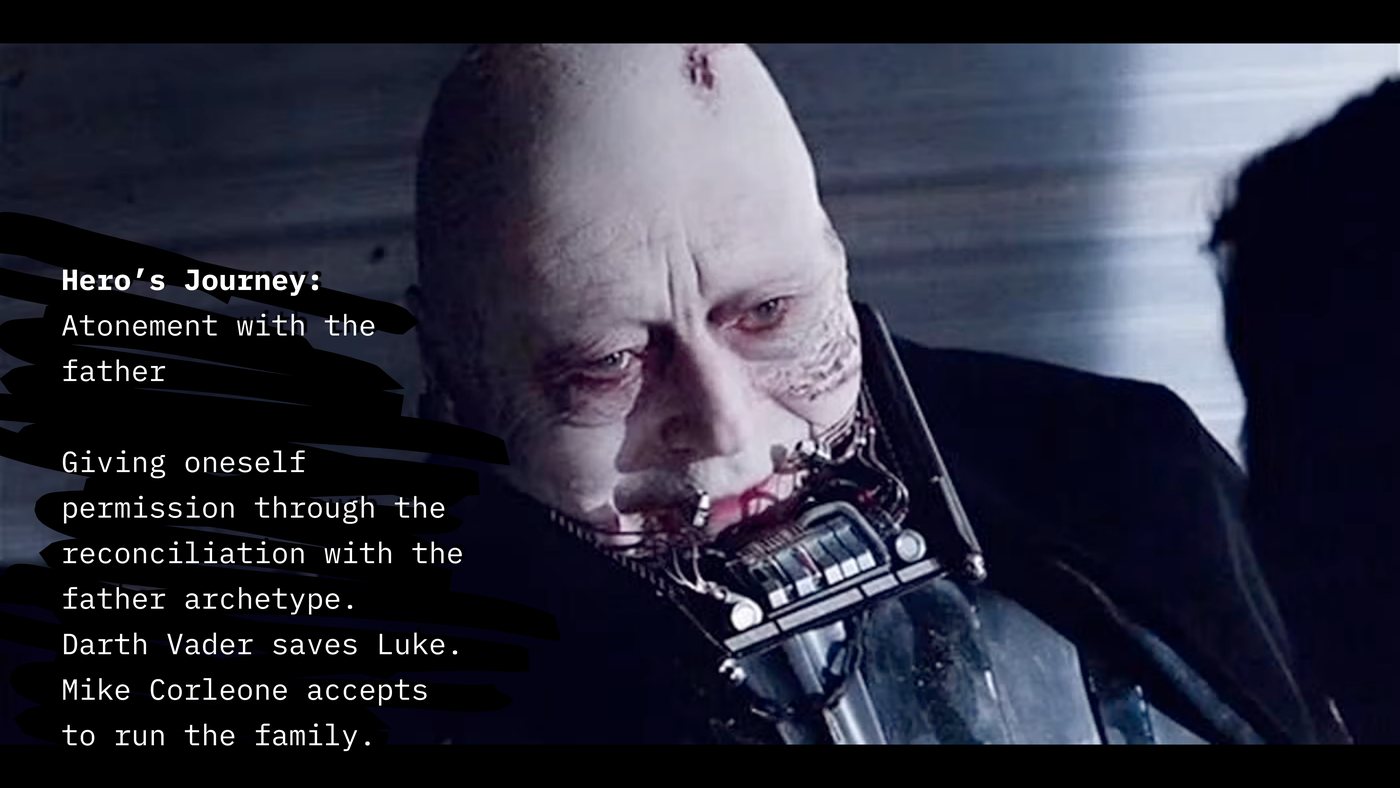
My version: “I’m gonna use my tarot cards. I’m gonna bring my whole self. I’m not gonna ask for permission anymore”
This is the moment where I said: okay, I am going to use my tarot cards. I am going to bring my whole self. I am not going to ask for permission anymore. I am not going to say, this is work because it is logic and rational, and this is my life because it is intuitive and whimsical.
Chapter 19 is where I decided to bring the whole self to the work. This is where I stopped asking anybody whether that was allowed. Those are two different events and the second one took longer.
Operating comes back: “start operating as well, because now you are capable of doing stuff in the world”
Start operating as well, because now you are capable of doing stuff in the world.
We are getting out of the spiral. We were right at the core at the beginning and now we can start to get out, inside out. The operating that gets banned in Reset is not banned forever. It comes back here, with somebody different doing it.
Frameworks come back too, from the inside out: build-measure-learn works, wholesale playbooks still do not
Do not forget that there are frameworks. Build, measure, learn works if you do it from the inside out. Small experiments work if you do it from the inside out.
Trusting a playbook wholesale, don’t do that. Borrowing some little bits and pieces here and there that match your experience and match your intuition, that is a good idea.
Nothing in this course is against method. It is against method arriving whole from outside and being installed on top of you, which is chapter one, at full price.
22. Review: what goes into your new plan once you know who you are?
Saying it out loud before you believe it: “I wanna speak on stage, and I wanna get paid for it”
In the review process I found myself in this very room, at that very whiteboard, saying a few things to some fellow coaches. And I am not so sure I was convinced I would be successful at them at the time.
I said: I want to speak on stage, and I want to get paid for it, and I want to do more YouTube videos. I just want to do them, and I do not want to be limited in doing them. I do not want to be bogged down by the fact that these videos go well or badly. I know that I am good at it. I am just going to do it.
Said out loud, to witnesses, while unconvinced. That is chapter 10 again, in a room with a whiteboard instead of a microphone. The decision comes first.
Making things for very few people on purpose: not for views, not for reach
And why am I doing it? I am doing it because I want to do it. I am not doing it for views. I am not doing them for reach. I am doing it for a few people.
These videos are not for a lot of people, and that is really, really great.
Which is a strange thing to say on a platform built on reach, and it is the same decision Sophie made in chapter eleven when she chose retreats for a select group over a fundable, scalable product.
The line that ties the course together: “confidence comes from knowing who you are, and knowing who you are tells you what you’re going to do”
Confidence comes from within. Confidence comes from knowing who you are, and knowing who you are tells you what you are going to do.
Self-knowledge is not a wellness outcome here. It is the input to the plan. This is the phase where your assumptions start coming together and start influencing what you do.
Betting on what you already love: “why don’t I bet on me?”
For me it was: listen to your intuition and do what you love. You love coaching, you love talking. Why do you not start loving talking to a camera?
I love talking to an audience. On a stage, at a conference, at a retreat, at a company, somewhere public, somewhere private. I love that.
So why don’t I bet on me? Why don’t I bet on something that I love?
Hiring coaches for the part I could not do: making money by speaking
For me it was: I am going to make money by speaking. I do not know how to do it. I am going to hire some coaches to figure out how to do it, as I did, and I started doing it.
In 2022 I bought a whole system to replace a decision I had not made. Here I already knew what I was doing and why, and I hired help for the one part I could not do. Same act, buying expertise, and the difference is entirely in what was decided beforehand.
The Sun archetype: the reason kings and queens wear gold, the power to build something new
Review is about the Sun archetype. There is a reason why kings and queens wear gold on their heads, gold crowns.
It is because the ultimate power is the power of the sun. To dry up, to burn, to grow, to convert into electricity. It is the ultimate power, and it is the power to build something new.
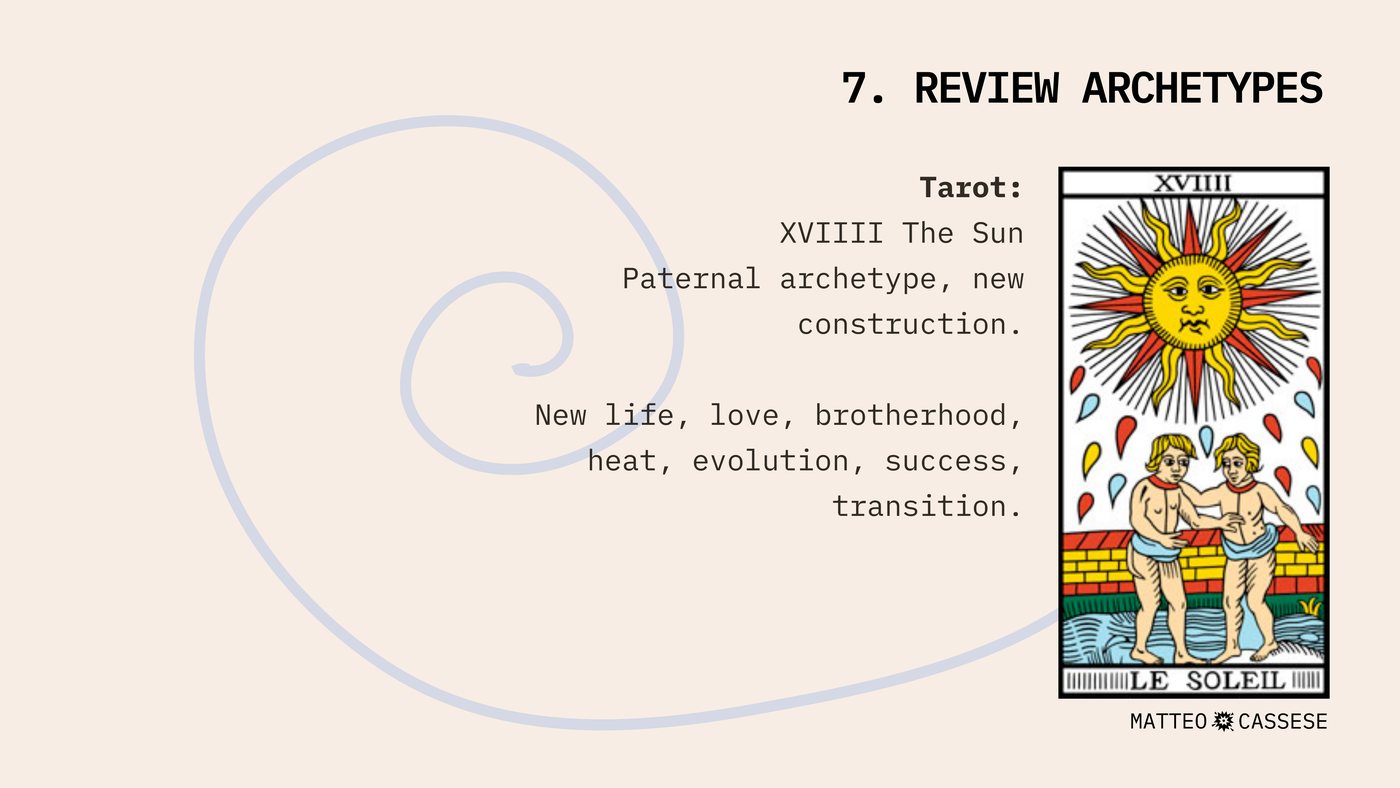
The magic flight: the bicycles in E.T., Neo taking flight, the great birds carrying the Fellowship home
In the hero’s journey this is something you see in basically every movie. There is one scene where you see the world from above, usually towards the end. It is called the magic flight.
In E.T. it is the most iconic version, where they are cycling and at some point E.T. has them all flying away from the police chasing them. Or Neo taking flight. Or the great birds in Lord of the Rings picking up the Fellowship and carrying them home.
What all three have in common is the change in altitude. You have been down inside it for the whole film, and now you can see the shape of the thing you were in.
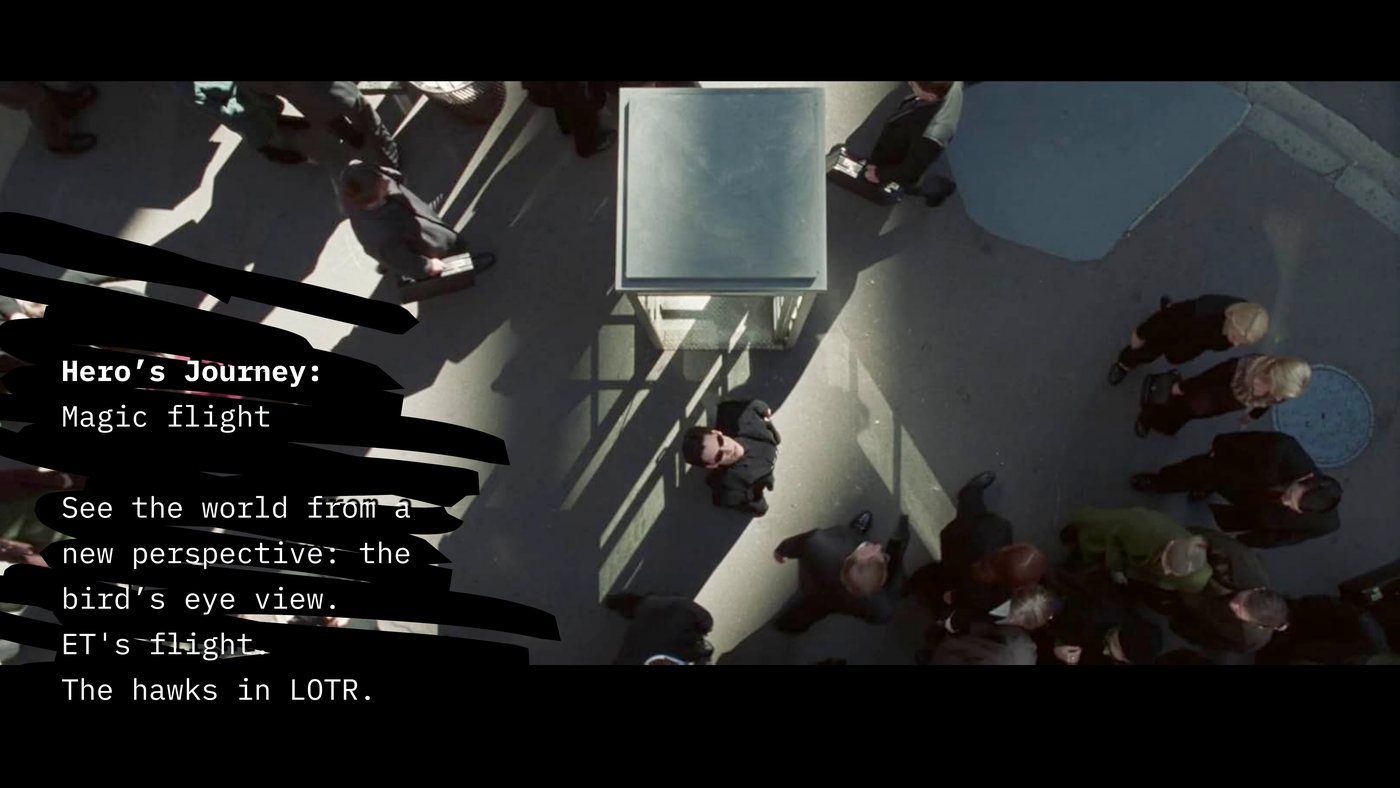
Write the plan down. Execute. Observe yourself and the market. Get a board of allies
For you it looks like this. There is a new plan, and write it down. Start executing.
Observe yourself. Observe the market. Do both things. Meet with clients. Open up. Talk about your process. Get a board. Get a board of allies, of friends, of supporters who can do the work with you.
It is a moment to experiment, to accept complexity, to see the whole picture: you, your new idea, and the market. And it is where the aloneness of Let Go ends, on your terms.
Where my own plan stands: a mix of coaching and speaking. Not finished. Chosen
Right now it is a mix of coaching and speaking. Hopefully in the future I can tell you that I can rely on either one or the other as I wish.
That is what Review is. Making your own plan, reviewing it, testing it, bringing it into the world. Not a finished answer. A chosen one.
I bet on the thing I already loved and hired coaches for the part I could not do. If that is where you are, my offer is business coaching for founders: matteoc.com/entrepreneur-coaching/.
23. Dream: imagine something bigger, so big it scares you
Why the pleasant phase is the frightening one: we are good at pain, rubbish at dreaming
Now it is scary. Now it is really scary.
At the first steps, Reset, Explore, Let Go, it was mostly pain and suffering and sweat, toil and blood. And we are good at that. What we are rubbish at is: can you dream, and can you dream bigger?
Founders will sit through months of demolition and then go completely quiet when they are asked to want something.
“Well, I never heard of anybody doing that”: the putdown, in German, and what it implied
The other day I was telling a guy about my pivot and how I am focusing on speaking. And in an almost derogatory way, and it was in German, so it sounded really harsh, he said: well, I never heard of anybody doing that.
Meaning: that is not a real job. That is some made-up stuff.
Which is what a dream that is big enough sounds like to somebody standing outside it. Not an argument. Not evidence. An observation that they have not personally encountered it before, delivered as a verdict.
Acknowledge it does not feel good, and keep going anyway
Obviously you do not feel good when people criticise you. But then, you know, Germans.
Say plainly that it stung, make a joke you might lose half the room with, and carry on. No reframing exercise, no processing of the feedback. The sting is real and it is not information.
Making the dream bigger: paid to talk, then hundreds of thousands, then millions
Being paid just to talk, which is basically the definition of coaching and speaking, is already a pretty big dream. What is a bigger dream? Getting paid hundreds of thousands for speaking. Maybe getting paid millions for speaking. Why not getting paid millions for coaching?
It goes up. That is the instrument you are steering by in this phase, and it is pointing the other way from every other phase in the guide.
“Dream so big that it scares you, and then dream bigger and it’s gonna scare you more”
Dare to dream, and dream bigger, and dream so big that it scares you, and then dream bigger and it is going to scare you more.
The stopping point most people use is the size at which it becomes uncomfortable to say out loud, which means the size of your dream is currently being set by your embarrassment.
The question underneath: what happens when you remove all of your limiting beliefs?
What happens when you remove all of your limiting beliefs and all of your blockers? That is the stage we are in.
And it is only askable here. Ask it in month one and the answer is fantasy, because the beliefs are still fully in place and you are just imagining a version of yourself that does not exist. Ask it after Let Go and Regulate have actually happened and it is a live question about a real person.
Judgment, card 20: an angel with a trumpet, a calling announcing itself
Another super powerful card from the tarot. We started from 10 and we are now at 20, which is why I say it is not very linear, this journey, in terms of numbers.
On Judgment you can see an angel with a trumpet, so there are clearly some echoes from the Bible here. There is a new irresistible consciousness growing inside of us, and it is an announcement. It is a vocation. It is a calling. It is your calling. It is what are you going to do.
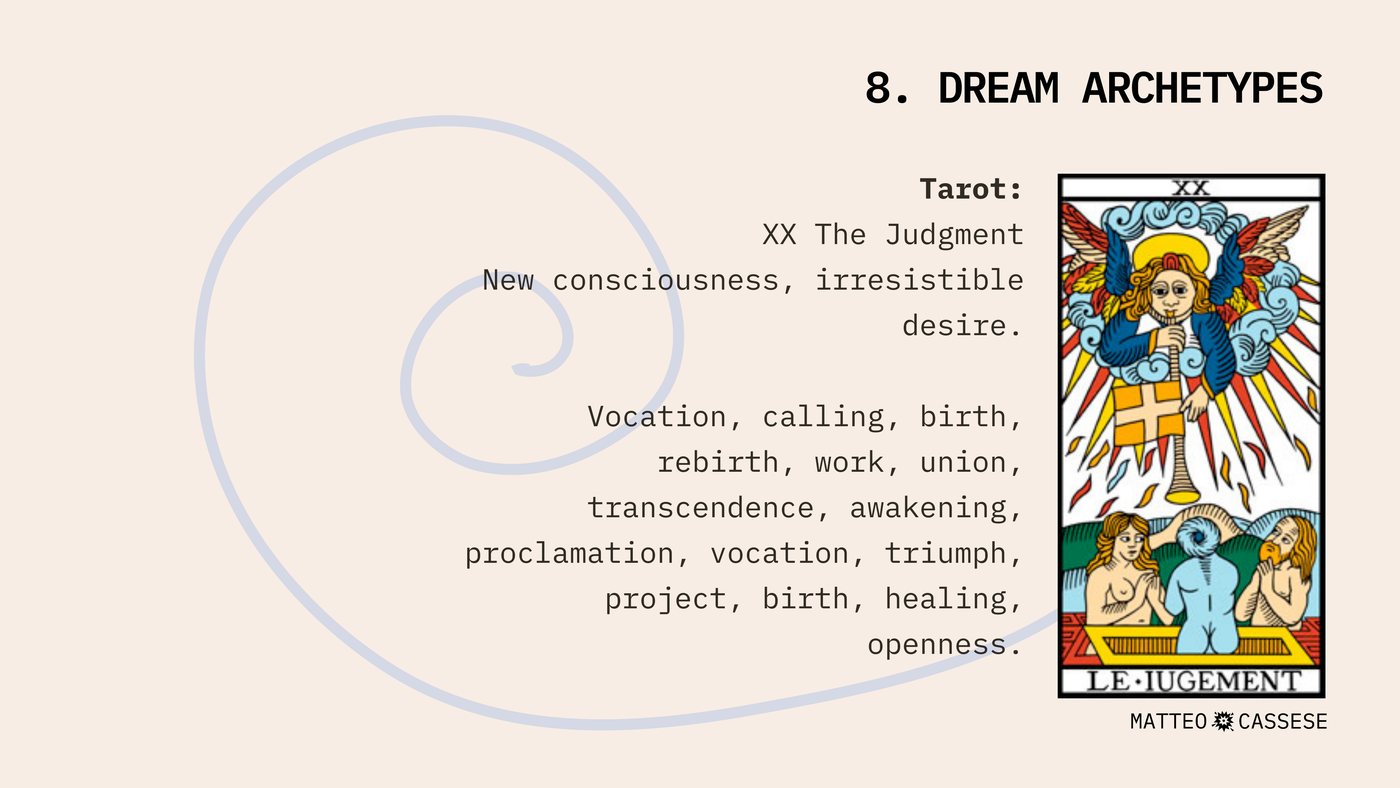
The people who knew you before did not go on the journey with you. Holding both worlds is part of the work, not a failure
In the hero’s journey there is a beautiful moment called the mastery of two worlds. The hero goes on the adventure, changes, becomes somebody new, and then has to go back home.
At home they will not be recognised unless they master both worlds: the one where they went on the adventure, and the old home, the one that did not change. Because the people in the village did not go on the adventure. They feel the consequences of the adventure, but they did not do the internal transformation.
Which is why the man who said he had never heard of anybody doing that was not being cruel. He was in the village. Holding the two worlds at once is a named step of the story, not a sign that you have got something wrong.
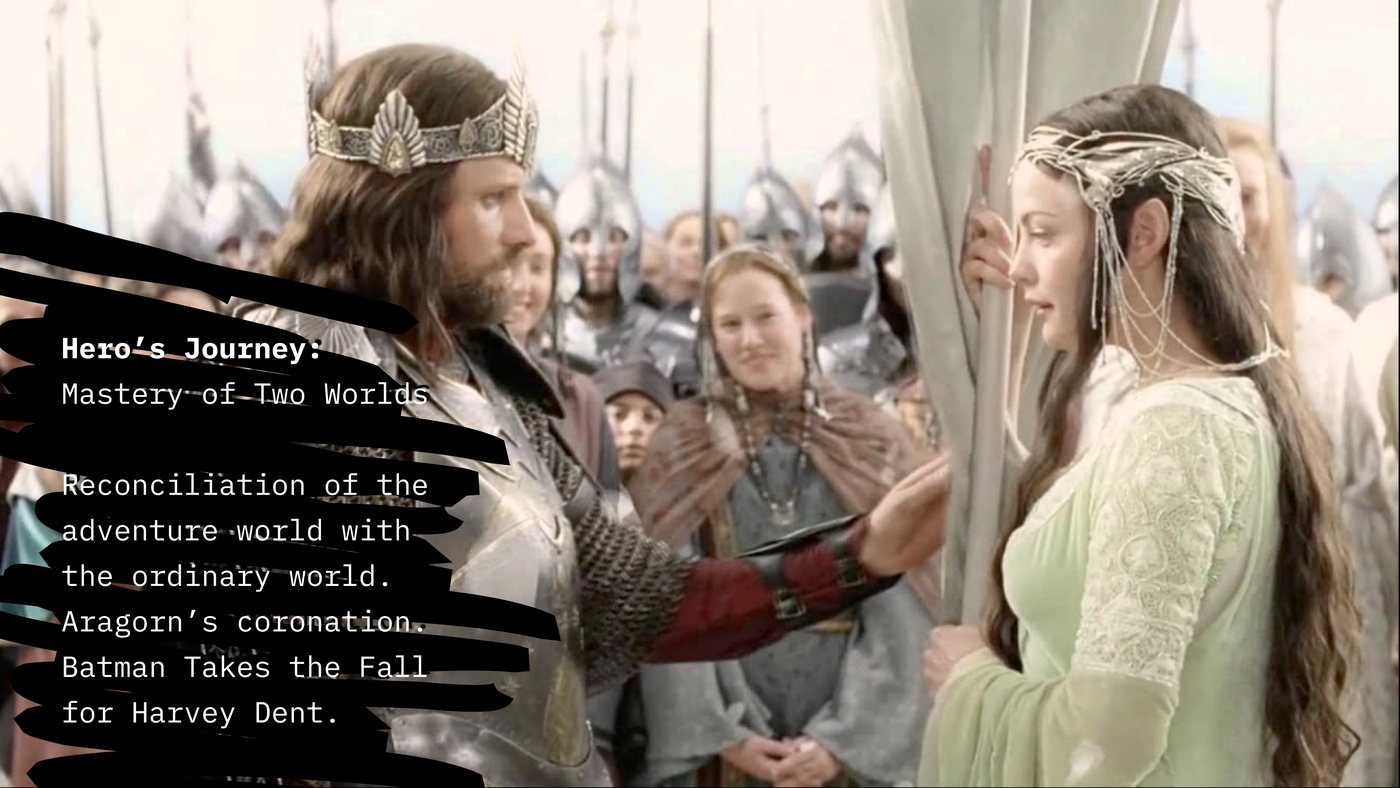
“If you’ve done all these steps, and they might take years, you are unlimited now”
In practice, the power of dreaming is realising that if you have done all these steps, and they might take years, you are unlimited now. You can go and do whatever you want. You can be whoever you wish to be.
The claim is not that anyone is unlimited. It is what is left after the demolition, and the demolition is eight chapters long.
24. Become: what does it look like when your work and your person finally match?
The hardest phase to describe: “I feel like a little bit of a fish in the water”
What has happened for me in the become phase is where I am right now. So for me it is quite hard to actually explain it to you.
I feel like a little bit of a fish in the water, so I feel quite limited in the way I can explain myself to you about what happens at this stage.
The cycle runs again: for the business model, for a new project, for YouTube, for stages
The nine steps happen one time because you are rethinking your business model. There is a second time because you have a new project. A third because you are thinking about YouTube. A fourth because you are thinking about stages. And so on.
So I am constantly resetting. I am constantly exploring. I am constantly letting go. Several of these are running at once, at different depths, on different parts of the work.
“It’s not that I have become and that is over and that’s the end of it”
Become is a phase you pass through, repeatedly, on different things, and then you are back at Reset for the next one.
The World, card 21: the most powerful and most beautiful card in the deck
The most powerful and the most beautiful card of the tarot deck is number 21, the World. Complete and total realisation. The world is your oyster. It is a happy ending. It is complete success and fulfilment.
All the different energies of the tarot, all the different symbols, are contributing to you. You have a little sceptre. You have a little vial with a potion inside. You can do whatever you want.
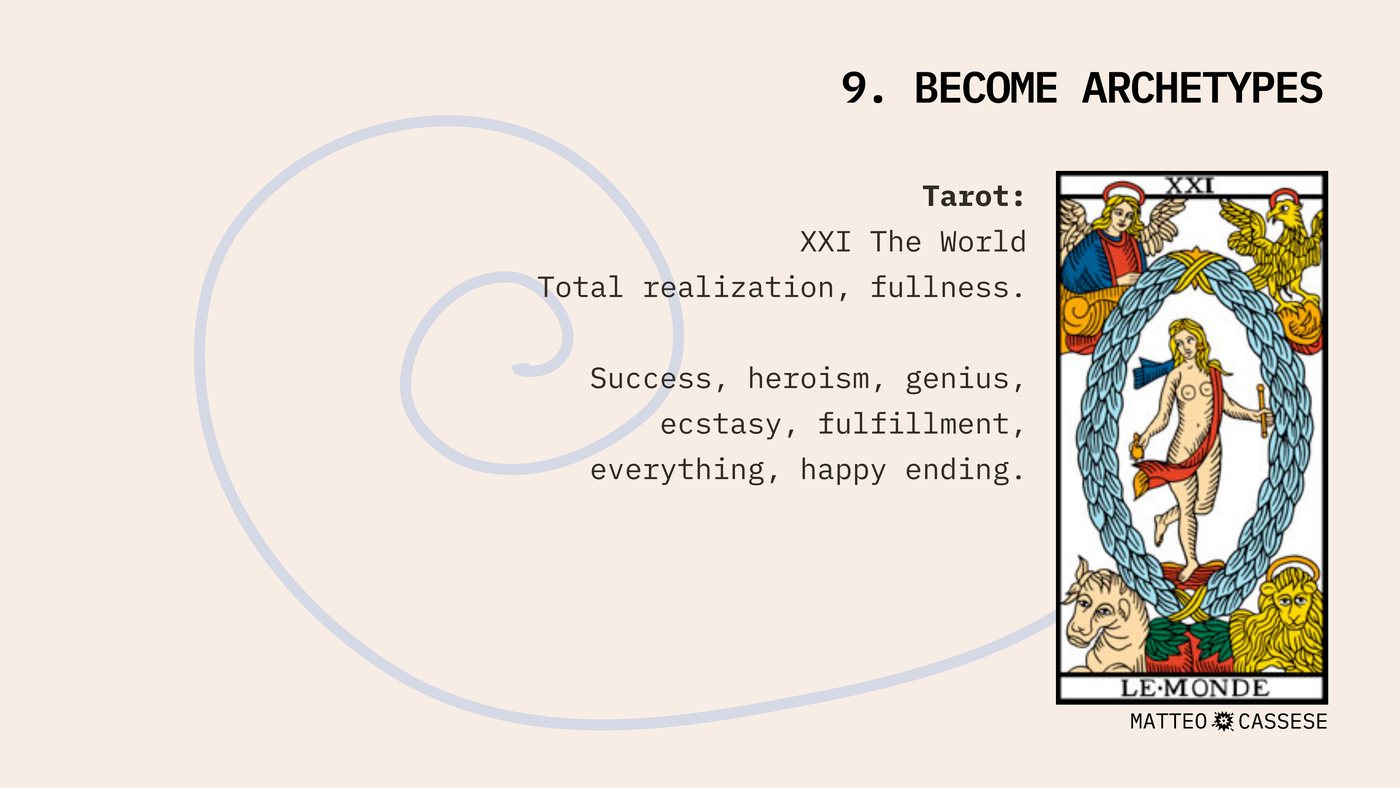
The freedom to live: Harry Potter at the station, the cycle beginning again
In the hero’s journey it is the freedom to live, after having reconciled all of the energy. After having gone through death and rebirth, you are now free to live. Everything is done.
At the end of Harry Potter the crew brings the children to the station. They are headed to Hogwarts. So the cycle even begins again, and that is a beautiful ending.
The last image of a story about one person’s transformation is a platform full of people about to start theirs. If you are here, this is absolute mastery, and you are free to do what impacts your heart and what impacts the world.
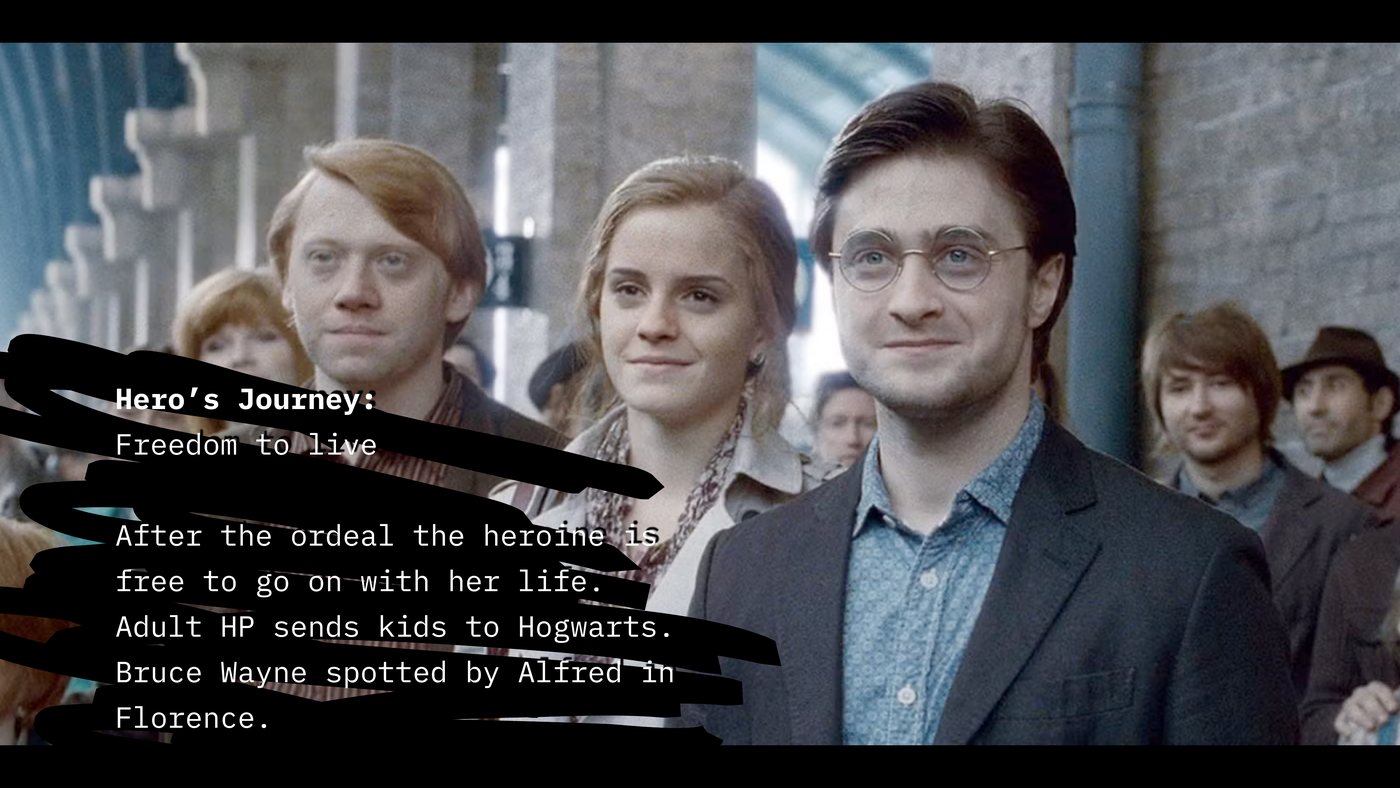
Work and logic finally run together with life and intuition
System 2, work and logic. System 1, life and intuition. At this point they are together.
Chapter 14 opened with those two brains split down the middle of a career: logic at work, everything else left at the door for fifteen years. This is the same two brains, in the same person, no longer sorted into a work pile and a life pile.
What I will not claim: “I don’t know if this means automatically money, success”
I do not know if this means automatically money, success.
What I will claim: “you know who you are, and you know what to do, and you are doing it”
But I know that it means this. You know who you are. You know what to do. And you are doing it.
Three things, and none of them is a number. On the founder burnout page, a business was running perfectly well and the person in the middle of it had gone. Those three are exactly what was missing, and the whole spiral exists to get them back. where a business was running perfectly well and the person in the middle of it had gone. Those three are exactly what was missing, and the whole spiral exists to get them back.
25. Will working on yourself actually change the business?
“If I’m trying to find more natural joy in the world or make more money effortlessly and I haven’t done the inner work, it will result in striving and doing things that are heavy and difficult. But if I do the inner work, it’s like I clear up a bit and then I can do that work.”
Will it make you more money? My three honest answers, side by side, from the videos
I gave three answers to this, and they do not agree with each other.
One: I am not going to tell you that this is going to make you more money. I think it is just going to make you happier.
Two: feeling your feelings is going to be good for you and is going to be good for business, and it is also going to be good for your wallet.
Three: I do not know if this means automatically money, success.
Somebody selling you this would pick one. I have three, they were all said in good faith, and the honest position is the spread between them.
Do you need a coach or a therapist? The real boundary between the two
I used both, for different things, in the same period, and the difference in what I asked for is the whole boundary.
What I asked my therapist for: I am not here for your advice or for anything. I want to tell you my story with today’s knowledge, and I want you to tell me if I am bullshitting myself and if I am missing any crucial thing. That is going backwards, into material that is already there, with somebody trained to see what I cannot.
What I hired coaches for: I am going to make money by speaking, I do not know how to do it, I am going to hire some coaches to figure out how to do it. That is going forwards, into a capability I did not have, with a decision already made.
Do you have to shut the business down and fire your clients? What Reset actually asks for
That is what I did, and Reset does not ask for it.
What the phase asks for is this: stop being busy, close any open projects, stop operating, stop running around, stop reacting. Closing the business is on my list because it is what my own situation required, and it came with savings, a choice, and refunds paid over twelve months.
I have no test for whether you should do the same. There is not one in this course.
What if you cannot afford to stop working? The version that costs nothing: slow down, stop responding
Then run the Explore instructions, which cost nothing and require nobody’s agreement.
The best way to make space is actually not to make space at all. It is to take twice, or three times, or four times as long doing the same thing, being extremely intentional about it. You get letters, people send you stuff, people ask you stuff. Don’t respond.
And the limit, stated in the same breath as the instruction: chaos increases the moment I stop paying my bills, because then I go into collection, and collection is interest. So I am not suggesting you stop paying your bills.
Is the nine-phase journey just another framework? My own warning applies to my own model
I want you to push back, because we really do not need another framework. We have enough frameworks. You might be a square peg and you might not fit that round hole.
I said that about my own eight archetypes and it applies here in full. There is a version of this guide where you read the nine phases, install them wholesale, and repeat chapter one at a higher altitude.
The line that keeps it usable is the one from Regulate. Build, measure, learn works if you do it from the inside out. Trusting a playbook wholesale, don’t do that. Borrowing bits and pieces that match your experience and your intuition, that is a good idea. This model included.
Do you have to use tarot cards? How I use them, and the one thing I actually ask of you
No. I use them, all the time, as a business tool, and for fifteen years I never took one out in front of a client.
What I ask of you in the phase chapters is small: spend a little time looking at the card, and see whether it communicates something at a more subtle level, at a more intuitive level. Stare into the eyes of the hanged man and see what it tells you.
If that does nothing for you, the phase still stands without it. The thing that is not optional is the underlying move, which is bringing your whole self to the work. My version of that is tarot. Yours will be something else, and it will be the thing you currently keep out of the room.
What if meditation, journaling and retreats are not for you? There isn’t one recipe, and that is the point
There is no framework for this and there is not one recipe I can tell you.
Some people will find their confidence just by being in front of a computer, because that is where they belong. Some people will find it paragliding, because that is where they belong. Whatever gets you in touch with who you are is the work.
The lists in the phase chapters are my lists. They are examples of the category, not the category itself.
Do you go through the nine phases once, in order? The spiral runs again and again
It runs again. Once for the business model, again for a new project, again for YouTube, again for stages.
I am constantly resetting, constantly exploring, constantly letting go. It is not that I have become and that is over and that is the end of it.
The order still matters inside one turn of the spiral, which is why Regulate sits at six and not at one. It is the sequence that repeats, not a fixed set of stages you graduate from.
How long does it take? The only honest answer: no timeline exists in this course
For Reset, this could be a day, a week, a month, or a year. I do not know. For me it was quite a few months.
The other numbers on this page are from my own account, not a schedule. Four to five months of doing nothing, with the MythMaker material starting in the fourth. Three months for Sophie, from a funding round to running her first retreat. And for the whole thing, only this: if you have done all these steps, and they might take years.
There is no recovery timeline in this course, because there is no honest one to give.
Can you do this alone, without mentors or a coach? Alone while shedding, supported once building
The two halves of the spiral have different answers, and mine changed halfway through.
Going in: I disconnected from most of my mentors. I really was in an alone state where all I could do was shed things. You let go of your conviction that you need help, that you need mentors, that you need playbooks.
Coming out: get a board. Get a board of allies, of friends, of supporters who can do the work with you. And hire for the specific thing you cannot do, which is what I did with the speaking.
So the answer is not a preference about independence. Alone while you are shedding, because help at that point tends to arrive as a playbook. Supported once you are building, because by then you know what you are asking for.
26. Where do you start if you recognise yourself in all of this?
The first move: stop operating, stop reacting. Then see what turns up in the space
Stop being busy. Stop operating. Stop running around. Stop reacting.
Then the questions of the second phase, which are the actual work. Where do your thoughts go? What attracts your attention? Where do you want to go? What happens if I stop reacting? What happens if I invite chaos?
Nothing on that list requires money, a course, or anybody’s agreement. It requires that the space stays open long enough for something to arrive in it, which is the only difficult part.
The guard that travels with it: I did this with savings, by choice. It is my account, not an instruction
Everything I have described I did with savings I chose to spend on it. That is a condition of my account and it changes what the account is worth to you.
I have no test for whether you should shut anything down, and I am not telling you to stop paying your bills. There is a version of the first move that costs nothing, in chapter 25, and it is the one I would start with.
Who this is not for: “this video is not for everyone. This video is definitely not for everyone”
I said that at the end of the last video . This is not for everyone. This is definitely not for everyone.
Not everybody should have leverage and not everybody is looking for leverage. Some people are looking for their craft, and that is perfectly fine, and there is absolutely no blame. I do not have a silver bullet. I do not have a solution for everything.
What you get if you stay: a plan that comes out of who you are, confidence that is not borrowed from it
A plan that is apparent because of who you are. Not because it is a good plan, not because it is the plan everyone suggests. Because it is your own.
And confidence that sits in you rather than in the thing you just shipped, so that a project can fail without you becoming a failure. Those two are connected, and the connection is the sentence the whole course arrives at: confidence comes from knowing who you are, and knowing who you are tells you what you are going to do.
Start with the first video: Half of you wants to create, the other half obsesses with results. Your business is stuck between their tug of war · watch it on the founder burnout page
That is where the course begins. One half of you has the ideas, the other half runs the operation, and when only one of them is in charge you get either a business with no money in it or a person with no ideas left.
Watch it, or read the founder burnout page. Or both.